Follow Us on Google

By Vivian Onyebukwa
Dr. Yetunde Ayo Oyalowo, a public health physician, has more than 18 years of experience in the field. She studied medicine at the Universities of Ilorin and Lagos, at both the graduate and post-graduate levels. She also has post-graduate certificates in occupational health and safety, managing occupational health services, marketing and business strategy, career advancement and leadership skills for women, from universities in London and Lagos Business School. In this interview, she spoke about the work she does and life generally.
What do you hate about people’s attitudes to health issues?
What I don’t like is, generally, Nigerians don’t prepare for their health. They have this belief of “I reject it in Jesus’ name that I am not going to fall ill.” Therefore, they don’t prepare for ill health. They prepare for Owambe parties in advance. They also save money in order to buy cars, houses, etc. But they never prepare for ill health. People are not doing health insurance. They are not even keeping emergency funds for their health. When they fall ill, they tend to go a-borrowing. If they don’t get someone to borrow, at times, it may cost them their lives or make them look for inferior medical care. Nigerians should learn to do better, place health at the top of their priorities and prepare in advance for ill health.
What is the “Mobile Doctor” thing all about?
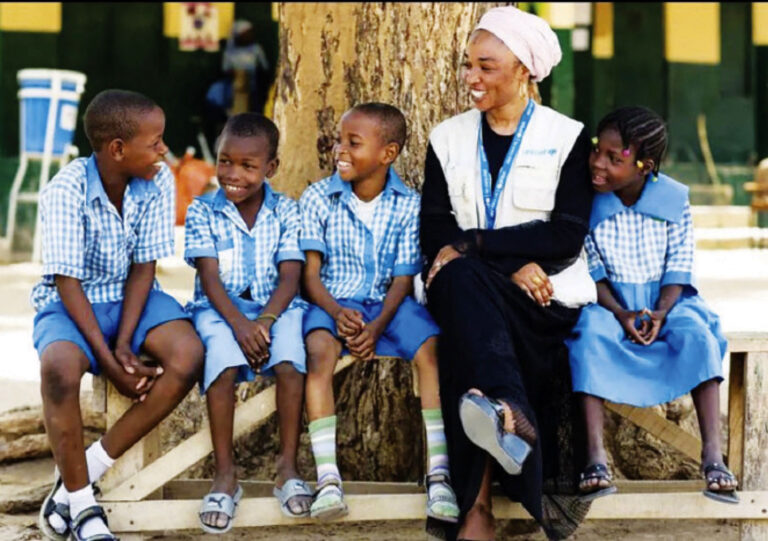
“Market Doctor” is a social impact enterprise that provides affordable and accessible basic healthcare to people, especially those in the informal sector, rural areas, and slums. They either do not have access to quality healthcare or cannot afford it. We ignite hope in them by taking healthcare to their doorsteps without disturbing their day-to-day activities. We believe in a world where people can have access to basic health services irrespective of their location, religion, ethnic group and social class. We started about five years ago, and over the years, we’ve had over 100 partnerships. They include organisations, associations, companies, religious bodies, schools and individuals.
Why did you decide to go into this?
It was because of the story my father told me. My name is Yetunde. In Yoruba belief and culture, Yetunde is a name given to the first female that is born after her grandma died. My father is a university teacher. He told me that my mum died of diarrhoea. But before he could get to her in the village, things had already gone really bad. There was nobody to attend to her. By the time they took her to the hospital, she had already died. My father actually wanted me to become a medical doctor. So when I became one, I kept on ruminating on that story. I saw that there are still lots of people in that situation. If you don’t have money, you can’t go to the government hospital, as cheap as it is. A lot of people are turned back at the hospitals, just because they can’t deposit money. I thought of what we could do for such people. That’s when I decided to go to the market where people come and go. I reasoned that they can add healthcare to their shopping list.
What has the journey been like so far?
This project has directly impacted more than 100,000 people in just a few years across 14 states of the federation. Our work exemplifies that anyone, from any background, can have access to healthcare at a minimal cost and can purchase primary healthcare within their limits of affordability. We have reached about 350,000 people. Over 100 health agents had been trained, providing a source of income for 54 doctors, 127 nurses, and 213 administrative staff since inception. Over the past five years, “Market Doctor” has had 88 staff and more than 350 volunteers, of which 80 per cent are women.
We focus on non-communicable diseases, accounting for more than 60 per cent of deaths, including hypertension and diabetes screening. We also take mobile clinics to communities and markets to deliver healthcare services for health conditions like malaria, diarrhoea, upper respiratory tract infections and basic eye screening for reading, to improve productivity and prevention of blindness. We have health agents that can use point-of-care devices.
How long do you intend to do this?
This is a legacy project; it is not something that would end. That is why most of my staff can function without me. I have projects in Lagos. But I have never been there. This thing is about interest. Once you have the interest, we can move.
Do you see yourself owning a big hospital in the near future?
That is not my vision. I would rather be happy if I had more than 100,000 health workers scattered across Nigeria and reaching out to people.
What do you intend to achieve with the “Market Doctor?” concept?
Our goal is to reduce the time it will take to access healthcare by bringing it to its natural habitat, which can be a community, home and workplace. It is also intended to have a Nigeria where the health worker is within the reach of everyone. Also, it is about making sure that Nigerians do not lose their daily income because they want to access healthcare and do not spend their scarce funds on journeys to health centres, or waste time waiting to be attended to.
What’s one of your most memorable moments on this job?
There was a man, a Baba Loja of a particular market, that is, a market leader, whom we took his blood sugar. It was extremely high. He never knew that he had a blood sugar problem. We went to his office, took it again and we told him our findings. They admitted him immediately. He came back after he was well to thank us, adding that but for us he would just have died. There are many with that kind of health challenge who do not know about it.
What can you say about the Nigerian health sector?
We need to refocus. We should put down grandeur projects and building of 1000 bed hospitals, bringing in big equipment, because there are even no doctors to work in these hospitals. People can’t afford to use the equipment. We need to go down to the grassroots. If it is well in the grassroots as regards primary care, then a lot of people would not need the second or tertiary care that we are all hankering after. Again, we need to invest in our health workers. I am not talking about only doctors. I am talking about community health workers, health extension workers, and para-medicals. We need to invest in them; they can do much more than they are doing at the moment. We are losing medical professionals to other countries or professions because there is no encouragement in the sector.
What’s your advice to companies as regards corporate social responsibility (CSR)?
We want them to see that health is a way they can give back. People tend to give back when it comes to entertainment. They give away things like generators and so on. But healthcare is a way you can actually give back. When people are doing landmarks like birthdays, they should come and donate health-wise, to the communities. We call it birthday blessings.
What are some of the challenges you face on this self-assigned project?
Security is a major challenge because we move around the villages to deliver healthcare. Also, we still have challenges with how people accept healthcare. A lot of cultural practices need to be abolished. There is a need to educate people. There is a brain drain. You see, medical personnel are leaving the country all the time. So most of the time, we also have to ensure that we have qualified people to do the work and continue to train more people to do it.
What have you learned from working among different cultural groups and ethnicities?
We are very diverse in Nigeria, culturally and religiously. We are differently oriented and how you work with one part, tribe, or culture, is different from how you work with other cultures. For instance, in some areas, there are serious gender stereotypes such that when you go to such areas, women are not even allowed to come out for medical outreaches. In some other areas, if the women have to go, their husbands have to escort them. What this means is that if their husbands are not at home, they won’t come and have access to healthcare. Some also have religious inclinations; some religions don’t believe that medications are vital to well-being. Some still believe in traditional healing and traditional way of doing things. So you have to find out what is obtainable in the culture, adapt to it and treat people accordingly.
What can you say about the fate of medical practitioners in Nigeria?
Generally, I think doctors in Nigeria are not well compensated. When I talk about compensation, I am not only talking about income. I am talking about different aspects of compensation and enumerations such as allowances and work conditions. This is because the training is extremely rigorous and the work is extremely sensitive. The reward for all of these should be very tangible. That’s why we are having a brain drain. The brain drain is not all about money; it is about conditions of service.
Despite the passion you have for what you are doing, if you see the opportunity to work abroad, are you saying you would not want to grab it?
Yes. I would like to work abroad if the conditions are fantastic, and if there is an opportunity for research and growth. But when what you do is fuelled by passion, and not money, you just find that you are somehow stuck. You find a lot of joy in doing it, no matter the obstacles. A lot of grace and prosperity comes from helping people. Going abroad is not the ultimate achievement in life. There are a lot of other things one can do in Nigeria, without going abroad. If you find purpose in what you do, until you have accomplished your mission, you will not look back.
There are complaints that doctors are being kidnapped almost on daily basis. What can be done to stop this?
I don’t think it is only doctors that are being kidnapped; all categories of people are being kidnapped. The moment kidnappers perceive that the reward will be handsome, they will go for it. The reason probably doctors are endangered species is that people expect that when they are kidnapped, their colleagues would rally around, put together some money and rescue them. But to avoid kidnapping, basic security rules should be obeyed. They include not living flamboyantly, being security conscious, keeping a very good travel diary and informing others where you would be at a particular time. Of course, you need to avoid travelling at a particular time of the day or night. Also, you need to avoid dangerous areas. But in all of this, we can’t afford not to move around. Travelling is part of life, so I think in this regard, the government has to do more about security.
What’s your take on the high cost of obtaining drugs in Nigeria?
A good number of people in Nigeria earn a daily income. So they may not be able to attend to their healthcare because doing so may mean missing work. I think the solution is education. If everybody has at least a primary school education, then they can look up to preventive care, because with education, you can do a lot of preventive healthcare. But when you are not educated, you can’t be taught the proper understanding of preventative care. You will definitely fall into curative, which means you have to keep on buying drugs.
Does the problem of fake drugs pose any danger to your work?
For us, we’ve never had the issue of fake drugs because we partner directly with pharmaceuticals and they supply the drugs directly to us. We’ve never had to deal with the issue of someone collecting fake drugs from us.