Follow Us on Google
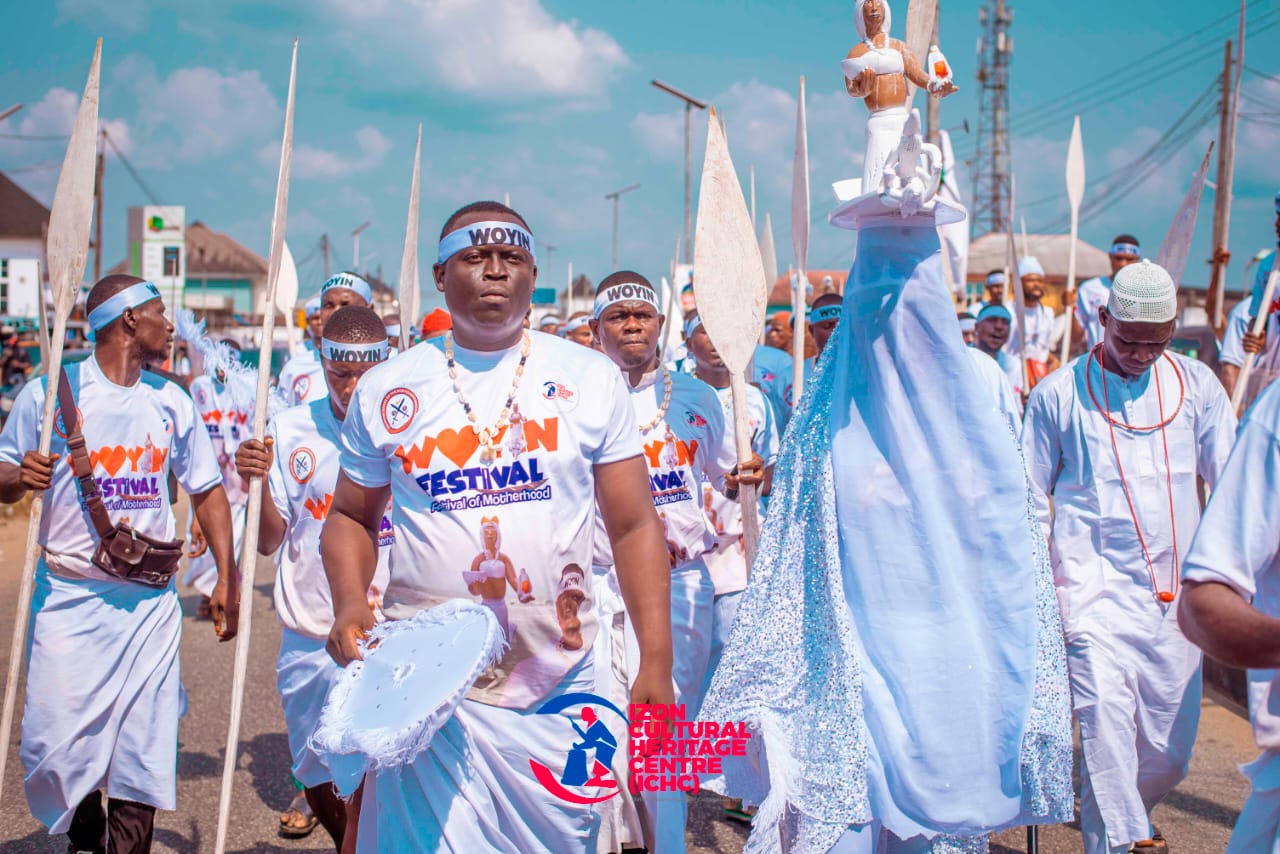
Traditional worshippers gathered at the Izon Cultural Heritage Center (ICHC), where the Temple of Woyin, the mother god of Ijaw land, is located, to celebrate their festival.
The festival was held to accord reverence to the mother of Ijaw land, which they called Woyin.
The cultural festival, which was called Woyin Festival of Motherhood, brought worshipers from all parts of Ijaw Land who gathered at the Temple located at Tenacious Road, Yenagoa, Bayelsa State, to dance, pour libations, and engage in other forms of activities to celebrate their mother god.
The worshippers who believe that the god of the Ijaw Land is a woman were all adorned mainly in white clothes depicting purity, and they danced to the delight of all, playing their music with traditional tools like the Talking Drums, Gong, and other traditional instruments.
Speaking at the festival, the host and organizer of the festival, Apostle Bodmas Kemepadei, explained that for an average Ijaw man or woman who believes in tradition, the Ijaw Deity is a woman because “Ijaw spirituality originated from Woyin, the revered great Ocean Mother.”
On the reason for the festival, Kemepadei maintained that the festival represents a Cultural and Religious revival of the ancient tradition that pays homage to motherhood, recognizing its significance in human development, communal co -existence and the continuity of ancestral lineage.
The convener maintained that the Ijaw perspective of all creation emanated from a feminine source, adding that every spirit and every breath of life originated from the primordial mother.
He said that Ijaws of the East refer to her as Wayengi, while parts of Central, refer to her as Woyengi, Western refer to her as Teme-arua, Ziba-arua, Ayiba-arua, among other names.
In other climes, he said that she is referred to as Mami Wata, which translates to mother of the water, embodying the mystery, beauty, and generosity of the ocean.
On why he decided to delve into Traditional Religion and Worship, Apostle Bopdmas Kemepadei explained that he was interested in the exploration of traditional worship due to his curiosity about the numerous unanswered questions found within the Bible.
“This interest was further fuelled by the manner in which Jesus was baptized and the miracles he performed utilizing elements such as earth and water. Additionally, I recognized that the Bible provides a historical account of a specific ethnic nationality.
“Consequently, after conducting further research, I concluded that it was time to also concentrate on the cultural practices of my own people. As I began the practice, I met other individuals also practicing it, and after careful observation, I was further inspired by High Chief Oweizide Ekpemupolo, akaTompolo, who has become my spiritual master.
On the difference between his Traditional way of worship and others, Kemepadei stated that “From a personal perspective, I observe limited differences between the practices described. For instance, the Bible in the Old Testament discusses offerings of animals and food, whereas in the New Testament, the sacrificial offering was a human being, specifically Jesus.
“Additionally, the Bible emphasizes baptism in water and the use of water to perform miracles, which mirrors our own practices of baptizing with water and utilizing it for miraculous purposes. However, akin to the Bible, we do not endorse human sacrifice.
He berated the white men for describing African gods as evil, yet went away with them to establish their museums.
Kemepadei advised that the fundamental principle of serving God is to respect life, adding that “it is imperative that we demonstrate tolerance towards one another, irrespective of the diverse cultural practices of worship.”