Follow Us on Google
Bimbola Oyesola,
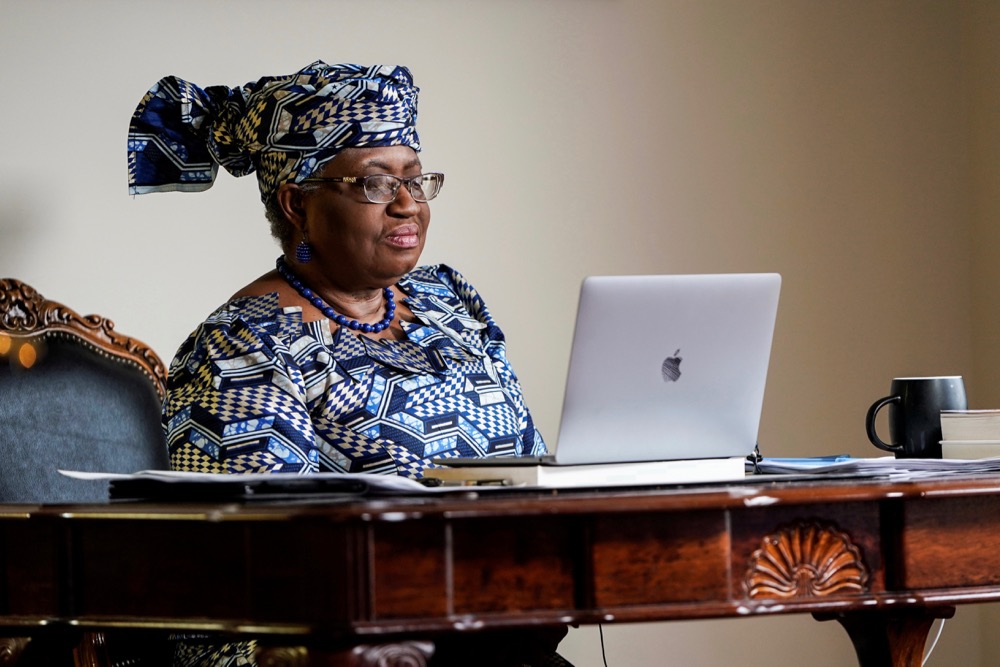
As the Artificial Intelligence takes over virtually every areas of human endeavour, World Trade Organization (WTO) Director General, Dr Ngozi Okonjo-Iweala has warned that AI must be shaped “not as a tool of exclusion, but as a catalyst for shared prosperity.”
Speaking at the University of Greater Manchester 2025 November to Remember Global Series, the WTO Director General said “AI Must Not Deepen Global Inequality.”
Her talks were with a powerful call for equity, responsibility, and multilateral cooperation in the age of artificial intelligence.
Delivering her lecture titled “Artificial Intelligence and the Future of Global Trade: Opportunities, Risks, and Multilateral Pathways,” Dr Okonjo-Iweala told a diverse global audience that AI is already transforming production systems, supply chains, and trade logistics. “Artificial intelligence is rewriting the rules of global commerce,” she said. “But without strong international cooperation, it will widen the gaps between nations rather than close them.”
She emphasised that the world stands at a critical crossroads. “We must ensure that the AI revolution is fair, inclusive, and anchored in trust,” she urged.
“Developing nations must not be left behind in this technological wave. With the right multilateral frameworks, AI can unlock new opportunities for all.”
The lecture, held under the stewardship of moderators Professor Jerome Carson and Dr Ikpenmosa Uhumuavbi, featured vibrant participation from students and researchers across continents.
Student ambassadors Salome Uwah and Gladys Chisom Okoro were widely praised for their coordination and professionalism during the high-level event.
In her reflections, Sam Johnson, Head of the School of Creative Technologies, described Dr Okonjo-Iweala’s address as “a defining moment for the University.”
She said the message of inclusive innovation aligns with the institution’s mission of preparing students to lead responsibly in a fast-evolving digital landscape.
Principal organiser and Director of the Centre of Intelligence of Things (CIoTh), Professor Celestine Iwendi, thanked the WTO chief for her “timely, visionary, and globally relevant message.”
He reaffirmed the University’s commitment to advancing academic inquiry at the intersection of AI, human development, and global trade.
Other News
Dr Okonjo-Iweala’s keynote served as a powerful centrepiece in a series that brought together some of the world’s most influential thinkers in technology, innovation, and global policy.
The event, themed “Powering Possibilities: Technology, Trade, and the Future of Human Development,” attracted participants from Africa, Europe, the Middle East, Asia, and North America.
Across its sessions, the series featured an extraordinary line-up of global luminaries. Kathleen Kramer, 2025 IEEE President and CEO, delivered an inspirational address on the power of volunteerism. Prof Joaquim Jorge, incoming President of the IEEE Computer Society, explored how responsible AI innovation can reshape global education systems.
Other notable sessions included Dr Chidinma Agbamuche Maduka of PANA Holdings, who delivered a moving keynote on career navigation and future-ready skills; Professor Mohammed Alani, who examined the future of AI-infused cybersecurity; and Dr Vandana Sharma, a Stanford Top 2% scientist, who unpacked the possibilities of Agentic AI.
Technology visionary, Dr Vishnu Pendyala delivered one of the series’ most striking talks titled “AI or Die,” warning that nations and industries that fail to embrace innovation risk irrelevance.
Meanwhile, Nurun Nahar, Senior Fellow and educator, discussed “The Human-AI Nexus” and the future of teaching in an automated world.
Industry insights continued with Dr Milos Tesanovic of Samsung Research UK, who explored the future of 6G connectivity, and Dr Dvorah Graeser, CEO of RocketSmart, who showcased breakthrough ideas in AI-driven entrepreneurship.
Supply chain strategist Prof Tony Hines however rounded off the technical perspectives with a session on demand-driven logistics.
The programme’s success was also attributed to its outstanding academic moderators, including Dr Vidya Amarapala, Dr Thaier Hamid, Dr Olayinka Ojo, Professor Jerome Carson, Dr Anchal Garg, and a team of dedicated student ambassadors such as Kimberly Ukura, Simon Nwigwe, Qamar Abbas, Babatope Makinde, and others who ensured seamless delivery across all sessions.
At the closing ceremony, Sam Johnson commended the participants for creating an unmatched platform for global knowledge exchange. “This series has strengthened our position as a leader in innovation-driven education,” she said. “We are proud to host conversations that shape the future of technology and society.”
Professor Iwendi echoed this sentiment, expressing deep gratitude to partners and participants. “This series is a testament to what universities can achieve when they embrace global collaboration and visionary thinking,” he said. “We remain committed to empowering the next generation of thinkers.”
As the curtains fell, the University of Greater Manchester celebrated what has become one of its most influential academic events. With thousands of participants, world-class speakers, and transformative ideas, the 2025 November to Remember Series reaffirmed the institution’s standing as a global hub for innovation and leadership.
The concluding message from the high-level gathering was unmistakably clear: while technology is remaking the world with unprecedented speed, its benefits must be shared universally. As Dr Okonjo-Iweala declared, “The future of trade—and indeed the future of humanity—depends on how wisely and how fairly we harness the power of AI.”