Follow Us on Google


• Ubong Anietie-Udo clinches Global Alliance top award; Akinsanya Glory, Fathiu Bello win $1,000, $500 prizes respectively
• Neliaku, honoured as ‘Grand Commander’ of young professionals
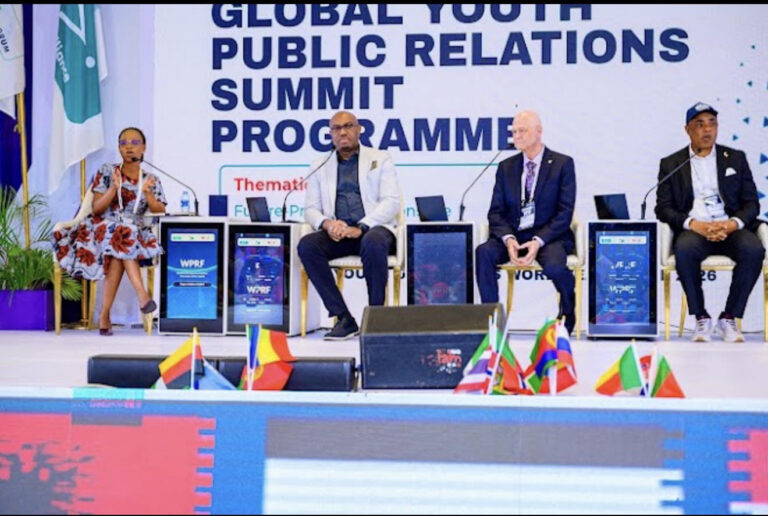
A Nigerian communications innovator, Ubong Anietie-Udo, haswon the $1,500 star prize at the 2026 World Public Relations Forum (WPRF) Youth Innovation Challenge with an artificial intelligence-powered platform designed to transform public relations practice.
Anietie-Udo, who works with Mo Eden Media Consult, emerged winner of the innovation challenge with Perceptor, an AI-powered, all-in-one communications tool designed to help public relations practitioners plan campaigns, create content, manage crises and reach target audiences more effectively.
The competition featured three finalists, with Akinsanya Glory emerging first runner-up with the Save Me safety application, while Fathiu Bello came third with Campaign Intelligence Nigeria.
While Anietie-Udo received the $1,500 Global Alliance President’s Prize, Glory won the $1,000 African Public Relations Association (APRA) President’s Prize, while Bello received the $500 Nigerian Institute of Public Relations (NIPR) President’s Prize.
The prizes were sponsored by the Global Alliance for Public Relations and Communication Management, APRA and NIPR.
Presenting his innovation before communications professionals at the forum, Anietie-Udo said Perceptor was developed in response to the growing challenge of information overload and the difficulty of securing public attention in an increasingly crowded digital space.
He explained that the platform would simplify the work of communications professionals by integrating several functions, including content planning, press release writing, campaign perception analysis, crisis management and media outreach.
According to him, Perceptor also provides media directories, recommends suitable media organisations for specific campaigns and helps practitioners localise their messages to reach intended audiences.
He described it as a one-stop communications platform that would eliminate the need for practitioners to move between multiple digital tools to execute routine professional tasks.
During the question-and-answer session, Anietie-Udo said the platform was also designed to address language barriers in communication, revealing that it had been simplified to accommodate Nigerian Pidgin, with plans to incorporate Hausa and Yoruba.
Asked what distinguished Perceptor from existing artificial intelligence platforms such as ChatGPT, he said the innovation was specifically designed for public relations and communications practitioners, offering industry-focused responses and integrated professional tools.
The second-place innovation, Save Me, presented by Akinsanya Glory, seeks to improve the safety of Nigerian students through instant emergency alerts, an artificial intelligence companion, voice-activated assistance and safety education.
The application is designed to support students before, during and after emergencies, including robbery, harassment and assault.
The developer said the team had built a prototype and was preparing to pilot it on selected campuses, with plans to partner student organisations, university managements and campus security departments.
The proposed business model offers students two months of free access before introducing a monthly subscription fee of N900.
The team also projected between 500 and 1,000 paying subscribers within its first year, with plans to expand to 10,000 users by the fifth year.
Responding to concerns about unreliable internet connectivity and power supply, the team admitted that the current version depended on electricity and internet access but said it planned to improve its capabilities.
It added that where a user’s phone went off, the application would transmit the person’s last known location to an emergency contact.
Bello, a final-year Mass Communication student of Lagos State University, presented Campaign Intelligence Nigeria, a platform designed to help organisations and campaign planners develop location-specific communication strategies.
He said the platform would provide information on the demographics, cultural backgrounds, religious considerations and media consumption habits of communities to help organisations deliver messages that resonate with their intended audiences.
Unlike generic artificial intelligence responses, Bello said the platform would rely on information supplied by people familiar with the communities being targeted.
He explained that the initiative would engage and pay local contributors to provide relevant community information for its database.
The audience, however, questioned the proposed data-gathering process, particularly how indigenous communities would be engaged and how the platform would ensure the accuracy and quality of information collected.
In a related development, the President of NIPR, Dr Ike Neliaku, was honoured by young professionals at the forum in recognition of his commitment to developing emerging communication practitioners.
The young professionals conferred on him the symbolic title of “Grand Commander” of young professionals and presented him with an award of recognition.
They also expressed appreciation to the NIPR leadership for providing a platform for young professionals and communication scholars to develop their skills and advance their careers.
The award presentation formed part of the concluding activities at the 2026 World Public Relations Forum in Abuja, which brought together communication professionals and stakeholders from across the world.