Follow Us on Google
By Lukman Olabiyi
For many children and teenagers, a slight unevenness in the shoulders or a subtle curve in the back may appear harmless.
Yet, medical experts warn that such seemingly minor signs could indicate scoliosis, a spinal condition that, if left undetected, can progress into severe deformity, chronic pain, breathing difficulties and significant psychological distress.
Concerned by the growing number of undiagnosed cases and the widespread misconceptions surrounding the condition, medical professionals, advocates and health stakeholders have intensified calls for greater public awareness, stressing that early diagnosis remains the most effective way to prevent serious complications.
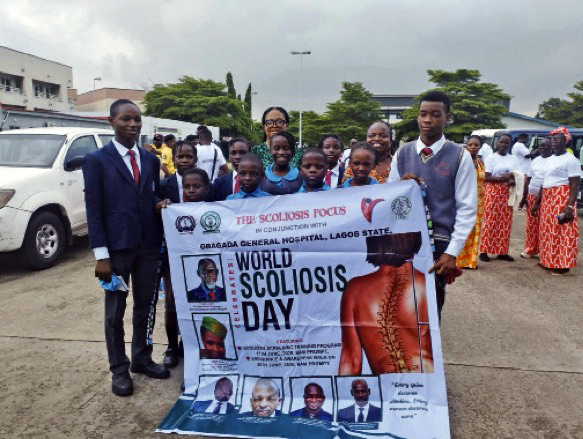
The appeal was made in Lagos during a walk and public awareness campaign to commemorate World Scoliosis Day, where healthcare professionals, schoolchildren, parents, advocates and community members gathered to educate the public on the importance of recognising the early warning signs of the spinal disorder.
The awareness programme, organised by the Scoliosis Focus Foundation in collaboration with Gbagada General Hospital, had the theme: “Every Spine Deserves Attention, Every Person Deserves Care.”
Throughout the event, participants carried placards, distributed educational materials and engaged residents on the need to seek prompt medical evaluation whenever abnormal spinal curvature is suspected.
Speaking during the programme, the Managing Director and Chief Executive Officer of General Hospital, Gbagada, Dr. Oseni Olugbenga, described education and public enlightenment as the foundation of effective scoliosis prevention and management.
According to him, ignorance about the condition often delays diagnosis until the spinal curve has become severe, making treatment more difficult, expensive and emotionally challenging for patients and their families.
He explained that increasing awareness among parents, teachers and caregivers would enable them to identify early warning signs such as uneven shoulders, protruding shoulder blades, uneven hips or an abnormal posture, prompting timely medical intervention before irreversible complications develop.
Olugbenga commended the Scoliosis Focus Foundation for supporting government efforts through sustained awareness campaigns, school education programmes, counselling services and assistance for patients requiring braces or corrective surgery.
He reiterated that early detection remains the single most important factor in achieving successful treatment outcomes.
Beyond its physical effects, Olugbenga noted that scoliosis often leaves deep emotional and psychological scars on patients, particularly adolescents who may face ridicule, bullying or social isolation because of visible spinal deformities.
He urged Nigerians to replace stigma, discrimination and prejudice with compassion, understanding and support, adding that a more accepting society would encourage affected individuals to seek medical care without fear of embarrassment.
Founder of the Scoliosis Focus Foundation, Dr. Ayomide Akintan-Adejuwon, said World Scoliosis Day serves as a global platform to promote awareness, encourage early diagnosis and advocate improved access to quality treatment for people living with scoliosis.
Other News
She disclosed that the foundation was established about 14 years ago with the mission of giving hope to patients and their families through education, counselling, advocacy and support services.
According to her, one of the greatest challenges remains the limited public understanding of the condition, leading many families to attribute spinal deformities to superstition or spiritual causes rather than seeking medical attention.
Akintan-Adejuwon explained that scoliosis is characterised by an abnormal sideways curvature of the spine and can affect individuals of all ages, although it is most commonly diagnosed during adolescence, particularly during periods of rapid growth.
She revealed that approximately 80 per cent of scoliosis cases are classified as idiopathic, meaning that the exact cause remains unknown despite ongoing medical research.
Other forms of the condition, she explained, result from congenital spinal abnormalities present at birth or neuromuscular disorders that interfere with normal spinal development.
She identified family history, rapid adolescent growth, congenital abnormalities and certain genetic factors as key risk factors, noting that females are generally more susceptible to developing severe spinal curvature than males.
Akintan-Adejuwon encouraged parents to observe changes in their children’s posture and not dismiss complaints of persistent back discomfort or visible body imbalance.
She stressed that when detected early, many cases can be effectively managed using observation, physiotherapy or spinal braces, reducing the need for complex surgical procedures.
Also speaking, Chairman of the Medical Guild, Lagos, Dr. Oluwole Olusanya, emphasised that early diagnosis remains the most powerful tool for preventing scoliosis from progressing into disabling stages.
Although the causes of most scoliosis cases remain unknown, he said some children are born with congenital abnormalities that interfere with proper spinal development, while others develop spinal curvature during growth.
Olusanya called on governments at all levels to institutionalise routine scoliosis screening in schools as part of regular health checks, arguing that such preventive measures would significantly improve early detection rates.
He also advocated increased investment in specialised treatment centres, training of healthcare professionals and improved access to affordable diagnostic and corrective services across Nigeria.
According to him, early intervention not only improves medical outcomes but also reduces the financial burden on families and enhances the quality of life of affected children.
As the World Scoliosis Day campaign concluded, stakeholders agreed that sustained public education, school-based screening programmes and stronger collaboration between government, healthcare providers and non-governmental organisations are essential to ensuring that no child suffers unnecessarily from a condition that can be successfully managed when detected early.
For the experts, the message was clear: every spine deserves attention, and every individual living with scoliosis deserves timely care, dignity and hope.