Follow Us on Google
By Josfyn Uba
As you are reading this, Hanatu, 13, is set to be married off to Anwal, 56, a polygamist with nine children, in her Kentuke village, in one of the North Central states of Nigeria.
Her marriage rites had been concluded shortly before she withdrew from school because her poor parents could not continue to sponsor her education.
While 12 year old Ehis, a Junior Secondary School 2 student, somewhere in Edo State and his classmates sit on the bare floor because there are not enough seats to go round the school, Ekine’s frustration is further compounded as a teenage girl whenever it is that time of the month when her monthly cycle comes because there’s no provision for adequate water supply in her school location in Taraba State.
This is the stark reality and fate of a large number of other children like Hanatu, Ekine and Ehis in the country.
When dreams are alive
Nonetheless, many children across Nigeria dream bigger than the challenges they face. They imagine futures where they feel safe, heard and supported. They want clean water, good schools and healthcare, and adults who protect and guide them.
These hopes match Nigeria’s goals and the global promise of the Sustainable Development Goals but progress is uneven. While some indicators show improvement, millions of children still lack the basics needed to survive, let alone thrive. The gap between policy commitments and lived reality remains wide for many families.
The United Nations Children’s Fund (UNICEF) estimates that 1.3 million children in Nigeria are out of school, which experts say poses a ticking time bomb for national development, if nothing is done to stop the trend.
This report is based on the real-life experiences of children living in Nigeria in 2025. It opens a window into their world through first-hand accounts and hard data that illuminate the daily struggles many children endure and the dreams they have for their futures.
Therefore, it was only natural that as Nigeria joined the rest of the world to mark the World Children’s Day, and UNICEF organized a media symposium in Lagos, top on the agenda for stakeholders like journalists, UNICEF representatives, development partners, civil society as well as the private sector was to X-ray these and other issues to proffer solutions for the rights and welfare of Nigerian children.
With the theme of the event, “Reinforcing the Role of Media in Mainstreaming Child Rights,” which was curated by UNICEF Nigeria, the Nigerian Guild of Editors (NGE), and the Diamond Awards for Media Excellence (DAME), the media was strongly called to be a driving force and agent of change.
Reiterating how storytelling and accountability in journalism can change the narrative and create a better future for Nigerian children, UNICEF Nigeria representative, Ms. Wafaa Saheed, said, “The data tells us that millions of children are being left behind, but it also shows where progress is possible. The media can change how we see these children, from statistics to stories of strength and hope. Every time a journalist gives voice to a child, the nation takes a step forward.”
In the words of the president of the Nigerian Guild of Editors, Mr. Eze Anaba, “Editors decide what the nation pays attention to. We must ensure that the struggles and dreams of Nigeria’s children remain part of our everyday conversation. That is how societies grow more humane, more honest and more hopeful.”
Mr. Lanre Idowu, chairman of DAME, in his remarks, noted that nothing steers public debate and accountability like powerful journalism, as it can impact positively on children’s lives: “Good journalism does not just inform. It saves lives. When the press asks why a child is out of school or why a health centre is closed, it triggers solutions.” Mr. Idowu reiterated that, “Today is a call to all of us in the media to be the steady voice that speaks for those who cannot yet speak for themselves”
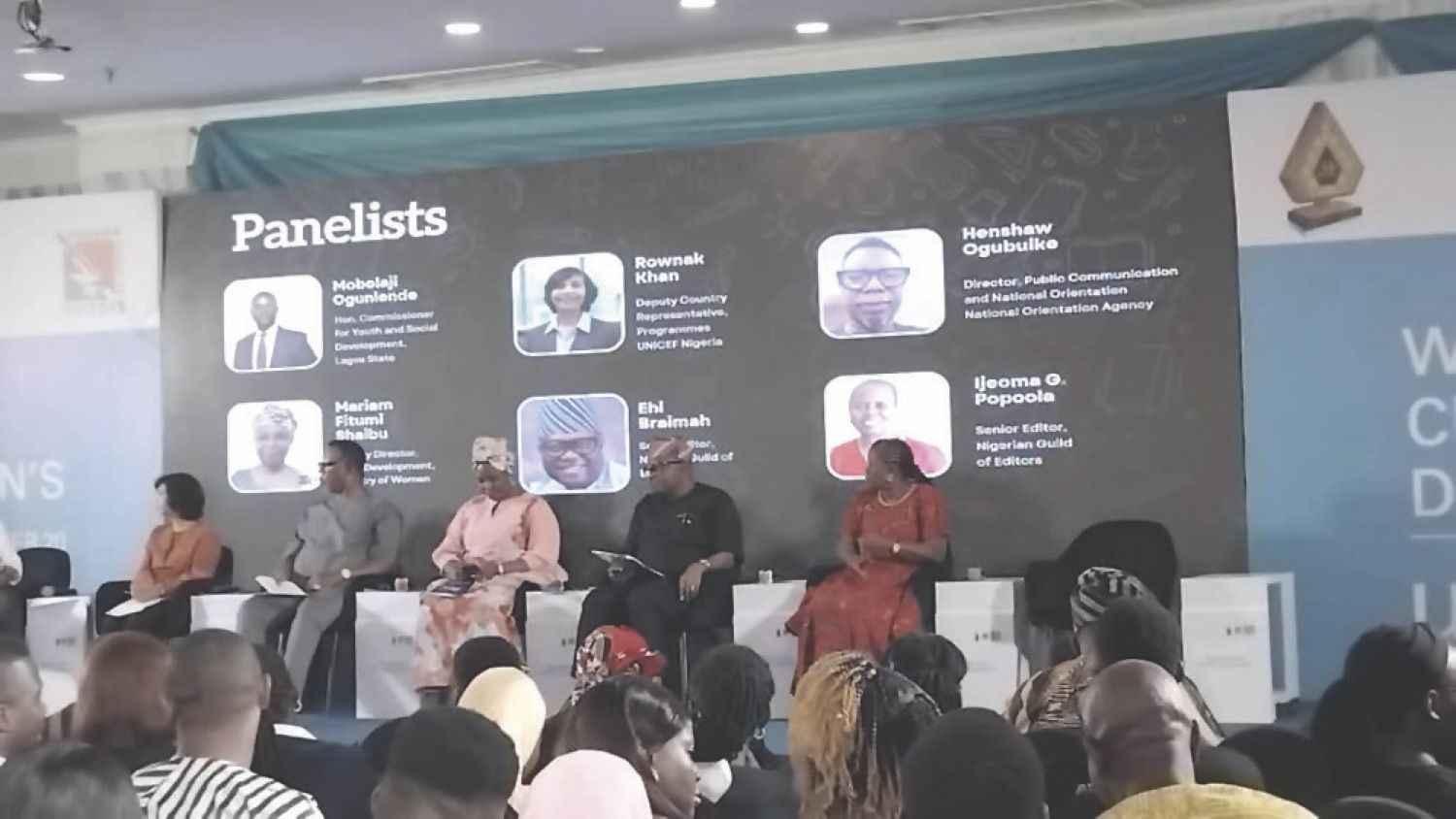
Dr. Chinonso Egemba, popularly known as Aproko Doctor, moderated the panel session titled “Equipping the Nigerian Child for the Future: How Prepared Are We?”
This session, which proved a remarkable highlight of the day, had panelists Mobolaji Ogunlende, Lagos State Commissioner for Youth and Social Development, Rownak Khan, deputy country representative, UNICEF Nigeria, Ehi Braimah, media professional and communication consultant, Ijeoma Popoola, Nigeria Guild of Editors, Mariam Shuabu, representative of the Ministry of Women Affairs, and Henshaw Ogubuike, director, public communication and National Orientation Agency.
Other News
Their focus, too, X-rayed the urgent need for policy action, while stressing how meaningful commitments from the government can translate children’s concerns into actionable policies given the backdrop of deficits in education, health, protection, clean water and participation in national discourse.
The panelists pushed for stronger collaboration with the media to challenge harmful practices, promote ethical reporting and keep children’s survival and education at the centre of national discourse. Even as stakeholders drummed support, appealed and highlighted the need for commitment towards improving the lives of children, they also reminded the children to position themselves in discipline, conduct and acquisition of relevant skills needed to prepare them for an impactful life of the 21st century and take their pride of place in meaningful participation as true leaders of tomorrow.
Undeniably, one constant denominator during the event was the reaffirmation of stakeholders’ resolve to ensure that children’s voices continue to shape policy and decision-making. It is, therefore, hoped that, as the message to turn children’s stories into meaningful action breaks through the walls of government bureaucracy and mere rhetoric, the call for a collective responsibility in building a safer and more inclusive environment where every child thrives, lives healthy and happily will continue to echo in the minds of all attendees for years to come.
Light on the horizon
Despite the grim picture and staggering statistics of despair, with swift interventions from UNICEF all hope is not lost for the Nigerian child. A recent UNICEF publication, The Nigerian Child 2025, captures some stories of survival and hope.
Akuru Peremobowei, 10 years old student, alongside his neighbours from Amassoma, NDU, in Bayelsa State, had heard terrifying stories in the wake of a cholera outbreak that gripped their riverside community where the same water serves as a toilet and domestic water source. They face daily exposure to the deadly pathogen that spreads through contaminated water.
Young and terrified Akuru had said, “I have heard that cholera is a deadly disease, making people pass stool and later die.”
Finally, Akuru and his neighbours have reason to breathe again. No one died in the cholera outbreak because they received life-saving vaccines from the Bayelsa State Primary Health Care, in partnership with UNICEF.
Yet another story of survival was the case of Zara, 14, who had been forced into an unwanted marriage by her poor and illiterate grandmother, where she endured beating, humiliation and starvation before she finally escaped to another village in Bama, Bornu State.
Her bitter experience represents the violence many girls go through when their families cannot afford food and are grappling with abject poverty.
But Zara’s lucky escape and finally finding help at a UNICEF supported centre where therapy sessions helped her heal and rediscover her childhood through friendship and laughter with other girls who survived such trauma has given her hope to live again. For Zara, “I did not want to marry at the time. To my grandmother, I was disobedient. But I was afraid. I did not understand why I should marry against my will.”
Available data indicate that Nigeria leads Africa in child marriage, with 23 million girls married off before adulthood.
When the weather changes everything, environmental threats are often made worse by poverty and lack of awareness. Blessing Joseph is a 15-year-old student whose story takes on even greater urgency against the backdrop of climate change’s devastating toll on Nigeria. Floods, droughts and extreme heat are becoming more frequent and severe, tearing through homes and schools and disrupting services children rely on to survive and grow.
Through the UNICEF Green Rising Initiative, Blessing and her classmates in Cross River State are empowered with gloves and seedlings, planting over 26,000 trees and restoring mangrove forests along Calabar River. The youth-led climate revolution is blooming as hundreds of young people transform their communities through hands-on environmental action.
Blessing said, “When we clean the mangroves, we are not just picking up plastics. We are protecting the fish, the water we drink and air we breathe.”
.