Follow Us on Google

From Christy Anyanwu, London
Claire Adaobi Maduka is the creative director and founder of MaShakara, a contemporary heritage fashion brand rooted in African craftsmanship and created for a global audience.
She was a prominent participant at the recently held Africa Fashion Week London (AFWL) 2026, where her designs, crafted with Akwete textiles from Nigeria, attracted significant attention from visitors and potential buyers.
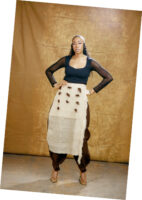
She spoke with Sunday Sun.
How did you come up with the name MaShakara, and how is it connected to your journey in fashion?
The name came from my grandmother, whose nickname was Mama Shakara. I shortened it and adopted it to honour her life. The inspiration behind my designs, my persona and the personality of the brand all stem from her. Hence, the name MaShakara.
Are your mother and grandmother into fashion?
No, neither of them was a fashion designer. My mother is a retired civil servant, while my late grandmother was a businesswoman.
I came into fashion because I have always had a flair for it. I initially explored the industry as a young model before moving into corporate work as a consultant. I worked in project management and business consulting for almost 10 years in Canada, including with a Fortune 500 company, before deciding to follow my heart and take fashion more seriously.
Even as a designer, you look so much like a model. How do you pull it off?
I started modelling secretly because my parents were initially against it. As I gained confidence, I became particularly interested in using flexibility and movement to create unconventional poses.
I see the body almost like architecture. I enjoy using the silhouette and movement of the body to create shapes and visual compositions through the lens of the camera. I have always had a passion for that form of artistic expression.
Back then, I was afraid my father would be angry with me for modelling, but he became quite proud when I won a beauty pageant at the American University of Nigeria in Yola, popularly known as ABTI, where I was a student. I participated in pageants at school and, surprisingly, I won in 2012. That experience encouraged me to take my passion further and eventually pursue fashion design.
What drives your creativity, patterns and choice of fabrics, which make your designs quite unique?
I became increasingly conscious of the environmental and human impact of textile production and the materials we wear against our skin. That made me want to explore a more sustainable approach to fashion, particularly through natural and biodegradable fibres and by building on craftsmanship that already exists within our cultural heritage.
I visited Akwete in Abia State and was inspired by the heritage and craftsmanship of the women there. Many of these women are important providers for their families, and they have preserved traditional weaving knowledge through generations. That inspired me to work with them, support their craftsmanship and help bring their talent to a wider international audience.
I design the patterns and concepts, and then work closely with the weavers to translate those ideas into the textiles themselves. That collaboration allows me to take an established Nigerian weaving tradition and reinterpret it through a contemporary design language.
In such a competitive industry, I also wanted MaShakara to have a distinctive identity. That is why I focus on exclusive designs and limited pieces for clients who appreciate individuality and craftsmanship.
Aside from fashion, what do you do in Paris?
Currently, I am a full-time student at ESMOD Paris, where I am studying Fashion Business and Luxury Management.
My professional background is in economics and consulting, so I wanted to strengthen my formal understanding of the fashion industry, particularly the business and luxury side.
I taught myself many of the creative skills I needed, including sketching and illustration. I also took short courses in Abuja that helped me build the foundation and tools I needed to communicate my designs to the weavers.
Now, I am further developing my knowledge of the industry while also building an international network across fashion capitals such as Paris, London, Lagos, Milan and New York.
Could you tell us a bit about your childhood?
I have always been a Shakara girl. I stood out among my peers in school. I would go to school and come back with an ironed uniform. I was always very particular about how I dressed and presented myself.
At one point, I even convinced my parents to change my primary school because the uniform at another school was more appealing to me. I remember the school had purple, black and white uniforms, and the purple immediately caught my eye. I wanted to go there because I loved the aesthetics.
I didn’t even think much about what the school was teaching at the time. I was focused on the aesthetics!
Looking back, I realise that I have always had an eye for fashion, presentation and individuality. That part of me has been there since childhood.
What are the objectives of your social-impact organisation?
I am developing a social-impact initiative under the Shakara Group called Shakara Aid. The initiative is focused on supporting and empowering women weavers and helping to preserve traditional craftsmanship.
Traditional weaving knowledge is at risk of being lost because many young people no longer see it as a viable livelihood. They sometimes perceive it as old-fashioned, while internationally, there is growing appreciation for heritage craftsmanship and the stories behind handmade textiles.
Through the initiative, I want to develop training programmes that can help preserve and revive this craftsmanship, starting from Akwete village, while also supporting young people and families in need in communities across Nigeria.
Hopefully, it can eventually become a broader programme that supports children and communities beyond Nigeria.
What were your parents and friends’ perceptions about your decision to become a fashion designer?
When I started this brand, my parents and most of my close family members were initially against the journey. But through God’s grace, I insisted on pursuing it. For me, it has been a spiritual journey because I prayed and fasted about the decision. When you come to identify what you believe is the voice of God, you have to trust that process, listen to your inner voice and keep pushing.
Today, they have made peace with my journey and are much more accepting of what I am doing.
One moment that really changed their perception was seeing a senior Nigerian government official publicly wearing one of my designs. She was attending an event in Geneva, Switzerland, and wore my outfit from head to toe. Seeing that helped my family understand that what I was building was becoming something tangible.
I think the story is a message to anyone who feels discouraged because someone has told them they cannot do something.
Listen to your inner voice, trust God, work hard and stay humble.