Follow Us on Google
- “It always seems impossible until it is done.”
—Nelson Mandela - “Real estate and construction of homes is the quickest way to develop a society. It creates a lot of job opportunities across board.”
- “If a small company like FIT Group can achieve this much, one now wonders what a focused and deliberate state government can achieve with housing and how many of their citizens they can empower because owning a home is empowerment.”
By Agatha Emeadi
The excitement in Enugu State at the moment is on an upward swing as a beautiful new city is fast springing up to adorn the landscape of the Coal City state.
The new city is anchored in line with global best practices to meet the needs of the 21st Century, driven by the Internet and digital era.
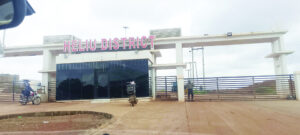
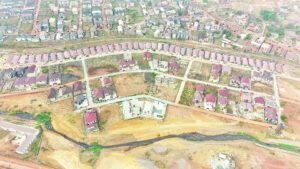
This is the serene HELIU District, a humongous project that sits on a large expanse of land situated off the Enugu-Port Harcourt Expressway, near the Independent Layout area of the Enugu metropolis.
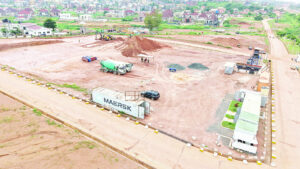
In the new city, construction activities are ongoing at various sites.
The aesthetic entrance to the elegant city emerging from the ground arrests and holds the attention of a first-time visitor, who is left in awe of the excellent manifestation of the marriage of mind and matter, to produce architectural masterpieces of real estate.
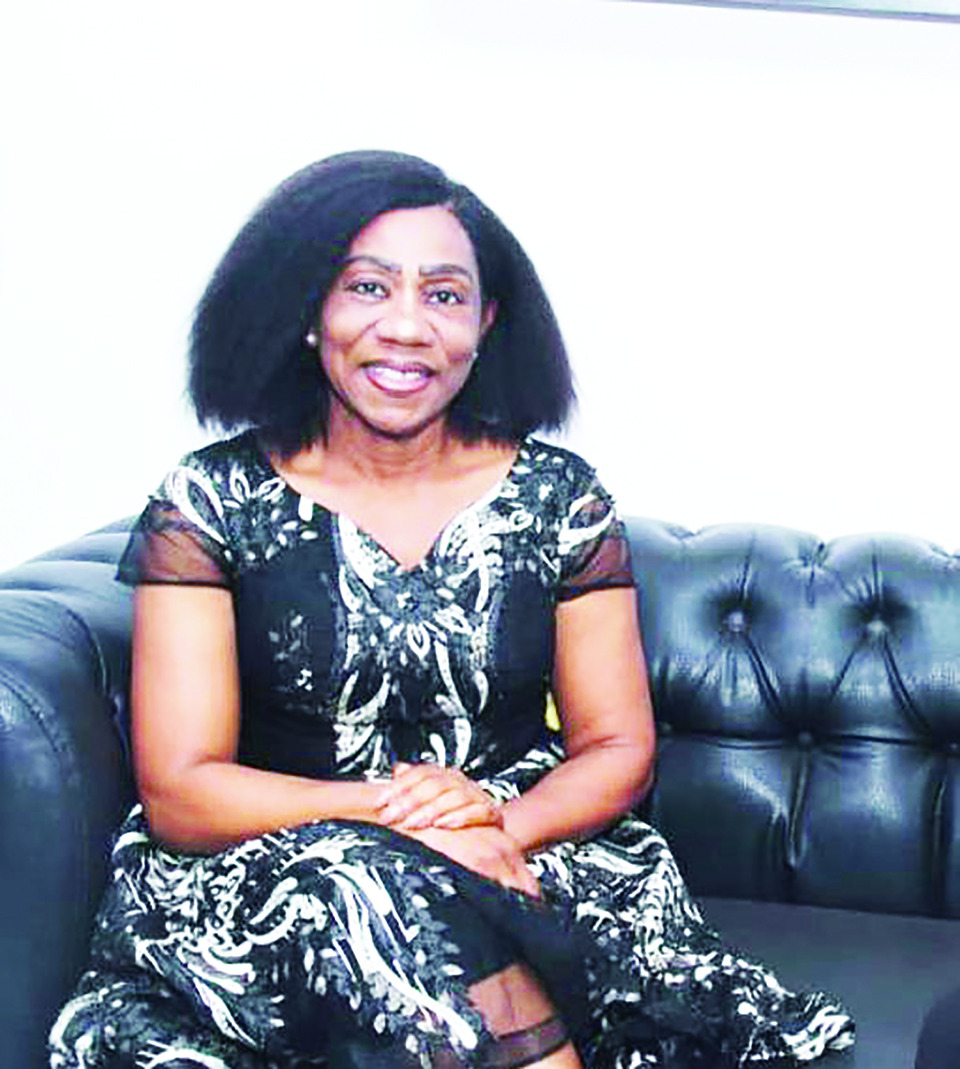
Indeed, HELIU District is the newest exhibition of the creative fecundity of the FIT Group, a real estate firm, conceived and birthed by Chief Loretta Aniagolu, who leads a team of thorough-bred professionals whose skills harmoniously merge and flow with excitement and unbridled sense of purpose, discipline, diligence, dedication and commitment.
All of these are focused on delivering high-quality, elegantly designed, practical homes and other buildings that are Internet-ready – they have ports that enable connection to the network of high-speed fibre-optic cables that run underground to match the ambience of the exquisite modern HELIU District.
The projects, when completed, would make the District a state-of-the-art real estate development initiative that has introduced a paradigm shift in the way residential satellite towns and corporate projects should be executed in a speedy, cost-effective manner, to tackle the crippling deficiency in the country’s housing stock.
The HELIU District will boast of a standard hospital, a first-ever Hilton Hotel in the Southeast geo-political zone, a Technology Hub, school, a convention centre and sports centres. Others will include an old people’s home and an all-inclusive shopping mall.
Some major projects, like the Technology Hub, have been completed, while others are at various levels of completion.
The real estate development seed, an acorn, sown by FIT Group in Enugu, has germinated and is now flourishing, but it needs to be watered to grow into a giant oak.
A more massive investment is the “water” required to achieve the goal of nurturing the acorn into an oak.
The foremost real estate giant behind this lofty initiative, Chief Aniagolu, wants investors to partner with the FIT Group to push this laudable real estate development stride to the next level and then replicate the template nationwide.
Chief Aniagolu, who is at the helm of affairs of this monumental project, is the Chief Executive and Managing Director of FIT Group. She is a smart, focused, intelligent real estate development professional, whose wealth of experience and deep knowledge about international practices, processes and procedures have combined to enable her to successfully drive the economic development initiative.
In this interview, she revealed how the ambitious new city – HELIU District – was conceived, the uncommon facilities, the benefits and many more.
How did you conceive the idea of a classic project like HELIU District?
I have worked as the coordinator for economic development for Enugu State and in the course of doing that job I realized that the biggest problem we face in the country is lack of proper management of our resources. Daily, you would hear the refrain, ‘we do not have the resources’, but I realized that we have the resources, but the problem is that we need a lot of brainpower to manage the available resources effectively. From that context, I began to have a positive thought towards real estate development. Well, when one’s small company is taken out of creativity to bring out something that people think is impossible one then realizes that it is also possible to do other things. That was how the motivation started. When I came to this realization, I resigned from the government in 1999, to set up a consulting firm. I worked as a consultant for a number of states like Bayelsa, Cross Rivers and Taraba, to create ideas and how they could work for their people. Some states embraced the ideas while some did not. One of the proud moments of working as a real estate consultant was working with former Governor Donald Duke of Cross River State. He actually implemented quite a number of our projects and made Cross River stand out in Nigeria. So, we were very proud. With this development, added to what I already had in my brain, it motivated me greatly to show that when opportunities materialize into projects and are implemented, they change the lives of people.
Therefore, from my little thinking, I have understood that Nigeria’s problem is allowing the society to become generally unproductive. This is the reason the country is contracting instead of expanding because it is becoming a rental economy, where hard work is not rewarded, jobs are not given out on merit. So, people are not actually tasked to work hard, fend for themselves and be creative. When one sees where the world is going, how creative and how every society is pushing their young ones, then one wonders where Nigeria will be in the next 10-15 years. It is very serious, dangerous and backward.
After conceiving the idea of HELIU district, how did you start?
After looking at the different things that I had done, I realized that real estate and construction of homes is the quickest way to develop a society. It creates a lot of job opportunities across the board. I can tell you that after my secondary school education, my parents being strong Catholics sent me to Ireland to further my education. Within one year, people were relocating to America. But a very ingenious Prime Minister in 1979 took over the Republic of Ireland and decided that real estate was the fastest way to drive the economy and also looked at the tax situation. At the time, Information Technology (IT) was coming up. He gave tax reliefs to all the IT companies and they made Ireland their headquarters. His tenure was focused on policies and changes, and after him other prime ministers started implementing policies, which saw the building of 80,000 homes a year. Then Ireland joined the European Union and was able to get loans and started the transformation of Ireland that we all now see today. Real estate was their biggest drive. When the economies are down in western countries, what they use in pushing it is building homes. This is because with real estate, when one builds homes, it creates a lot of jobs. In Nigeria, for every 100 homes built, 500 jobs are created. So, imagine the multiplication effect. Therefore, I realized that the fastest way to grow the economy is through real estate. At the end of the day, even when the economy is bad, there will always be the middle class who will buy homes and that was what motivated us to move from being consultants to become home builders.
Considering how Ireland used real estate development to grow the economy, I strongly believe that our nation should adopt the Israeli strategy of mass production of prefabricated components that are then assembled onsite, to rapidly deliver residential and commercial buildings at a fast pace.
Most buildings abroad are not done like the Nigerian type where they carry blocks and build. This is the reason houses are not produced with speed in Nigeria. Instead, overseas, their houses are produced in factories, shipped in containers and assembled at the final point.. If houses are built through the factory, one can do 10,000 houses in a year. America does 1.3 million houses in a year. England does over 100,000 houses in a year. They all use it to create jobs and turn their economy around. Building is the first thing to be done to create jobs and turn the economy around. When the Second World War ended, the World Bank, which was called International Bank for Reconstruction and Development (IBRD), focused on financing small housing projects. The governments gave developers loans to build and gave mortgagers money to buy. So, in America, for every 100,000 homes, it produces about 300,000 jobs. Therefore, jobs became continuous and unending. Then think about the amount of building materials that were used to build 100,000 homes in a year. Calculate what such would have done to the GDP of that country in just one year. Therefore, a driver and cleaner with consistent jobs could buy and own a one-bedroom apartment. That was also what China did to take 100 million people out of severe poverty. Egypt has become one of the fastest growing economies in Africa today because they have started doing mass housing projects. They are doing about 80,000 housing units in a year. For Nigeria, they all know what to do but are simply narrow-minded.
124 bungalows built by FIT Group, are they for rent or outright sales?
All the bungalows built by FIT Builders Limited have all been bought. Most of the owners of the ones that are not occupied live abroad. But all the 124 units were sold to people.
When will the other projects be completed?
Well, we are trying to give better value for people who buy our properties. Therefore, we are doing integrated projects where we have both residential and commercial real estate. The way it is, if a person buys from us, it helps the value of the property to go up a lot quicker. When we finished the 124 bungalows in 2020, we sold them for N8.7 million each, but now it is being resold for N70m. This is the beauty of real estate. It not only gives you a nice space to live, but wealth as well.
What is the total size of the projects?
The whole project rests on 120 hectares of land, which is I.2 million square meters. Again, components of the convention centre are being constructed in China, and the work has reached the 50 percent mark. When it is finished, it will be shipped to Nigeria in the form of completely knocked down (CKD) parts, which will then be assembled and installed onsite. That was the way Hilton Hotel in Abuja was built by the Israelis and brought to Abuja for assembly.
For the hotel part of the project, we are building the first Hilton Hotel in the South East. We will appreciate if investors are involved because we are real estate developers and not hoteliers or hospitality development people. But we want to use whatever land we are given to create an opportunity for some of these projects, so people will benefit. We are not just selling houses and putting money in our pocket rather we re-inject the money into the economy and get experts to expand the base and opportunity for people in Enugu State and the South East. When investors get involved in the Hilton Hotel project for instance, we will not be the only owners. We are building it with our funds. It is very difficult to borrow money in Nigeria, which is part of the reasons the real estate sector is not developing as fast as one wants it to develop. It is really very slow. Most banks in Nigeria do not want to lend money. So, it is a battle and we keep trying and working hard. Then again, we have opportunities because some foreign companies have shown interest because it is Hilton, though we have not concluded. Interestingly, we are also making our entry into East Africa. The banks there are all willing to give us money to build homes for people in the part of Africa.
Did FIT Group acquire the land where the projects are situated or the land was allocated to it by the government?
We only own the land where we are building our properties, the rest of what is there is an agreement with the government for us to provide the infrastructure, sell to people at prices close to the cost of putting the infrastructure in place, then the buyers will then get their Certificate of Occupancy from the government, after making necessary payments to the government. A lot of people resident in the District own the houses and the land because they completed the process.
Land matter procedures and procurement bring a lot of issues. Ordinarily, in a normal organized society, the government is supposed to acquire land, provide the infrastructure and invite developers and have a share, but it does not happen in Nigeria. A lot of times, when government acquires land, they leave it fallow because they do not provide any infrastructure. That is why people buy land and it stays for years, undeveloped. Some even die in the process, yet it is not developed. But the present government is smart. What we did with the Ifeanyi Ugwuanyi administration is what state governments should be doing. When you acquire a place, sign with a developer and have the developer provide the infrastructure, sell the property and do all the charges, then give them bill because the developer would have been paid.
Water is a major challenge in the state. How will the project deal with the challenge?
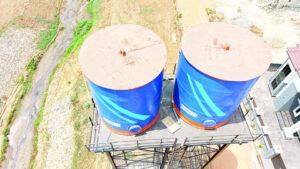
For the fact that we are building a hospital, school and other facilities, we realized that water and electricity are needed 24 hours of the day. Not just for the residents but for the commercial properties to function. First we conducted a survey to see where we could find water. The contractor had to drill very deep. Eventually we had two boreholes there. Each is a minimum of 280 meters deep, which passed the coal layer to get to where water is. That was the only way to do it. We have four more bore holes coming up. One would be dedicated to the hotel, one for the hospital and the other two for the rest of the projects. There is water demarcation and three bridges have been completed for easy access. Instead of running a pipe from the boreholes to the tanks, we decided to do the boreholes since we found water on that side. That is why both sides have their different boreholes. At the completion of the project, we would have conquered the water challenge. Again, at the level we are operating, all the projects would create huge employment opportunities. For the Tech Hub, that would also attract people, especially young ones in this era of Artificial Intelligence (AI) and Information Technology (IT). All these would touch the economy positively.
With these gigantic projects, do you find time to rest?
I do, but I cut out a lot of social events. Some social events are actually stressful. With these big projects, I cannot have many friends. After my working hours, I try to relax. On Sundays, I do not work at all.
In running these projects, what are the challenges?
There is only 24 hours in a day, so not having enough time is a huge challenge. Staffing is a big challenge because one needs staff with skills, and who are willing to live in Enugu. A lot of young people want to live in Lagos and Abuja. To also convince banks or financial institutions for heavy loans even as a lady is challenging as well. So, we have been using our personally generated funds to re-inject into the project; even the profit also goes into the project to get them completed. Again, one has to be resourceful in the way things are managed. Personally, when something comes to my mind and I look at it critically, analyze it and think I can do it, I pursue it rigorously and get it done. Today, the success for all is no longer in muscles and biceps where women could not compete, but in the brain that God distributes without gender disparity. Nigeria needs to borrow a leaf from Rwanda and make more women inclusive in their government. That is exactly what I do with my staff. I work with the best brains and the most skilled, and there is no place for tribal sentiments.
Have you spoken to the governors of your state, past and present, including stakeholders on the need to invest in the project?
It was former Governor Sullivan Chime who actually acquired the land for this district. He wanted to use it for a housing project with an American company. I guess the American company disappointed and that was how we got invited because I have never done a project in the Southeast at that time. Rather I have worked in the north. It was Abbey Mortgage Bank that called and asked if we could be interested in the arrangement because they were in the arrangement with the American company and that was how FIT Group got involved. Unfortunately, by the time we had finished the designs Chime’s tenure had ended. We gave the design to Governor Ifeanyi Ugwuanyi and explained to him that if he wanted to develop Enugu, this would be the fastest way because it is always a very good step to change the face of a place. He looked at the design and asked if former Governor Chime had seen the design, we said no, that we were unable to present it to him because it was the end of his tenure. He could not see it. Ugwuanyi agreed to work with it and that was how we signed the MOU with the government to do the project. We applied to own part of the land, but the rest of it still belongs to the government. We will provide the entire infrastructure for the place, add our own cost and sell to the public. Members of the public would buy and acquire their titles from government. So, technically, the land belongs to government. It is also the government that is issuing titles to the people. It also issued titles to us for the section that we own. We just own about 20 hectares out of the entire 120 hectares.
Is government part of the funding of the project?
No. We have not received funding from government. Rather, we have made paynotes in accordance with the agreement with the government.
So how is the project being funded?
Well, we fund from our own sources. The company sources funds and we raise funds from what people pay for their properties. Instead of taking it out as our profit, we re-invest it into the project.
What new opportunities would the facilities provide?
Well, we have completed the Technology Hub. We think it will be a game-changer in Enugu because it is a well-built location. We are looking to partner with a technology company that will be involved in training the young people in the area of technology, to get them involved in Artificial Intelligence (AI) and innovations by writing programmes, setting up call centres to service corporations around the world. We expect the company that will sign up to manage the Tech Hub will put it to good use and generate income with it.
So far, how much has been committed to the project?
We have done a little above N11 billion.
How much then is expected to complete the entire project?
It is per project. The Hilton Hotel needs between $15-18 million, the hospital is about $46-50 million, convention centre which is being manufactured in China is about a $I million. For our elderly care home, we expect it to run on half a billion to finish. We are borrowing for the hotel and hospital, but for the rest of the facilities, we are actually providing the funding ourselves. It is a lot of sacrifice because we could have collected our profits and walked away, which is what most developers would have done. A lot of the profits are being re-invested and that is why we can complete additional projects. We want this place to be a reference point. If a small company like FIT Group can achieve this much, one now wonders what a focused and deliberate state government can achieve with housing and how many of their citizens they can empower because owning a home is empowerment.
How long do you think it will take for the projects to be completed?
If the funding projections for the two anchor projects follow what we expect, by 2027 or 2028, the projects would be completed. Most of the infrastructures like the roads are solid roads because we sent our staff for training, to learn how to build concrete roads, that is why it is solid. We have done about 26 kilometres of drainage because some roads have drainages on two sides, while some are one. We have done a little over 10 kilometers of concrete roads, and still have about 8 kilometres more. Because we have done most of the drainage, when the rain stops, we should complete all the roads by the first quarter of next year.
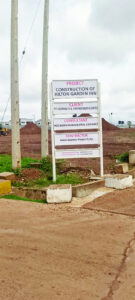
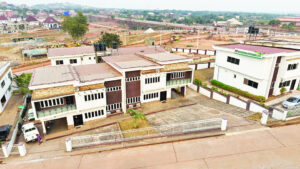
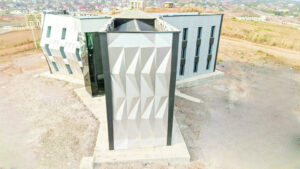
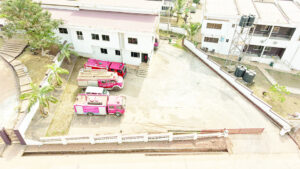
Some roofs are red and some are green. What exactly is the reason?
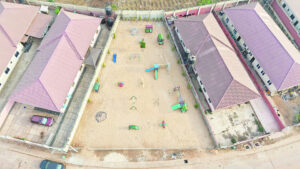
The reason is that if you look at the terrain, it is uphill and downhill. So, to get the beauty and aesthetics, following that pattern of beauty, if the roofs go in colours that are the same, it creates a pattern. When the buildings are completed and one looks at them, there would be a beautiful flow.
High-rise buildings are noticeably absent in Heliu District. Is there any specific reason for this?
We are not allowing more than one-floor buildings except for people at the downhill that can raise a basement. Except for the commercial area which one can see are cut off from the residential area. In all those streets, owned by local government, we bought them and named them after prominent people who have done much for Enugu State. We have Onyeka Onwenu who had just accepted hers before death came calling. We did the same for late Christian Chukwu and for Emmanuel Okalla who is still alive. We also named streets for my late father, Justice Anthony Aniagolu, who gave birth to me and raised me. Others include Senator Jim Nwobodo and people who fought for Enugu State. We could have sold the names, but we chose to give them to worthy sons and daughters of Enugu State and beyond. We hope that a project like this will stand tall when evil will be defeated in Nigeria. Then the young people will testify of our goodwill.
From which of your parents do you draw all this energy?
I think I am a combination of both. Though, some people say I took after my father because my mother is on the quiet side, very deliberate, takes her time. My father as a judge was a loquacious kind of person. I think I am a lot like him. I have a lot of energy, which I think is a DNA thing, though responsibility kept me in check. In my family, they are all very energetic people.
Take us back to your growing-up years in Enugu. How was it?
My mother had 11 of us and 10 are living. I am the fourth child. From her own parents, she is the only daughter with three brothers. When my father became a judge, he was transferred to Port Harcourt in Rivers State. I have not forgotten that as a kid in kindergarten, our teacher was Mrs. Amobi, a foreigner married to a Nigerian medical doctor. She would arrange us in circle keep warm milk and cookies in our fronts while we listened to stories and teachings. It has never left my head. A day came that it looked like I would not go to school because the driver was not available. I thought it was the end of the world because I was thinking about my warm milk and cookies. I told my mother I could walk to school. Then the nanny took me to school. We also lived in Calabar and returned to Enugu after the civil war. My fathered registered me at Queen of the Rosary College in Onitsha before my travel to Ireland and back home to study at University of Jos.
We’re recreating beauty of New York Central Park in Heliu District – Chris Madubuko, Chief Builder
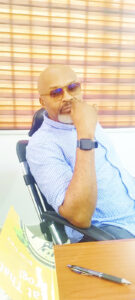
Tell us a bit about the project and yourself
I feel very happy seeing the results of our efforts, considering the dedication and commitment we keep putting in to see the projects materialise. There has been a lot of construction done and infrastructures built. The completed 124 three-bedroom units with facilities en-suite have been sold out. That was the first project we did.
We have these buildings across and the ones behind the few on the federal way. This has involved a lot of work. I am an economist but became a builder by induction, love and expression. I love creative things and have been writing songs. Besides building, I have a recording company by the side as a hobby. Surprisingly, I discovered some of the artistes you know in Nigeria.
Building is what I do for a living while the other things are my hobbies. Even when I lived in the United States, I was writing songs and producing music. I want to create a platform, to uplift young people.
When do you think this district would be completed?
Well, nothing is ever completed, but we will keep making adjustments. I think by the end of next year, we will be looking at true finality. The project is a big frog to swallow. But we are swallowing it and conquering one at the time. To the glory of God, up until now, we are not exposed to any banking support, but we are wide open for investors now.
What other projects have been completed?
There are three completed bridges that link the entire district with all the drainages. All the projects sit on 120 hectares which is 1.2 million square meters. The bridges are there because God gave us a beautiful stream that runs five kilometers through the district.
Will the stream be retained in its natural state within the project?
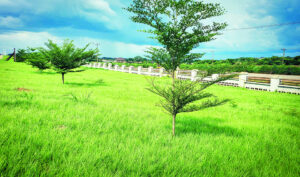
Yes, we want to bring the Central Park in New York to Enugu. On completion, the aesthetics would be world class. We are not people that design without building. We design and build and bring out the beauty of every piece. We have a jogging, cycling and picnic trail. These are no mean feats, just beautifully crazy. It is another magic because one can decide to remain here and wallow in comfort.
Is there any government or stakeholders’ intervention?
This is one of the most successful Public-Private Partnership projects. We are expecting support naturally and get the necessary interface that we need. We have a governor who understands the importance of a place like this because he was a successful entrepreneur who I believe is able to capture the essence of what we are doing. So, there are no interruptions.
FIT is building 21st Century smart city fit for digital living, operations –Engr. Fred Okoye, Engineering Head, FIT Group

- “Despite the challenges, we will still sink four or five more boreholes that will serve the community. Each has to go between 200-500 metres down to the ground.”
Prior to joining FIT Group as Head of Engineering, Engr. Fred Okoye worked in the Enugu State Ministry of Works and retired as a Permanent Secretary. His brilliance put him in line to secure a full academic scholarship to study Civil Engineering at Manchester University, United Kingdom, under the aegis of the British Council. In this interview, Okoye explains the engineering perspectives of the unique things about HELIU District.
How was it at the beginning and how is it now?
When we came here, this place was barren land, complete bush. The only sign of life here was a church which had a makeshift shelter where the congregation gathered to worship.
We started off by getting the boundaries set out, in collaboration with the Ministry of Lands and the surveyors who initially demarcated it. We were shown boundary bumps and commenced work on clearing and marking out boundaries to find out the extreme of it. We measured out the starting area, even though with what we did, the government later reduced part of it. We are not on the initial size that we set up. After that, we faced the whole sequence of getting the infrastructure setting on the roads and demarcating all the boundaries completely. Then we commenced clearing the bush, the expanse to be cleared kept expanding as it went. We had a lot of delays because there were too many gullies. It was not a very straightforward job; we closed up or filled some of them, and set all the roads. Our major starting point was from the federal road which gave our initial referral point. At the same time too, we had community opposition which was a big challenge but we engaged the police who assisted us to secure lives and property. It was not funny initially because we were not welcomed at the time, but later, the issues were all resolved and we had peace to commence work.
How many of the projects have been actualized so far?
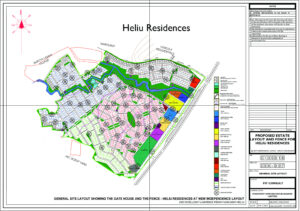
Most of the initial projects have been them actualized. Initially, most people thought the whole place belonged to FIT Consult. It is not so because we have our own portion of the site allocated to us as a developer but the rest is for the public. If you want to be here, you just buy your plot from FIT Group, your design your structure and build it yourself. We remit to the government a certain amount for any plot we sell. We have our own portion, while most of it is for the public. For the already built ones, we do not allow more than one floor. We do not allow high rise buildings. There is also a minimum space between the boundary wall and the building. We accept one-story buildings or bungalows.
Why do you not want more than one-storey buildings?
We do not want the place to be so crowded because if you have more than one storey building, there is a tendency for many tenants to be there. But if a plot is large, there could be three families in one plot. We will not allow more than one family in one building. Every design comes to this place, which we forward to the Town Planning authorities and we advocate and request for their statutory approval.
It is common knowledge that it is difficult to get water in this axis. How were you able to overcome the challenges involved in getting water for the district?
Well, for the water scheme, we tried initially to see if we could get surface water or groundwater. We battled with that and tried to survey the bridge river. We investigated all of them to see what will work out. Then, we cast away the river source because the obstacles were enormous for us. We did everything we thought was feasible and the source point of the water we chose was about five kilometers from there. It was also quite exorbitant in cost, etc. Again, we went for groundwater by drilling boreholes. We had various studies, but the geology of the place we had was mostly shell which is not a water bearing environment at all. When you dig for about three meters you will encounter coal. For the fact that we had many failed attempts which led us to try many other points all over, it went far away from each other. We kept probing areas all over until we found one and had to drill down to 200 meters before we found water. What we are doing now is to test the quality of the water. There are more points we have chosen and the contracts have been awarded and it will be done. Despite the challenges, we will still sink four or five more boreholes that will serve the community because we used scientific methods to probe the ground. Each has to go between 200-500 metres down to the ground while studying every meter of the kind of soil, recorded and tested to determine if there is prospect of picking the water. We try to know the contamination and finally when successful, the project will be more than a borehole. I must tell you that it is a very stressful public-private sector collaboration between the Enugu State government and FIT Consult, a private establishment. We are able to make much movement because the government backed us. The Ministry of Lands backed this project with their surveyors who carried out the marking and demarcations.
Looking back, what memories bring a smile to your face as you reflect on this project?
We cannot tell the story of this land without government input. First, the then Governor Sullivan gave us the initial nod for the land. But the project could not take off before his tenure ended. Thereafter, we approached his successor, Governor Ifeanyi Ugwuanyi, who welcomed the initiative, approved it and it kicked off. He gave us free hand and protected us because as at that time, we were being attacked by Awkunanaw youths, who would come here and disturb us. It was not funny at all. For instance, when we were working on the first road, about 40 of them came. We had a driver on a bulldozer who was pulled down by these youths and the bulldozer continued rolling because it was on forward gear. It crossed the express road. Fortunately, through the mercy of God, there was no oncoming vehicle. The governor intervened and warned the people not to interfere again.
Was awareness created in the community before the project started, because when it is completed, the community will be the major beneficiary?
Yes, we held awareness campaigns. We even drafted an agreement. When Governor Ugwuanyi intervened, the issues were resolved, and we moved in to begin the preliminary works.
What challenges did you encounter when you commenced building?
All the structures existing today on the land were built right from the take-off day in 2015. The scope keeps growing step by step. We are still generating new ideas even till date, especially concerning the services and what the project will provide. The scope has been expanding. When you have a project, it generates or attracts other supporting projects. One of the latest ideas we added is a convention center which will serve several purposes.
With the rate of progress, when do you think the project would be completed?
The projects would be opening gradually. We do not have a firm date, but those clearly marked ones like the hospital and hotel have construction times that are targeted. A lot also depends on funding. Financing is a major determinant in completing a project.
As a builder, what do you think about designing the convention center in China, shipping and assembling it here?
We have had several zoom meetings to that effect. What is in vogue at the moment is that science is truly advancing because block work is very slow. In different foreign countries, some prefer bricks instead of blocks. We will look at what science is giving at the moment and the cost.
Keeping promises made is our unique selling point –Ifeoma Igboji (FIT Marketer)
- “Vision of CEO about providing real estate is to make it affordable. At all times, she makes sure that the prices are commensurate with what our target audience can afford.”

Ifeoma Igboji is the Plots Administration and Reconciliation Manager, who joined the organization from the beginning. She operated from the Lagos office before relocating to the headquarters. Prior to her joining FIT Group, she worked with some advertising agencies like MC&A, Inside + Two and Media Studios, all in Lagos State.
As the Plots Administrator and Reconciliation Manager, what does your typical day look like?
First, we are estate developers and there are specific rules for developing a place because plots must be allocated to buyers or owners. Someone needs to oversee the details and administration related to a specific plot of land and that is part of my job specification.
The land meant for FIT Group has been sold out. Buyers rushed for them based on our antecedents developers. The people who bought plots within the project area are required to build in accordance with the specifications specified. We have services that have been signed, agreed and presented to the public as what we want to do. That is still what we are doing. Therefore, we provide security, water and electricity 24 hours, daily, and do all the infrastructures in the district.
What was the unique selling point of the district?
Our unique selling point is that we keep the promise we make to buyers. First, we built a prototype and put out the word about it. Then, we invited buyers to come and check it out, to experience it because it is about service and products. We are selling, developing lands and buildings. Our focus is on services, providing infrastructure which entails constructing a unique concrete road. The concrete roads will last for over 20 years which is a heavy investment delivery that we are giving out. So, when buyers come and see the quality and the icing on the cake, they want to be part of it. Our project is not a façade; we are already doing all that we promised. When people see a product that is worthwhile, and affordable, they will invest in it.
How affordable are the plots?
Our plots are very affordable. We started with N8 million for a plot of serviced land, and it grew and increased based on the economy. Our Chief Executive is a financially sound personality who understands the bolts and nuts of the financial system. Her vision about providing real estate is to make it as affordable as it could be. At all times, she makes sure that the prices are commensurate with what our target audience can afford. But unfortunately, the system and economy are dragging so much that people find it a bit tight to explore into what they should afford and own.
When we started, we sold the 3-bedroom units for N8.6 million. At that price, junior workers could afford units. But unfortunately, the poor state of the economy has made it difficult to buy properties as low as N8.6m. At all times, we are sure that our prices are under control.
You sold at N8.6m, what is the current price now?
Yes, we sold at N8.6m then. But it appreciated and people who bought earlier started reselling from N20m to N45m and now it is N70m.
What about the ordinary plot, how much does it cost now?
We have different sizes of the plots, and different locations. We have 450 square meters which is sold at N66000 per square meter which amounts to N29.7m per plot. Other developers might be selling higher but our CEO is not bothered. Her belief is that people should have and own a home. In as much as she is giving back to the society by making it so low, it is indirectly affecting us in the sense that we still have our infrastructure to deliver. Again, we do not match up with our sales. Our expenditure becomes a problem. When we started this project, a bag of cement was N2,000 today one bag of cement is N10,000 or more. And that is what we use to build our roads.
Our digital eyes are open, alert 24/7 –Ifeanyi Nweke, lawyer, FIT Group security head

Barr. Ifeanyi Nweke, a legal practitioner and Head of Security for FIT Group, directly supervises the security architecture within the district. He is also a senior assistant to the Managing Director and Chief Executive. He talks about security in the district.
How have you been able to combat criminality within the project areas?
It has been a hectic one in the sense that Nigeria, the district and the community are all vulnerable. But within the district, we try as much as we can to see how we can curtail the influence of criminality within the district. We take cognizance that it is an on-going project. For us to control criminality in and out is very difficult and it requires a lot of tenacity and dexterity behind the security job. As would be expected we have people who are working at the various construction sites. Some are staying as residents of the district. Therefore, when you have two sets of characters within the area where projects are ongoing, it is not an easy job designing, deploying and sustaining security protocols. But the Management has been actively supporting and encouraging the operational activities of the personnel that compose the security architecture. We have about four sets of security operators. They are the men of the Nigerian Security and Civil Defence Corps (NSCDC), Nigerian Forest Guard,which is a national security outfit as well, Sonafem Organization, another security organization and Wilforce Security including the local intelligence known as undercover, whose operatives have their ears to ground, gathering actionable intelligence.
Personally, as a security expert, I have my modus operandi which I might not divulge here for obvious reasons. It has been hectic. We have been dealing with people though one cannot rule out the activities of the hoodlums who engage in burglary and theft in general.
Has there been any case of kidnapping of any staff or worker within the project areas?
We have never had any case of kidnapping of staff or workers. But we have had cases of pilfering of wires and appliances, which happened a long time ago. But we recovered all of them. Presently, security is a very big project right now and the cost is so enormous, but we are doing the best we can.
Give us a general picture of security operations and facilities available within the district
We maintain 24 hours surveillance which employs the use of closed-circuit television (CCTV) cameras installed at strategic spots, and are being monitored digitally from a central control. For instance, the NSCDC maintains an office within the district. We also have mobility and communication gadgets. The Wilforce Security operatives man the entrance and exit gates. Operatives of the Forest Guards and Wilforce Security move around the district. They are all trained personnel who are constantly updated with relevant skills to be able to meet up and stay ahead of new threats.