Follow Us on Google
• Does a husband’s presence matter at the antenatal, postnatal clinics?
By Ngozi Nwoke
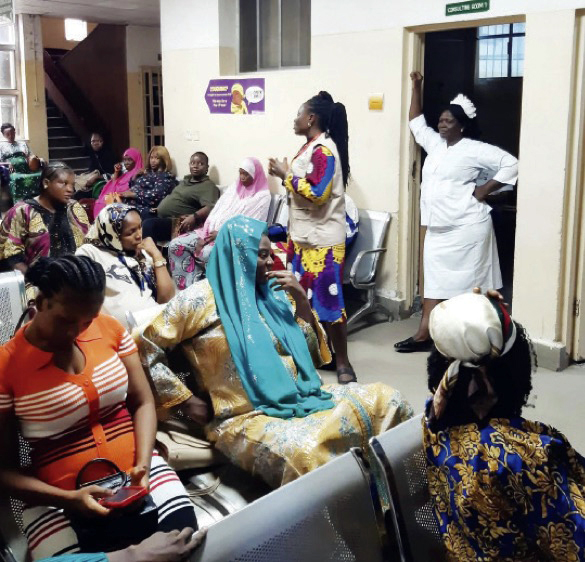
At 8:15 a.m. on a Tuesday, the antenatal clinic of the Lagos Island Maternity was already a crowded hall. Women sat on long wooden benches, ankles swollen, wrappers tied tight under their bellies. Some were fanning themselves with notebooks. Others were dozing, heads rested on the shoulders of their mothers or sisters.

The situation was the same at the Federal Medical Centre (FMC), Ebutte-Metta also in Lagos.
There, the narrow corridor leading to the antenatal unit was crowded before the arrival of the nurses. Pregnant women were in different stages of discomfort.

The seats were full, the floor space taken up by those who came too late to get a seat. All through the waiting period, like their counterparts at the Island Maternity, their husbands were absent. Not one man sat among the expectant mothers. They were probably at home, work or some other places.

They call childbirth a “women’s business. But the business of birth is not just a woman’s business. And the absence of men is costing lives,” experts warn.
Global health research has been consistent for years. They pointed out that when fathers are involved in the birth process, mothers and babies do better.
Doctors say a husband’s presence reduces maternal stress during labour. A calm mother bleeds less, pushes better, and recovers faster. Involved fathers are more likely to support exclusive breastfeeding, take the baby for immunisation, and notice danger signs early.
In communities where men escort their wives to the clinic, midwives report fewer cases of obstructed labour, higher uptake of tetanus shots, and better compliance with postnatal checkups. The logic is simple. When two people are watching, one is more likely to act when something goes wrong.
Yet in Nigeria, the cultural script still says a man’s job ends at paying the hospital bills. After that, he steps back.
This concern was expressed by the United Nations Women (UN Women) over the poor level of male involvement in maternal and child healthcare services in Nigeria, revealing that only 3.4 per cent of men accompany their spouses to antenatal and postnatal clinic visits.
The Country Representative of UN Women to Nigeria and ECOWAS, Ms Beatrice Eyong, disclosed this during a two-day social norms training for traditional, religious and community leaders on promoting male engagement in support of antenatal care (ANC), postnatal care (PNC) and prevention of mother-to-child transmission (PMTCT) in Nigeria, held in Makurdi, Benue State.
Eyong said findings from recent UN Women research showed that male participation in maternal healthcare remains critically low.
She described the statistics as worrisome, noting that the absence of men in maternal and child healthcare support systems has continued to affect the well-being of women and children across communities.
Eyong said the research recently conducted by UN Women shows that “Physical presence and active participation of men remain critically low. Evidence shows only 3.4 percent of men attend clinic visits with spouse; male partner overall involvement is 13.8 percent; only 3.3 percent attend more than two visits; average Male Involvement Index is 19.8 percent.”
She stressed that harmful cultural beliefs, gender norms, stigma, misinformation, and lack of family support have continued to hinder effective uptake of maternal healthcare.
But some men think differently. Promise Nduka, a Lagos based trader, said: “It’s not my place to be there. When my wife was pregnant with our first child, I gave her money and told her to go to the hospital.
“I think that was enough. Sitting in the clinic with other women? People will laugh. They will say I’m not man enough. So I wait outside. My father never did it. My grandfather never did it. Why should I?”
The case of Musa Idris, a security guard is different. “My boss won’t allow it. I work 12-hour shifts. If I miss work to follow my wife to antenatal, they will replace me. Nobody would care that I have a pregnant wife.
“They will say if you want to keep this job, come to work. So I sent her with her sister when she was pregnant. I didn’t like it, but I had no better option and I thank Allah that she safely delivered the baby.”
Amos Willy, a mechanic lamented, “The nurses don’t respect us. The last time I went with my wife, one nurse asked me, ‘Are you a woman?’ in front of everyone. Another nurse told me to wait outside because men distract the patients.”
He admitted that he didn’t know what to do. “Honestly, I felt useless. I just sat there. But my wife later said it helped her when I was there. After that, I said never again will I accompany her to the clinic for antenatal.”
On the contrary, Raphael James spoke in support of fathers taking a more active role during pregnancy, delivery, and after birth.
He believes pregnancy is a shared responsibility between husband and wife.
“If my wife is pregnant, I see it as both of us carrying that pregnancy, even if I’m not the one physically carrying the baby,” James said.
He explained that he would make it a point to attend antenatal visits to hear directly from medical personnel and understand how best to support his wife at home.
“I would go to antenatal visits because I want to hear what the doctor says directly, ask questions, and know how to support her better at home,” he stated.
James also said he would be present during delivery if his wife desires it, describing his role as one of emotional and practical support.
“During delivery, I’d be there if she wants me there, to hold her hand, encourage her, and make decisions if needed,” he said.
For the postnatal period, James emphasised the importance of continued presence, noting that new mothers need support during the vulnerable weeks after childbirth.
Other News
“And for postnatal, I would show up too because the first weeks after birth are tough, and she shouldn’t be doing it alone,” he added.
Rejecting the notion that accompanying a wife to the clinic undermines masculinity, James said presence matters more than public perception.
“It’s not about being ‘man enough’ for other people to see. It’s about being present for the person I married,” he said.
He acknowledged that attending clinics may require sacrificing work hours and enduring uncomfortable moments but said the trade-off is worthwhile.
“Even if it means taking time off work or dealing with awkward looks at the clinic, that’s a small price to making sure she feels supported and safe,” James concluded.
Mrs. Queeneth Kingsley, a mother of two adolescent girls, has said her husband’s active involvement during her pregnancies made a significant difference in her maternal health experience.
She confirmed that her husband accompanied her to antenatal, delivery, and postnatal visits on both occasions.
“For the antenatal visits, he would take time off work whenever he could, sit through the long queues with me, and ask the nurses questions I was too shy to ask,” she recounted.
Kingsley said her husband remained present during childbirth and was allowed into the delivery room briefly during her second delivery.
She added that his support extended to the postnatal period, ensuring she attended checkups and helping with the baby during consultations.
“And after, for the postnatal checkups, he made sure I went and even carried the baby while I talked to the midwife,” she said.
According to Kingsley, having her husband present eased the emotional and physical strain of pregnancy and childbirth.
“Honestly, it made a big difference. Pregnancy and childbirth are difficult times. Having him there meant I didn’t feel like I was carrying everything alone,” she explained.
She noted that her daughters observed this conduct and now hold clear expectations for marriage and fatherhood.
“My girls see that too now, and I think it shaped how they expect a husband to treat his wife,” she said.
Kingsley also lamented that many women do not experience similar support, noting that some men still view maternal healthcare as solely a woman’s responsibility.
The barriers are clear: stigma, work constraints, hostile clinic environments, and a deep belief that childbirth is a woman’s domain. In addition to that is the fact that many clinics run only during work hours, making it impossible for employed men to attend.
Adebayo Okon, a sociologist at the Institute for Social Health and Research, Lagos, said the problem is rooted in how masculinity is defined in Nigeria.
“We teach boys that to be a man is to provide, to be tough, to be emotionally distant,” he explains, adding that caring for a pregnant wife is seen as soft, as feminine.
“So men avoid it, not because they don’t love their wives, but because they fear what other men will say.”
He argues that in other parts of the world, “being a present father is now part of being a responsible man. In Nigeria, we are still stuck in the old model where the man is the provider outside, and the woman handles everything inside.
“But the inside affects the outside. A woman who dies in childbirth leaves the man alone to raise the children. That is not provision.”
Okon says change will require deliberate public education, male role models, and policies that make it easier for men to show up.
Ngozi Eze, a midwife for 18 years at a primary health centre in Owerri, explained that when a husband is present, the woman relaxes.
“She holds his hand. She listens more. If there is bleeding after delivery, he can run and call for help. If the baby is not crying, he notices. But when the husband is absent, the woman is alone with her fear. Sometimes, she refuses to push because she feels abandoned. We lose time.”
Ene Kachi, another midwife, agrees that men who are present during the delivery become responsible fathers and husbands.
“Men who come to antenatal ask better questions. They remember to remind the wife to take her iron tablets. After delivery, they support breastfeeding. The ones who don’t come, we see the wives struggle. Some stop coming for postnatal visits for different reasons.
Both midwives say they try to welcome men, but many hospitals lack space and privacy, making it awkward for husbands to stay.
There are several other factors that discourage men from showing up at the clinics. Nigeria’s Labour Act provides 12 weeks of maternity leave for women. For men, there is no national paternity leave policy. Some private companies offer 5 to 10 days, but most public sector jobs offer nothing.
In Nigeria, asking a man to take a morning off for antenatal care means asking him to risk his salary. In a country where 40 per cent of workers are in the informal sector with no job security, that’s a big risk.
Health policy experts say introducing paternity leave and adjusting clinic hours to include evenings and weekends would remove a major barrier. So would training health workers to treat men with respect and to involve them in counselling.
The exerts also noted that if Nigeria wants to reduce maternal mortality, male involvement can not remain a footnote.
They called for clinics to become male-friendly. That means shorter waiting times, private spaces, and staff trained to engage fathers, not mock them.
They urged employers and the government to address time and stressed that flexible hours and a formal paternity leave policy would signal that fatherhood is work, too.
They suggested communities to challenge the idea that caring for a pregnant wife is unmanly, urging religious leaders, and traditional rulers play a role in their positions, adding that when people see respected men escorting their wives, the stigma weakens.
The experts said that until Nigerian men see that role as part of manhood, too many women will continue to face labour alone. And too many babies will start life without both parents present.