Follow Us on Google
By Oluseye Ojo
The Lagos-Ibadan Expressway is one of Nigeria’s most important highways. It is a busy road, with thousands of vehicles plying it daily, including trucks, buses, and private cars.
The key transportation route plays a crucial role in the country’s economy, facilitating the movement of goods, services, and people between the South West and other parts of Nigeria.
It directly connects the commercial hub of Lagos to the historic city of Ibadan and beyond. It also connects Sagamu-Ore highway and Abeokuta, the capital of Ogun State, from the Sagamu Interchange.
The 150-kilometre highway was reconstructed by the Federal Government recently and it is always a smooth ride on the road. It usually takes about one hour for a car to get to Lagos from Ibadan.
Though the two lanes are generally good and smooth, they are fraught with pesky issues, including over-speeding and wrong overtaking. Trucks parking wherever they like have made the expressway hazardous for road users.
A report from FRSC stated that a total of 175 road traffic crashes occurred along Lagos-Ibadan Expressway in the first quarter of 2025, which led to 393 injured persons and 73 deaths in 1,271 road traffic crashes.
Anthony Joshua cheats death
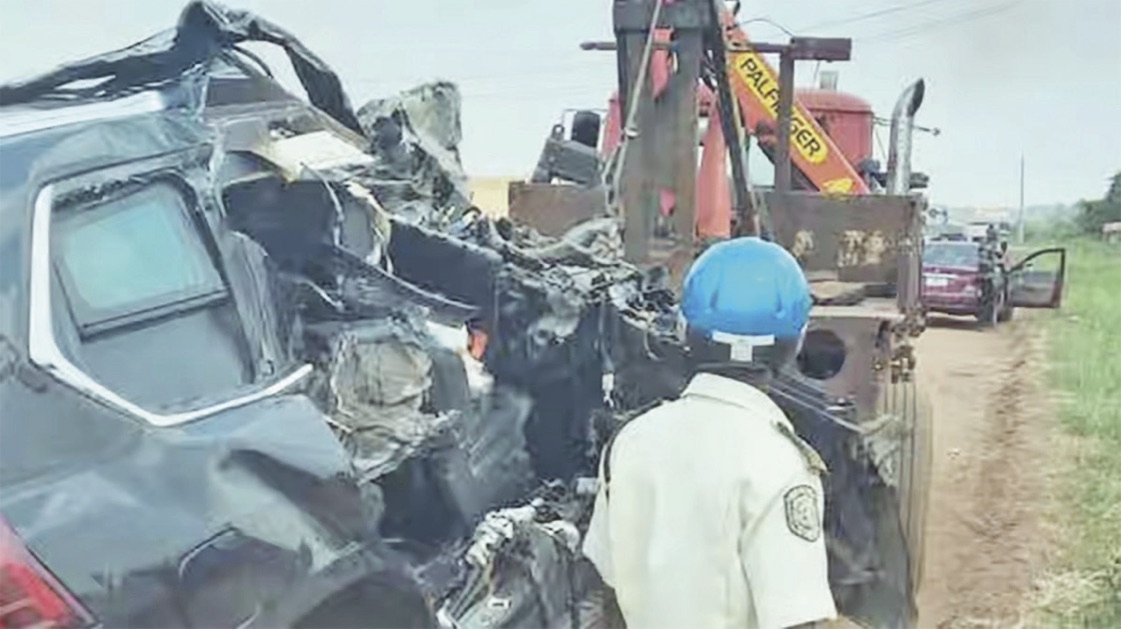
On Monday December 29, 2025, the world-renowned boxer, Anthony Joshua, cheated death in a ghastly road crash, that occurred around Sinoma area, near Sagamu,the Ogun State axis of Lagos-Ibadan Expressway.
But the crash came with heavy casualties, as two other occupants of the Lexus SUV carrying Anthony Joshua, died on the spot. They are Sina Ghami, AJ’s strength and conditioning coach for over a decade, who co-founded Evolve Gym in London and worked with elite athletes across multiple sports, as well as Kevin ‘Latz’ Ayodele, his personal trainer and childhood friend, known professionally as Healthy Mindset, who played a significant role in Joshua’s career and was part of his inner circle. Joshua sustained minor injuries in the accident.
An Assistant Corps Marshal, Corps Public Education Officer, Federal Road Safety Corps, Headquarters, Abuja, Olusegun Ogungbemide, said the incident involved two vehicles: a black Lexus Jeep and a stationary red commercial Sinotruck
“A total of five adult males were involved in the crash. Two persons sadly lost their lives, one sustained injuries, while two others escaped unhurt. Anthony Joshua was rescued alive and sustained minor injuries.
“Preliminary findings indicate that the Lexus Jeep, which was suspected to be travelling beyond the legally prescribed speed limit on the corridor, lost control during an overtaking manoeuvre and crashed into a stationary truck well parked by the side of the road.
‘The primary causes of the crash being excessive speed and wrongful overtaking constitute serious traffic violations and remain among the leading causes of fatal road crashes on Nigerian highways,’ Ogungbemide stated.
Hard shoulders of highways
A public commentator, Reno Omokri, in one of his posts on the accident involving Anthony Joshua, commended the swift response of people around the scene, security and safety officers. He wished Joshua a quick recovery.
But he explained what hard shoulders of highways are meant for. According to him, “if you go back and study the video and photographs from the crash scene, you would note that the trailer was parked on the hard shoulder, which is permitted under highway regulations both in Nigeria and abroad.
“A hard shoulder is a part of a highway or expressway, separated by a solid white or yellow line or other markings. It is intended for use as an emergency stop for vehicle breakdowns, accidents, or by emergency services.
‘A hard shoulder is not a lane, and it is not meant to be used for driving or overtaking vehicles ahead of you. There are warning signs on Nigerian highways reminding drivers not to use the hard shoulder.
“The cause of the accident, as the Police and FRSC posited, is over-speeding and reckless overtaking. That said, hard shoulders are not long-term parking areas, and vehicles should not be left there for extended periods.”
Grim statistics from crashes/trucks’ menace on highways
The key takeaway lessons from the accident, according to FRSC, are the need to avoid over-speeding, wrongful overtaking, and usage of hard shoulders of highways.
Available records showed that the majority of road traffic crashes in Nigeria involved trucks, either stationary or in motion.
The Executive Director, International Press Centre (IPC), Lanre Arogundade, a former Chairman, Nigeria Union of Journalists (NUJ), Lagos State Council, and ex-President, National Association of Nigerian Students (NANS), said in a post on his Facebook wall: “When the FRSC was engaged in real road safety work, trailers or articulated vehicles or whatever name they are called were not allowed to constitute the kind of nuisance they have become on the highways.
‘In those days, they cannot occupy three lanes at a time but would be compelled to maintain the lane meant for very slow vehicles in order to free the left and middle lanes meant for faster moving vehicles. The ones that broke down would also be promptly evacuated.
“I drove from Ibadan to Lagos on Sunday December 28, 2025, evening and it was absolute chaos meandering one’s way through the chain of haulage vehicles blocking almost everywhere.
“I had to blare my horn frantically to stop an SUV from running into one as the driver tried to overtake me. Exasperated, I told my elder brother that accidents are inevitable as long as their menace persists.
“The accident involving Nigerian international boxer, Anthony Joshua, is unfortunate, but I won’t say I am surprised.
‘It should be another wake-up call to FRSC to do the needful. That is not to say that some drivers are not outright reckless. Here’s wishing Anthony Joshua a perfect recovery and may the soul of the two people, who died in the accident rest in peace.”
Nigerians would not forget in a hurry the tanker explosion in Niger State, on January 18, 2025, where 86 persons were burnt to death and dozens others were injured, while scooping fuel from a tanker that fell.
Major accidents
From 2009 to 2024, research revealed the occurrence of at least 169 major accidents with 1,613 fatalities attributed to fuel tankers.
Records also showed that from January 2023 to June 2025, Nigeria recorded a crippling casualty figure of 180,460 individuals that were involved in road crashes.
The year 2023 alone saw 10,617 road crashes, involving a total of 70,092 persons. A total of 5,081 lives were claimed by the accidents, while 31,874 persons were injured.
The trend tragically continued into 2024. A total of 70,530 persons were involved in 9,570 road crashes, resulting in 5,421 deaths.
Within the first six months of 2025, many lives have also been lost.
The Corps Marshal of FRSC, Shehu Mohammed, reported officially on Thursday July 24, 2025 that a total of 5,281 crashes occurred between January and June of last year.
He added that the RTCs involved 39,793 people, with 2,838 lives lost, while 17,818 lives were rescued.
According to him, the figures represented a 3.9 per cent increase in crashes and a 2.2 per cent rise in fatalities when compared to the same period in 2024.
He stated further that the total number of people involved in road crashes increased by 8.9 per cent.
In 2022, the figures obtained on RTCs showed that there were 13,656 crashes, involving 45,348. A total of 6,456 people reportedly lost their lives.
By the end of September, 2025, the road traffic crashes have increased from 5,281 to 7,715 across the country for the year. Also, the number of people that lost their lives rose from 2,838 at the end of June to 3,915 by the end of September.
The number of injured also went up from 17,818 to 24,674 by the end of September.
According to him, 7,715 crashes were recorded nationwide in the first three quarters of 2025. He added that it was a 10.04 per cent increase from 7,011 crashes in 2024.
He stated further that 24,674 people were injured, compared to 22,373 in 2024, representing a 10.28 per cent rise. Within the same period, 3,915 deaths were recorded, which were higher than the 3,811 deaths in 2024, representing an 11.55 per cent increase.
A report also revealed that between 2016 and 2021, a total of 32,617 persons lost their lives to the road, while 65,053 persons were also injured. This means at least 49,575 persons died in road traffic crashes from 2016 to 2024, which is a period of nine years.
Last 10 days of 2025
Though statistics for the last quarter of 2025 have not been released by the FRSC, some fatal crashes were recorded, including the one of Anthony Joshua.
Records showed that on Tuesday December 22, 2025, multiple-vehicle accident occurred on Otedola Bridge, inward Berger, along Lagos-Ibadan Expressway. The crash involved a commercial bus, two Corolla cars, and a petrol-laden truck. Though no life was lost, two persons were injured.
In Jigawa State, no fewer than 34 persons lost their lives to road traffic crashes that occurred within the last 10 days of 2025. The latest crash, involving two Golf 3 vehicles and a tipper truck around 12:20 pm, occurred on Tuesday December 30, and claimed 18 lives, while two other persons were injured. The accident occurred at Danmasara Quarters along the Dustse-Kiyawa Road in Jigawa State.
Also, two crashes occurred on December 25, which was Christmas Day in the same Jigawa State .The first accident on the Christmas Day dispatched 11 persons to their early graves, while, nine others, including the driver, sustained varying degrees of injuries at Beguwa village along Sankara Road in Ringim Local Government Area of the state.
The second accident on the same Christmas Day involved an ash-coloured Honda Accord. The Public Relations Officer of the Jigawa State Police Command, Shi’isu Adam, said the driver, Yunusa Hassan, reportedly lost control while trying to dodge a goat and crashed into a tree. Six persons, including five women and one man died, while two other persons sustained fractures.
On Monday December 29, 2025, seven journalists lost their lives in a lone crash while returning from a wedding ceremony in Gombe South senatorial district.
How UK handles trucks on roads
In the United Kingdom, available information revealed that there are strict rules governing truck drivers’ working hours, rest periods, and fatigue management.
According to the rules, drivers are limited to nine hours of driving per day, with regular 45 minutes breaks after four and half hours drive. The rules stated further that drivers must rest for at least 45 hours per week.
As gathered, companies and drivers face penalties for non-compliance, including fines and licence withdrawal.
The regulations are enforced by authorities like the Driver and Vehicle Standards Agency (DVSA) and the police. The rules apply to both domestic and international haulage operators.
Experts from Nigeria have, however, described reckless driving by many heavy-duty truck drivers as a national emergency in Nigeria, with frequent accidents causing fatalities and destruction.
The identified factors contributing to the crisis include poor regulation, overloading, speeding, fatigue, and inadequate safety protocols
Many truck drivers, as gathered, are untrained, unlicensed, and work long hours without rest, increasing accident risk. Then, old and poorly maintained trucks are common, prone to breakdowns, and often left, either on the road or by roadside without warning signs, they said.
The survey also made it known that the Federal Government and FRSC cannot be exonerated from blame for neglect and purported weak enforcement.
The samples called for improved regulation, enforcement, and public awareness campaigns to address the issue.
Some drivers were said to have been resorting to drug use to stay awake while driving. The habits, as gathered, have inadvertently been compromising their ability to drive safely.
Also, some truck drivers have reportedly been handing over the control of the vehicles to substitutes, who might be young and inexperienced, and lack basic knowledge of road safety procedures.
In a recent media interview, a lecturer at the Nigerian Institute of Transport Technology, Zaria, Dr. Shehu Inuwa, said: “Across Nigeria, reckless driving by heavy-duty truck drivers has become a national emergency. From Lagos to Kano, Port Harcourt to Edo and the FCT, the headlines are grim and the consequences often fatal, leaving families shattered, and properties destroyed.
“For as long as vehicles have plied Nigerian roads, heavy-duty truck drivers have considered themselves kings on the highways. They have commanded a dominant presence with their massive, imposing, and often overloaded vehicles that cut through various states as they transport goods from one region of the country to the other.”