Follow Us on Google
•Marriage counsellors, relationship experts identify signs families, religious groups and neighbours can no longer afford to ignore
By Olakunle Olafioye
The coming together of a man and a woman in marriage is ordinarily a moment of joy, hope and celebration. For the couple, it is the beginning of a shared journey; for their families and friends, it is a promise of companionship, stability and a future built together. But for some couples, the journey has barely begun when the dream of marital bliss turns into a nightmare.

Across different parts of Nigeria, a disturbing pattern has emerged in which marriages barely months, or even days old, have ended in alleged spousal killings. In some cases, husbands have been accused of killing their wives; in others, wives have allegedly taken the lives of their husbands. This ugly trend has raised troubling questions about what happens behind the doors of newly established homes, and whether some marriages are being contracted without adequate attention to compatibility, emotional preparedness, psychological wellbeing, conflict resolution and the warning signs of domestic violence.
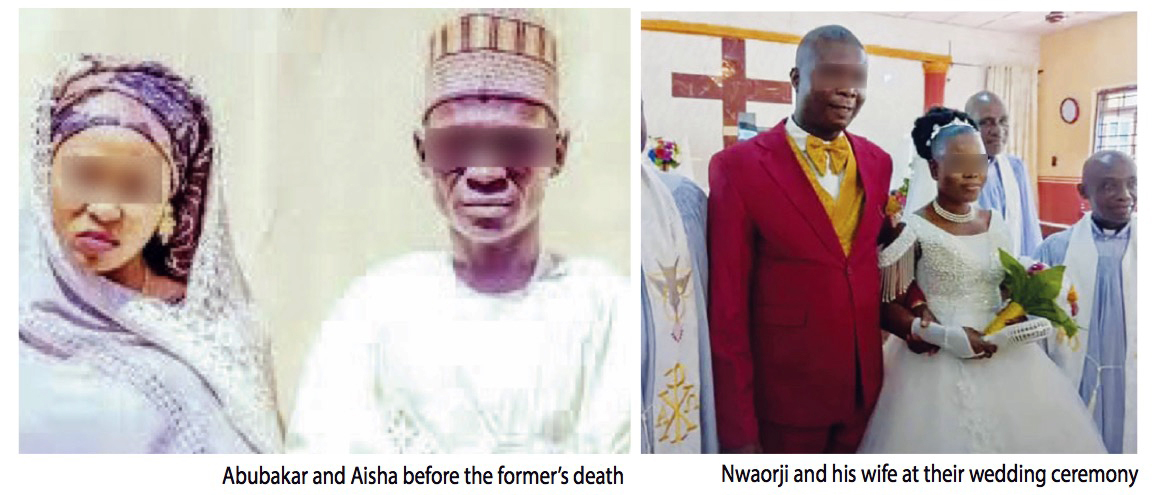
The latest tragedy to send shockwaves across Nigeria occurred at Umuokereke Ngwa in Obingwa Local Government Area of Abia State where the alleged killing of a newlywed, Innocent Nwaorji, was reported barely eight months after his marriage. Residents of the community said they are still struggling to come to terms with the circumstances surrounding his death, with his wife, Serah Nwaorji, reportedly arrested in connection with the incident.
A marriage cut short
The Nwaorji marriage, it was gathered, was celebrated in December 2025, amid the excitement and optimism that usually accompany weddings. According to neighbours and community sources, there were no obvious public signs of serious trouble between the couple. Innocent, who hailed from Umunwaoji, Umuonyeukwu Kindred, Umuokereke Ngwa, was described by relatives and community members as calm, hardworking and easy-going. But the optimism surrounding the marriage was shattered in the early hours of Sunday, August 9, 2026, when residents were reportedly jolted by news of a horrific incident in the couple’s home.
According to accounts from the community, Innocent was allegedly stabbed several times while he was asleep. By the time neighbours and other residents became aware of what had happened, the young man had reportedly sustained fatal injuries.
The development was said to have thrown Umuokereke Ngwa into panic and mourning. Subsequently, community leaders reportedly alerted security authorities about the incident, resulting in the immediate arrest of his wife, Serah, while operatives of the Abia State Police Command took over the matter. The precise circumstances surrounding the death, however, remain the subject of police investigation.
A community leader, who spoke on condition of anonymity, described the incident as “an unspeakable tragedy”, saying residents were still struggling to understand how a marriage that was less than a year old could end so violently. The tragedy has left the community grappling with one of the most difficult questions surrounding domestic violence: can a relationship that appears peaceful from the outside conceal conflicts capable of producing fatal consequences?
Another newlywed, another fatal argument
The Abia tragedy was not an isolated incident. On June 14, 2026, residents of Rimin Kebe quarters in Kano State were similarly thrown into shock following the reported death of a man simply identified as Auwalu, allegedly at the hands of his newly married wife, Fatima. The couple was said to have been married only about two months before the incident.
Unlike the Abia case, sources claimed that there had been tensions in the relationship. The couple were reportedly involved in a heated argument on the fateful day before the disagreement allegedly escalated into a fatal attack. Fatima was subsequently reported to have been arrested as authorities began investigating the circumstances surrounding Auwalu’s death.
The incident once again raised questions about the extent to which family members, friends and community leaders are able to detect serious problems in marriages before disagreements degenerate into violence.
Tragedy in Jigawa
Earlier in January, another newlywed marriage ended in tragedy in Jigawa State. Police in the state arrested a newly married woman over the death of her husband after he reportedly fell ill following a meal at their residence in Gauza village, Jahun Local Government Area.
According to a statement by the Jigawa State Police Command spokesperson, Shiisu Lawan Adam, the incident occurred on Friday, January 23, 2026. The deceased reportedly had lunch at home and subsequently became seriously ill. He was rushed to a hospital, where he was pronounced dead. The police said detectives attached to the Jahun Division subsequently arrested his wife as the principal suspect.
According to the police account, the suspect allegedly confessed during interrogation to putting rat poison in her husband’s food. She was also reported to have told investigators that she had been forced into the marriage by her parents. The police said the suspect allegedly revealed that she sent her cousin to purchase the rat poison.
The Commissioner of Police subsequently directed that the case be transferred to the State Criminal Investigation Department in Dutse for thorough investigation before prosecution. The police did not disclose the identities or ages of the couple.
Three days after saying “I do”
Perhaps one of the most disturbing cases occurred in Katsina State in November 2025 when residents of Jibia Local Government Area were thrown into mourning after a newly married man, Abubakar Dan Gaske Mai Nasara, was reportedly killed by his wife, Aisha Muhammad, barely three days after their wedding. The incident reportedly occurred on Sunday, November 23, 2025, at the couple’s home.
The deceased was said to have been asleep when his wife allegedly attacked him with a knife. He reportedly died before neighbours could intervene. Aisha was subsequently arrested, while police commenced investigations into the circumstances surrounding the incident and the motive behind the alleged attack.
Residents reportedly described Abubakar as calm and well respected, making the circumstances of his death even more difficult for the community to comprehend.
When husband becomes the aggressor
Spousal homicide, however, is not a crime committed only by women against their husbands. In October 2024, a newlywed woman, 25-year-old Olajumoke, was allegedly killed by her husband, 30-year-old Motunrayo Olaniyi, at their residence in Amazing Grace Estate, Elepe, Ikorodu, Lagos State. The Lagos State Police Command said the couple was involved in a domestic altercation on October 4, 2024.
According to the information released by the police, Motunrayo allegedly stabbed his wife several times, locked her inside their room and set the room ablaze. He was also reported to have inflicted injuries on himself.
Police officers from the Ikorodu Division responded to a distress call, put out the fire and reportedly found Olajumoke’s lifeless body inside the room. Motunrayo was rescued, treated at a hospital for his injuries and subsequently taken into police custody.
The case underscored an uncomfortable reality: domestic violence and spousal homicide have no single gender. While recent reports of newlywed women allegedly killing their husbands have attracted considerable public attention, men have also been responsible for fatal violence against their wives.
Other News
Beyond facade of blissful union
Although, there may be no comprehensive official national database providing a precise figure for spousal homicides in Nigeria, the recurrence of such incidents has continued to generate concern among families, advocacy groups, religious leaders and social commentators.
One particularly disturbing aspect of some of the reported cases is the short period between the wedding and the alleged killing. In some instances, the marriage lasted only days. In others, it lasted a few months. Similarly, the circumstances vary considerably. Some reports involve allegations of prolonged disagreement; others involve claims of forced marriage, while some communities say they noticed no obvious warning signs before tragedy struck. This, in the opinion of many analysts, makes the problem particularly difficult to address.
A marriage counsellor, Mrs Abimbola Shodimu noted that a marriage might look peaceful to neighbours, relatives and even close friends while serious emotional, psychological or interpersonal problems remain hidden within the home. “The absence of public quarrels does not necessarily mean the absence of serious conflict. Some relationships may be characterised by emotional abuse, threats, coercive control, unresolved resentment, financial pressure, incompatibility or psychological distress that outsiders never see,” she observed.
The danger of “marriage must work”
For many Nigerians, marriage remains much more than a personal decision between two adults. It is deeply connected to family expectations, social status, religion and community values.
Such a view, Shodimu pointed out, “can sometimes make it difficult for an individual experiencing serious problems in a relationship to seek help. A young couple may remain silent because they fear disappointing their parents. Others may be discouraged from ending a troubled relationship because of the belief that marriage must be preserved at all costs.
“There are also cases in which families become aware of serious disagreements but choose to “settle” the matter informally without addressing the underlying problem. Where violence, threats or coercion are involved, couples should not settle for reconciliation without proper assessment and intervention because that can expose vulnerable spouses to even greater danger,” she advised.
The role of families and religious institutions
Relationship coaches and marriage counsellor often advise that the responsibility for preventing marital conflicts should not be left entirely on couples. According to them, families, churches, mosques and traditional institutions have important roles to play in preparing intending couples for marriage and identifying situations that require professional intervention.
Premarital counselling, according to Shodimu, should go beyond discussions about wedding ceremonies, finances, religious expectations and traditional responsibilities. “Intending couples also need to understand communication, emotional regulation, conflict resolution, personal boundaries, consent, financial disagreements, parenting expectations and the consequences of abusive behaviour.
“Religious institutions, which are often among the first points of contact for intending couples, also have a significant role to play,” Shodimu said, urging state governments across the country to replicate a recent initiative by Lagos State government to empower faith-based marriage counsellors as parts of the efforts to curb conflicts among married couples in their respective states.
Lagos takes preventive steps
In Lagos State, authorities have increasingly placed emphasis on prevention and early intervention in the fight against domestic and sexual violence. On March 13, 2026, the state launched religious premarital online courses designed to strengthen the capacity of faith-based marriage counsellors.
The initiative according to DSVA Executive Secretary, Mrs Titilola Vivour-Adeniyi was informed by studies, which showed that more than 60 per cent of survivors noticed abusive tendencies before marriage but proceeded with the unions due to social pressure, hope for change or inadequate guidance.
“About 80 per cent of survivors in Lagos solemnised their unions through religious ceremonies, either in churches or through Islamic Nikah,” she said, adding that the statistics highlighted the strategic role of religious institutions in preventing domestic violence before marriages begin.
The argument is straightforward: if religious leaders are often involved in preparing couples for marriage, they should also be equipped to recognise potentially dangerous relationship patterns. Traditional counselling, experts have noted, may not always provide structured tools for identifying risk factors associated with domestic violence.
The Lagos initiative therefore seeks to place religious marriage counsellors alongside marriage registrars in a broader framework of standardised premarital counselling. The emphasis is on safeguarding families, preventing violence and ensuring that couples understand that marriage is a partnership rather than a contest for dominance.
Beyond wedding ceremonies
For decades, enormous attention has been paid to the preparation for weddings in Nigeria. Families spend months planning ceremonies. Couples invest heavily in clothes, venues, food, photography and entertainment. Religious and traditional rites receive detailed attention.
But what happens after the music stops and the guests return home? A relationship coach, Cecilia Bitrus pointed out that that is where the real work of marriage begins. According to her, the recent cases of spousal homicides demonstrate the need to look beyond the wedding ceremony and pay greater attention to the emotional and psychological preparedness of couples.
Her words: “Marriage counselling should not be regarded as a formality required merely to obtain a certificate or satisfy a religious institution. It should help intending couples ask difficult but necessary questions about themselves and their expectations of marriage.
“Are they entering the union willingly? Can they resolve disagreements without violence? Do they respect each other’s boundaries? How do they handle anger? What happens when there is disagreement over money, sex, family interference or child-rearing? Are there existing patterns of controlling or abusive behaviour?
“These are not pleasant questions, but they may be more important than the colour of the wedding attire or the size of the reception,” Bitrus said.
Warning signs that mustn’t be ignored
Bitrus further identified certain signs which family members, religious groups and neighbours must take seriously between couples. “Persistent threats, extreme jealousy, controlling behaviour, physical assault, intimidation, isolation from family and friends, destruction of property, forced sexual activity, financial control and repeated humiliation should not be dismissed as ordinary marital disagreements.
“Also, families should not encourage victims to remain in dangerous relationships simply to protect the reputation of the family. Where violence has already occurred, the priority should be safety and appropriate professional intervention. The belief that a spouse will automatically change after marriage can also prove dangerous when there is already a pattern of abuse,” she cautioned.
A family institution under pressure
While marriage remains one of the most important institutions in Nigerian society, relationship experts are of the opinion that its preservation cannot depend solely on cultural expectations that couples endure every difficulty at all costs.
A healthy marriage, they maintain, requires mutual respect, emotional maturity, communication, accountability and a willingness to seek help when necessary.
They admonished that when warning signs emerge, families must be prepared to intervene responsibly. Religious leaders must know when counselling is insufficient and professional help is required. Communities must learn to recognise and report credible threats. Government agencies must continue strengthening support systems for vulnerable spouses. And couples must understand that seeking help is not a sign of failure.