Follow Us on Google
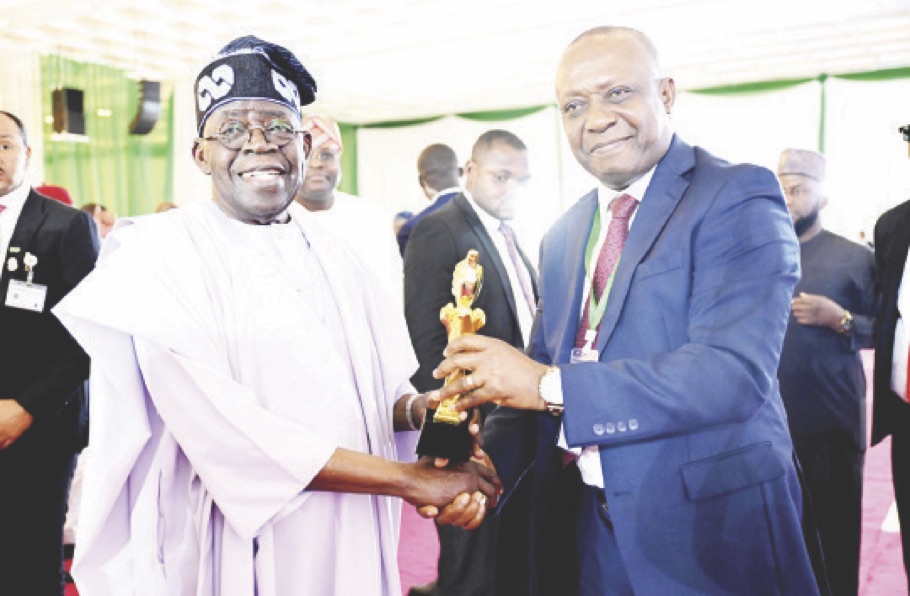
For two days, over 400 members of the crème de la crème of Nigeria’s media fraternity converged on Nigeria’s capital, Abuja for the 21st All Nigerian Editors Conference (ANEC).
The nation’s capital played host to the media elite, including an array of past presidents and fellows of the Nigerian Guild of Editors (NGE), distinguished editors, senior media executives, traditional rulers, and esteemed partners of the guild, from November 12 to November 13 2025.
The opening ceremony and Day One of the conference was held at the Banquet Hall of the Presidential Villa, while events of the second day of the conference held at the Nigeria Air Force Conference Centre, Kado, Abuja.
The conference, with the theme Democratic Governance and National Cohesion: The Role of Editors’ was described as a timely and crucial platform for reflection, dialogue, and renewal. President Bola Tinubu, in a show of solidarity, personally graced the occasion to declare the conference open. He set the tone for a candid exploration of the media’s role in shaping Nigeria’s future.
Imo State governor, Senator Hope Uzodimma, presented a keynote address on the topic: ‘2027: Editors as Catalysts of Democracy, National Cohesion and Electoral Integrity’.
Dignitaries, including the Minister of Information and National Orientation, Mohammed Idris, also addressed the distinguished editors.
Rousing welcome and media requests
At the opening ceremony of the conference on Wednesday, it was a rousing welcome for members of NGE and eminent personalities that came for the programme.
The NGE President, Mr Eze Anaba, welcomed the editors. He described the ANEC as the largest annual gathering of editors, media leaders, and thought influencers in the country.
“For more than two decades, this conference has served as a platform for national reflection, dialogue, and professional renewal within the Nigerian media landscape.
“We’re particularly delighted that His Excellency, President Bola Ahmed Tinubu, graciously accepted to declare this conference open.
“Mr President, your presence underscores your administration’s recognition of the strategic importance of the media in nation-building and in deepening democratic governance,” he stated.
Anaba noted that the gathering reflects the collective resolve to ensure that the media remains a cornerstone of Nigeria’s democracy.
The NGE President also acknowledged the role of editors in shaping Nigeria’s democracy and promoting national cohesion.
He emphasised the importance of the media as the Fourth Estate of the Realm, citing Chapter 2, Section 22 of the Nigerian Constitution, which empowers the media to hold the government accountable to the people.
He noted that the media is a veritable development partner, but lamented that its ability to perform the role is being hindered by economic challenges.
“The media is also a veritable development partner. But for it to effectively perform these roles, it must survive as a business. Without economic sustainability, our constitutional and social responsibilities become ineffectual,” Anaba stated.
He called on the government to recognise journalism as a public good, deserving of targeted fiscal incentives, legal protection, and developmental support.
Anaba proposed several policy recommendations for media sustainability, including corporate tax relief, Value Added Tax (VAT) exemption on media inputs, tax deductions for media advertisers, access to affordable financing, as well as digital transition and innovation grants.
According to him, corporate tax relief, and temporary tax relief for five to 10 years, would enable media houses to stabilise, meet operating costs, and sustain their watchdog role.
Anaba stated further that VAT exemption on media inputs is another area the NGE is seeking relief. In recognition of its social responsibility.
The media, he added, should be exempted from VAT on essential tools and equipment. He noted that the practice has already been emplaced in countries like Canada, India, and South Africa.
He also appealed to President Tinubu to support the media industry, as he made advocacy for a Media Freedom and Safety Charter to protect journalists and promote press freedom.
“For effective performance of our constitutional duties, we call for the repeal of laws that inhibit press freedom. We have already undertaken an exercise to identify these laws and we have also presented a proposal to the Minister of Information and National Orientation, the Deputy Speaker of the House of Representatives and the Constitution Review Committee of the House of Representatives in this regard.
“We also seek state-sanctioned protection of journalists carrying out legitimate work from arbitrary arrests or misuse of cybercrime laws,” Anaba stated.
The NGE President emphasised the critical role of editors in promoting unity, tolerance, and shared values in Nigeria.
He continued: “Democratic governance flourishes only when citizens are well-informed and when the media acts as a credible, independent watchdog.
“Editors must therefore defend the sanctity of truth, insist on transparency, and hold power to account – not as adversaries of government, but as constructive partners in the pursuit of national progress.
“Similarly, national cohesion requires that we rise above divisions and use our platforms to promote understanding, tolerance, and shared values.”
Anaba also paid tribute to past presidents of the NGE and acknowledged the contributions of veteran journalists to the growth and development of the media in Nigeria.
He enjoined editors to recommit themselves to the ideals of accuracy, fairness, and patriotism, as he reiterated the importance of responsible journalism in shaping Nigeria’s democracy.
Anaba recognised those whose foresight birthed the ANEC, with a special mention of Malam Baba Dantiye, who, as President of the Guild in 2004, initiated the first ANEC at Ada, Osun State.
‘What began as a modest idea in 2004 has now grown into a national institution — a vital forum where editors from across the country converge to exchange ideas, examine issues of governance, and contribute to shaping the direction of our great nation.”
He lauded all past Presidents of the Guild, who have sustained the tradition of annual reflection and engagement.
Anaba also gave special recognition to leaders of NGE, who have dedicated their lives to the growth and development of the media in Nigeria and beyond. The names he mentioned included— Uncle Sam Amuka, Aremo Segun Osoba, Prince Nduka Obaigbena, Malam Kabiru Yusuf, and Dr John Momoh.
Editors as catalysts of democracy
The air was electric with anticipation as Imo State governor, Senator Hope Uzodimma, took the stage to deliver a thought-provoking keynote address. He dissected the critical role of editors in catalysing democracy, national cohesion, and electoral integrity in the lead-up to 2027 general elections.
His address was a masterclass in clarity, insight, and vision, leaving the audience nodding in agreement and eager for more.
Uzodimma called on editors to play a pivotal role in shaping Nigeria’s democratic future. He emphasised that their role is crucial in promoting national cohesion and electoral integrity.
He stressed that editors wield significant influence in shaping public opinion and must exercise their power responsibly.
“The pen is mightier than the sword,” Uzodimma asserted. “Your reports and comments paint a picture of tomorrow. The picture you paint of 2027 is what Nigerians should expect,” he stated.
He urged editors to prioritise accuracy, verification, and context over sensationalism and virality. He added that objectivity is not just neutrality, but a moral requirement.
Uzodimma expressed concern over the trust deficit in Nigeria’s information ecosystem, citing the 2023 Edelman Trust Barometer, which revealed that 49 per cent of Nigerians distrust the media.
The governor attributed the trust deficit to editors’ failure to interrogate their own role in shaping public opinion.
Other News
“You have critiqued everyone else’s responsibility for public trust, but you have not interrogated your own,” he said.
Uzodimma called on editors to focus on nation-building narratives, as he raised the issues of shared values and principles that unite Nigerians. He cited examples of positive economic indicators, such as Nigeria’s $2.35 billion Eurobond, being oversubscribed by $10.65 billion, and urged editors to amplify such stories to inspire confidence in the country’s future.
The governor emphasised that electoral integrity begins with editorial integrity, stressing that editors must protect the integrity of the information ecosystem to ensure a credible election in 2027.
Uzodimma, who reminded editors of their critical role as the fourth estate of the realm, stated: “You are not spectators in 2027; you are active participants. The narratives you shape between now and the election will determine whether Nigerians approach 2027 with hope or cynicism, with trust or suspicion.”
He stated further that in all fairness, Nigerian editors have accomplished much that deserves recognition.
“Your newsrooms have produced investigative journalists who exposed corruption. You have published reports that held power accountable. Through your coverage, you have amplified marginalised voices. These contributions matter, and they are essential to democracy.
“But what is often missing is journalism that actively builds cohesion, not just reports on its absence.
“There is a difference between neutrally documenting division and actively choosing narratives that remind Nigerians of shared values, shared stakes, and a shared future.
“You report on ethnic tension, regional disparities, and religious conflict; as you should. But how often do your editorial choices highlight what binds us rather than what divides us?”
On the 2027 elections, he stated: “The reality heading into 2027 is that elections are won and lost not only on policies or candidates but on whether voters believe the outcome will be legitimate.
“That belief is shaped by whether they have been hearing fragmented, tribal narratives or cohesive, nation-building ones. And that is an editorial choice you make daily.”
Uzodimma also urged media gatekeepers to let 2027 be the election year “where the Nigerian media would become architects of a shared democratic future, where you demonstrated that journalism can be rigorous, engaging, commercially viable, and work in the service of national cohesion; where you accept that you are not only accountable for ‘Democratic Governance and National Cohesion’ but also for ‘Electoral Integrity and Trust Deficit.’ What you choose to do or not to do has enormous consequences for our dear country.”
Tinubu’s government and press freedom
The Minister of Information and National Orientation, Mohammed Idris, in his address, underscored the significance of a free and vibrant media in Nigeria’s democratic landscape.
He reaffirmed the commitment of President Tinubu’s administration to press freedom, stating that the government has nurtured an “unprecedentedly egalitarian media ecosystem.”
He pointed attention to the government’s dedication to upholding the constitutional principles of press freedom.
The minister’s speech was delivered as President Tinubu made a historic appearance at the conference, marking a significant moment in Nigeria’s journalism history.
“With over 1,000 licensed radio and television stations operating across the nation, it is significant to note that not a single one has been threatened, gagged, or shut down by the government for expressing dissent,” Idris said.
He attributed this to the government’s commitment to press freedom, adding that it was not a coincidence but a deliberate effort to uphold the constitution.
Idris also announced that Nigeria has been granted hosting rights for the International Media and Information Literacy Institute, which will connect the country to global media-literate dynamics.
He continued: “We are rapidly transforming our information architecture to complement this, ensuring that we not only consume information but also lead in shaping a more literate, discerning, and ethically sound global media landscape.”
The minister urged editors to see themselves as “essential partners in national renewal”, encouraging them to engage, critique constructively, and report with responsibility.
“The government of President Tinubu has demonstrated its faith in you through its actions, not just its words,” Idris said.
He noted that Tinubu’s appearance at the conference was evidence of the fact that the government is committed to press freedom and recognises the critical role of the media in Nigeria’s democratic journey.
Idris noted that the president’s presence was a symbol of his administration’s dedication to upholding the principles of press freedom and promoting a free and vibrant media.
“Let us work together to tell the Nigerian story with balance, with truth, and with an unyielding belief in the promise of our great nation,” he stated.
Editors, the truth and national cohesion
President Bola Tinubu, in his opening remarks, called on editors to exercise their responsibility with wisdom, fairness, and a strong sense of national duty, as they shape narratives and influence public understanding.
He emphasised the critical role of the media in sustaining democracy and promoting national cohesion.
“As editors and managers of the national information space, you shape narratives. You influence public understanding. You decide what becomes national focus and how our collective challenges are interpreted. The weight of that responsibility is significant,” he said.
Tinubu urged editors to uphold the highest standards of journalism, reporting boldly but truthfully, and critiquing government policy with knowledge and fairness.
“Your aim must never be to tear down, but to help build a better society,” he added.
The President, who listed the importance of national cohesion, said: “Nigeria is a large and diverse country. Debate and differences are part of our reality. However, disagreement must never translate into the erosion of national cohesion.
“Criticism, when informed and constructive, is a service to the nation. But cynicism that breeds mistrust and despair can weaken the very foundations of the society we all seek to improve. The national interest must always remain paramount,” Tinubu stressed.
He also emphasised the need for cooperation and trust among all stakeholders, including government, private sector, civil society, and the media, to build a better Nigeria. “Nation-building requires cooperation. It requires trust. It requires a shared understanding that our future is tied together,” he said.
The President expressed his administration’s commitment to securing Nigeria, sustaining economic stability, and widening opportunities for all citizens. “The reforms we have undertaken have been challenging, but they are designed to place our economy on a strong and enduring footing,” he added.
Tinubu’s stance was against the backdrop of Nigeria’s complex media landscape, where social media has increased the speed and scale of misinformation.
He urged editors to prioritise verification, balance, and professional judgment, saying, “In such an environment, the editorial function is more important than ever.
“Verification must be your anchor; balance must be your principle and professional judgment must be your guide,” he stressed.
Tinubu also paid tribute to Nigerian journalists, who have made sacrifices in the line of duty.
“Many journalists endured intimidation, detention, and personal hardship in defence of the public good. Their sacrifices are part of the foundation upon which our democracy rests today. We honour them not only in memory but also by remaining committed to the values they upheld.”
Speaking on the theme of the conference, he stated that it is a reflection on the state of democracy and the ways in which public discourse could either strengthen or weaken the bonds that hold the nation together.
“This conversation is necessary as we continue to build institutions that are transparent, resilient, and trusted by our citizens,” Tinubu said.