Follow Us on Google

By Sunday Ani
Imo State Governor Hope Uzodimma has said his administration has provided all the necessary infrastructure to boost the local economies of the state. He said the government had achieved the feat by laying the foundations, backing local enterprise and investing in the people.
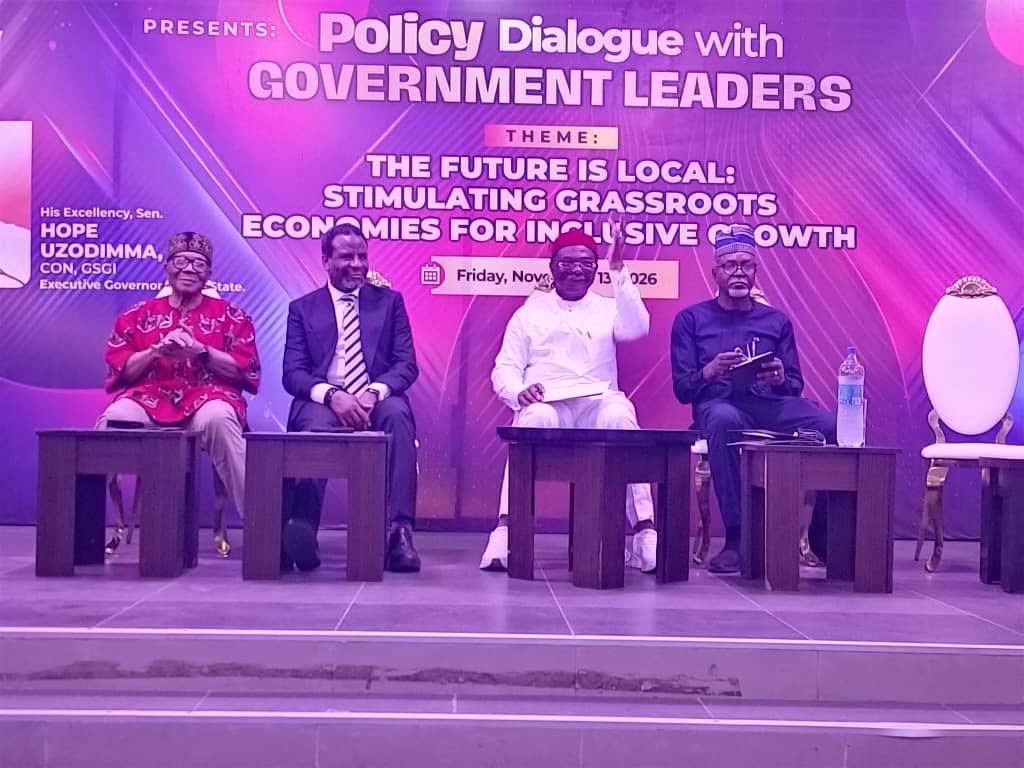
He stated this recently when he spoke as a guest speaker at the Lagos Country Club’s inaugural national policy dialogue with government leaders.
Themed “The Future is Local: Stimulating Grassroots Economies for Inclusive Growth”, Uzodimma stressed that the rural areas accommodate 80 per cent of the poor in Nigeria, underscoring the need to grow local economies.
He cited his local economic programme, OKOBI, meaning “One Kindred, One Business Initiative”, to demonstrate the theme of the event and also to draw an analogy with the Igbo apprenticeship (Igba Boi) business model.
Explaining OKOBI, he said the government must come closer to where economic life happens, often below the local government level, including the kindred, the town union, the age grade and the cooperative, which are institutions that people already trust.
“Under OKOBI, a kindred, social group or student club establishes a registered business that it owns collectively, governs properly and runs for profit, with training, technical support and access to finance through the Office of the Chief Economic Adviser. Members share in the profits, and because the business belongs to the group rather than to any one person, it can outlive the enthusiasm of its founders.
“By the end of 2025, more than 600 OKOBI businesses had been registered, with close to 20,000 members across all 27 local government areas in Imo State. The model has been studied by the London School of Economics, and earlier this year the Federal Government approved its adoption across the country,” he said.
On the Igbo apprenticeship system, he said: “It has for generations taken young people into a master’s business, trained them for years and then set them up on their own, often with capital from the very person who trained them.
“It has been widely acknowledged as one of the most effective systems of enterprise development this country has produced. Built entirely by communities, it has seeded businesses in every major city in Nigeria, including Lagos.
“When government designs programmes for the grassroots, it should build on institutions of this kind, which already enjoy the trust of the people, instead of inventing new ones and hoping that trust will follow.”
The governor noted that, to attract private capital, the government must provide the basics, including infrastructure, human capital and power.
He disclosed that his administration had since built more than 130 roads, provided energy sustainability, digitalised land administration in the state and, through the Skillup Imo project, trained more than 65,000 young people in software development, cybersecurity, artificial intelligence and related fields, with digital skills in all the 27 local government areas of the state.
He said that, through the Skillup Imo project and the state’s wider digital economy programmes, the administration had created more than 80,000 jobs and income-earning opportunities.
He also said that, with the state paying the highest minimum wage of N104,000, the economies of the local governments and rural communities had been boosted.
Other News
“A well-paid public workforce is one of the quickest ways to put money into circulation at the grassroots,” he argued.
He attributed the economic success recorded by the state to the reforms by President Bola Tinubu, saying that resources reaching the states had substantially increased since the president removed subsidies on petroleum products.
He described the theme of the event as both timely and significant, saying that Nigeria’s growth would be sustainable only when it was built on the strength of its many local economies.
“The government must lay the foundations, and private capital, much of which is represented here, must turn them into productive enterprises, jobs and prosperity,” he said.
He commended the club for organising the lecture and making him the maiden guest lecturer. “I thank the President of the Club, Mr Seyi Adewunmi, the Board of Trustees and the members of Lagos Country Club for inviting me. To give the first lecture in a new series at an institution which has been part of Lagos life since 1949 is an honour I do not take lightly,” he stated.
He noted that the theme was deliberately chosen to provoke conversation around development from the bottom up, which rested on a simple but compelling conviction that the future of Nigeria would not be secured by government policies alone, but by how effectively those policies translated into opportunities, productivity and prosperity at the grassroots.
In his opening remarks, the president of the club, Seyi Adewunmi, called on members of the club who are leaders in business and public life not to remain passive onlookers while Nigeria’s economic future was being shaped. He stressed that the dialogue was designed to bridge the gap between policy formulation and economic realities, a place where the government, private sector and citizens could sit at the same table and speak plainly to one another.
“For too long, many of us have spoken of the Nigerian economy as though it lives only in Abuja, in the Central Bank, in the oil terminals and in the headlines. But the real Nigerian economy wakes up at 5am as represented by the shoemaker in Aba, the tailor in Yaba, the trader in Onitsha, the farmer in Benue, the young developer in Computer Village and the okada rider who knows every shortcut in Nigeria better than any map.
“Small businesses carry nearly half of our national output and the overwhelming majority of our jobs. That is not the margin of our economy. That is its heartbeat.
“So today, we ask a simple question with a demanding answer – what would happen if policy met the people where they actually are; if credit reached the market woman before it reached the conference room and if roads, power and markets were built where the work is already being done?” he stated.
The chairman of the occasion, Alex Goma, commended the Federal Government for the policies it had implemented, which seemed to have stabilised the economy and reduced inflation, but lamented that the people were yet to feel any positive impact.
He, therefore, argued that policy without execution would not transform Nigeria’s economy, adding that execution of economic policy needed four things: leadership with a clear vision and the capacity to deliver, institutions that work, private capital that is willing and citizens who are engaged.
He charged the government at all levels to move from announcing to delivering. “Publish what you have promised, measure it at local-government level and remove the levies that still ambush small traders on our roads,” he said.
He challenged Uzodimma to prove his belief over the years that the future of Imo lies in its young people and in the digital economy. “We want to hear the lessons you have learnt in Imo: what has worked, what has not and what a state needs from Abuja, from business and from its own citizens to turn strategy into jobs,” he submitted.