Follow Us on Google
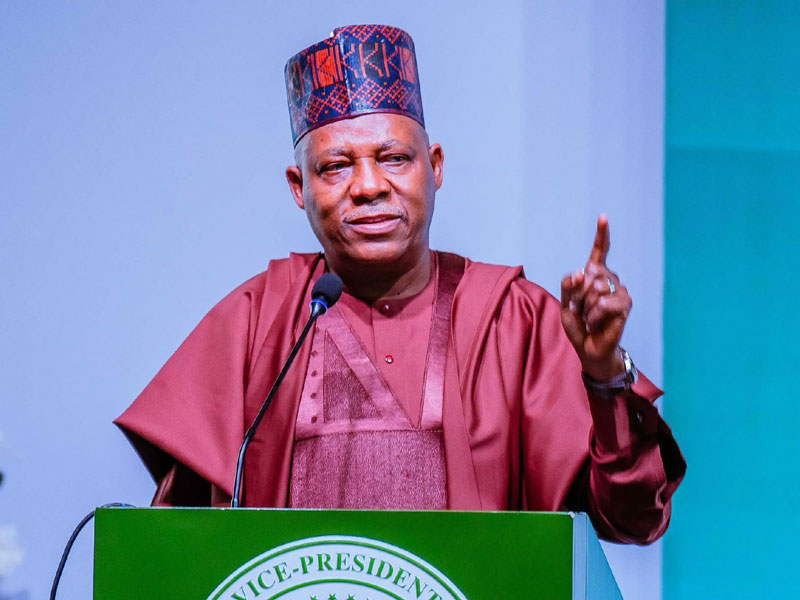
Vice President, Kashim Shettima, has announced that Nigeria is embracing artificial intelligence (AI) and other advanced technologies as part of a retooling strategy to transform its food systems. The move, he said, signals a decisive shift in the country’s approach to food security at a time when climate shocks, conflicts, and market disruptions are deepening global hunger.
Speaking on Monday at the opening session of the United Nations Food Systems Summit Stocktake (UNFSS+4) in Addis Ababa, Ethiopia, Shettima said AI, geospatial analytics, and satellite-driven climate intelligence are no longer abstract concepts but integral to Nigeria’s agricultural policy.
“Artificial intelligence, geospatial analytics, and satellite-driven climate intelligence are now part of our agricultural vocabulary,” he told participants. “We are deploying these tools to monitor production, enhance transparency, connect producers to markets, and reduce waste across the value chain.”
Shettima explained that this technological shift is being matched by large-scale investments in Special Agro-Industrial Processing Zones (SAPZs), which Nigeria is developing in partnership with the African Development Bank (AfDB) and the International Fund for Agricultural Development (IFAD). These zones, he said, are designed to create jobs, attract private capital, and integrate rural farmers into national and international markets.
“Our faith in the capacity of our people remains unshaken,” he said. “In partnership with the African Development Bank and IFAD, we are investing in Special Agro-Industrial Processing Zones. These hubs are not just places of production. They are engines of transformation.”
But he cautioned that ramping up production alone would not be enough to secure Nigeria’s future. “But production is not enough. We believe that a sustainable food system must also be a healthy one,” Shettima said. He noted that Nigeria has significantly scaled up school feeding programmes, nutrition-sensitive agriculture, and community-led nutrition education initiatives, adding that the Nutrition 774 initiative is ensuring that all 774 local governments in the country are now at the centre of nutrition delivery.
Other News
“This is more than a summit. This is a reckoning,” the vice president declared. “The scars of conflict, the uncertainties of climate, the distortions of markets, and the missteps in policy are all calling us to renew our commitment to multilateralism. A broken food system in any part of the world diminishes the dignity of humanity as a whole.”
Shettima reminded delegates that food and nutrition security are at the heart of Nigeria’s National Development Plan (2021–2025) and the Nigeria Agenda 2050. He disclosed that the Federal Executive Council had approved the National Multi-Sectoral Plan of Action for Food and Nutrition to operationalize the country’s revised food and nutrition policy. To further strengthen governance and accountability in the sector, he said, new Nutrition Departments are being created across relevant ministries.
The urgency of these reforms was echoed by other leaders at the summit. Ethiopian Prime Minister Abiy Ahmed called for predictable concessional financing for African agriculture, warning that hunger and climate change are “deeply linked.” In a recorded message, United Nations Secretary-General António Guterres also reminded participants that food systems touch on every aspect of human well-being.
“Food systems are about more than food,” Guterres said. “They are about climate, justice, and the right to a better future.”
Guterres warned that despite numerous pledges made since the 2021 UN Food Systems Summit, hunger has been rising as economic slowdowns, conflicts, and declining development assistance undermine progress. But Shettima stressed that Nigeria is determined to chart a new course and position itself as a leader in shaping food systems that not only respond to immediate needs but also secure long-term sustainability for generations to come.