Follow Us on Google
From Romanus Ugwu, Abuja
President Bola Tinubu has said Nigeria must embrace technology, innovation and knowledge-based opportunities to drive growth.
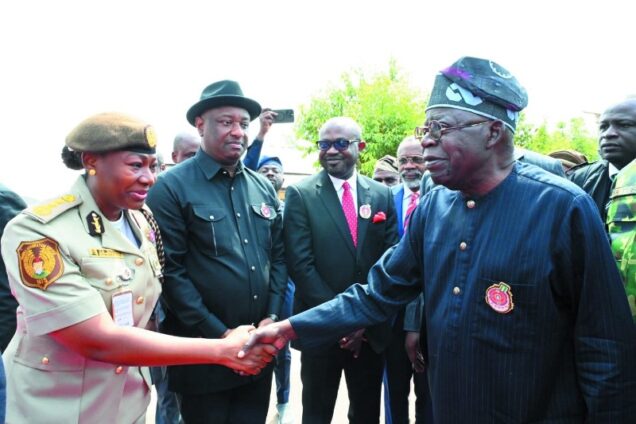
He stressed the transformative potential of revamped immigration and air travel systems during the commissioning of the Nigeria Immigration Service’s Technology Innovation Complex named Bola Ahmed Tinubu Technology Innovation Complex (BATTIC), at the Nigeria Immigration Service (NIS) headquarters in Abuja.
“We believe that if we rejig our immigration and air travel, we will benefit tremendously from the opportunity it offers for ease of entry and exit. By 2025 we could have achieved 100 present new passport regime,” he said.
The complex comprises seven key components, including a data centre, command and control centre, and visa approval centre, among others.
Tinubu also said the centre was inaugurated to provide a sustained communication architecture linking relevant agencies with collaborative technology along a trusted information network.
He commended the leadership and commitment demonstrated by those involved in the project, and looked forward to feeling its great impact and economic benefits.
“From the beginning of our administration, we promised to deliver innovative solutions across the government, including the NIS.
“Today, we have achieved that and we are making tremendous progress. Congratulations!
“We believe that by rejigging our immigration and air travel, we will benefit from economic opportunities.
“By the end of the year, March 2025, we aim to achieve a 100 percent new passport regime. Our passport is a security document that requires careful treatment.”
He emphasised that the integration of security measures across air, land, and sea represents a fulfillment of a long-held dream.
He commended Olubunmi Tunji-Ojo, Minister of Interior, for his achievements, particularly in the area of passport issuance, which had given Nigeria a great reputation internationally.
Tinubu hailed Kemi Nandap, the NIS Comptroller General, and her team for their efforts in taking the service to its rightful place as a security agency.
“I commend you for your judicious and prosperous leadership of the service. I have heard you loud and clear, and I am excited about the integration of security across air, land and sea.
“The centre has been commissioned to provide a sustained communication architecture linking relevant agencies.
“Our Visa Approval Centre will provide a one-stop shop for visa applications. With this innovation, Nigeria and other countries can travel with ease, do business with ease, and live honestly among each other,” the president said.
Tunji-Ojo announced that Nigeria is projected to save over N300 million annually with the implementation of new surveillance technology at NIS.
He emphasised that the country had been wasting billions each year due to inefficiencies in border management.
“This advanced system will enhance cooperation among security agencies and provide a rapid response to security challenges.
“This project is not just about air borders; it encompasses land and sea borders as well,” Tunji-Ojo explained, highlighting the critical need for effective management of Nigeria’s porous borders.
“By October, we expect to complete the first phase of this border surveillance system, allowing us to monitor activities several kilometers away.”
He explained the initiative includes an ECOWAS travel document aimed at facilitating easier movement across member states and an automated visa regime that promises 48-hour approvals. “We are fully in charge of border governance, with over 200 borders under our watch,” he added.
The minister also emphasised the importance of global partnerships enabled by this technology. “This technology affords us global integration where we can seamlessly collaborate with Interpol and other international security agencies,” he noted, underlining its role in enhancing Nigeria’s security framework.
Tunji-Ojo reiterated President Tinubu’s commitment to national security. “A secured border is a safe nation. This administration is determined to make Nigeria safe for all its citizens.”
He expressed pride in the achievements made thus far and assured that the new systems would significantly improve border control and immigration management in Nigeria.
Minister of Aviation, Festus Keyamo, in his goodwill message, said the project is a perfect example of what can be achieved with good interministerial cooperation.
He noted that the project which was earlier initiated about 18 years ago by previous governments, could not take off, due to interministerial conflicts.
“Before a flight arrives in this country, we already have all the data of the passengers on board and we can screen for security purposes without actually involving the passengers.”
Keyamo, who also noted that the data command center has been approved by the International Civil Aviation Organisation ICAO, said it will help the nation in management of passenger safety.
“The system which is connected to five airports across Nigeria, makes the country the seventh nation out of the 54 African countries to implement the project.
Meanwhile, Nandap has expressed confidence that the newly inaugurated new border surveillance technology, Bola Ahmed Tinubu Technology Innovation Complex (BATTIC), would support real-time video monitoring of unmanned borders areas across the federation.
The CG stressed that the technology would also ensure a constant watch on border activities, adding that her agency was setting a new benchmark in the use of technology to protect borders and enhance national security with BATTIC.
While x-raying the features of the technology, Nandap explained that, “BATTIC is a multi-faceted complex comprising several critical components that will play a pivotal role in Nigeria’s security and migration management.
“These include the Command-and-Control Centre for Regular Migration, the NIS Data Centre and Visa Approval Centre, the Interior Data Centre, the Passport Personalisation Centre, the ECOWAS National Biometric Identity Card (ENBIC) Centre, and the 0.5KW Solar Farm…”
“Each of these components has been meticulously designed to meet international standards, ensuring that Nigeria not only catches up with global trends but also becomes a leader in the management of migration data.
“With BATTIC, we are setting a new benchmark in the use of technology to protect our borders and enhance national security. At the heart of BATTIC’s mission is its ability to manage and analyse varying levels of data efficiently, using state-of-the-art technology,” she stated.
On the key functions and capabilities of the facility, the paramilitary agency’s boss said: “Some of the features include; Advanced Passenger Information (API) and Passenger Name Record (PNR) Analysis. This enables us to assess the risk levels of passengers even before they arrive in Nigeria or depart from their country of origin.
“Others are Identification of Suspicious Travel Patterns; by analysing travel data, we can detect anomalies that may indicate potential security threats. 24/7 Surveillance: The complex will support real-time video surveillance to monitor unmanned border areas across the federation, ensuring a constant watch on border activities.
“Integrated Communication Platform: BATTIC will facilitate seamless communication across all levels, from Border Patrol Units to Border Control Posts, State Commands, the Service Headquarters, and the Ministry of Interior.
“Cross-Referencing with National and International Watchlists: Data will be cross-checked against various national and global security databases, including INTERPOL, to ensure no security threats slip through the cracks.
“In essence, BATTIC will serve as the central hub for our digital infrastructure, dramatically enhancing our surveillance capabilities, streamlining migration management, and strengthening our national security framework,” she said.