Follow Us on Google
• Says, “it’s my parting gift as I bow out”
From Juliana Taiwo-Obalonye and Francis Onyedikachukwu, Abuja
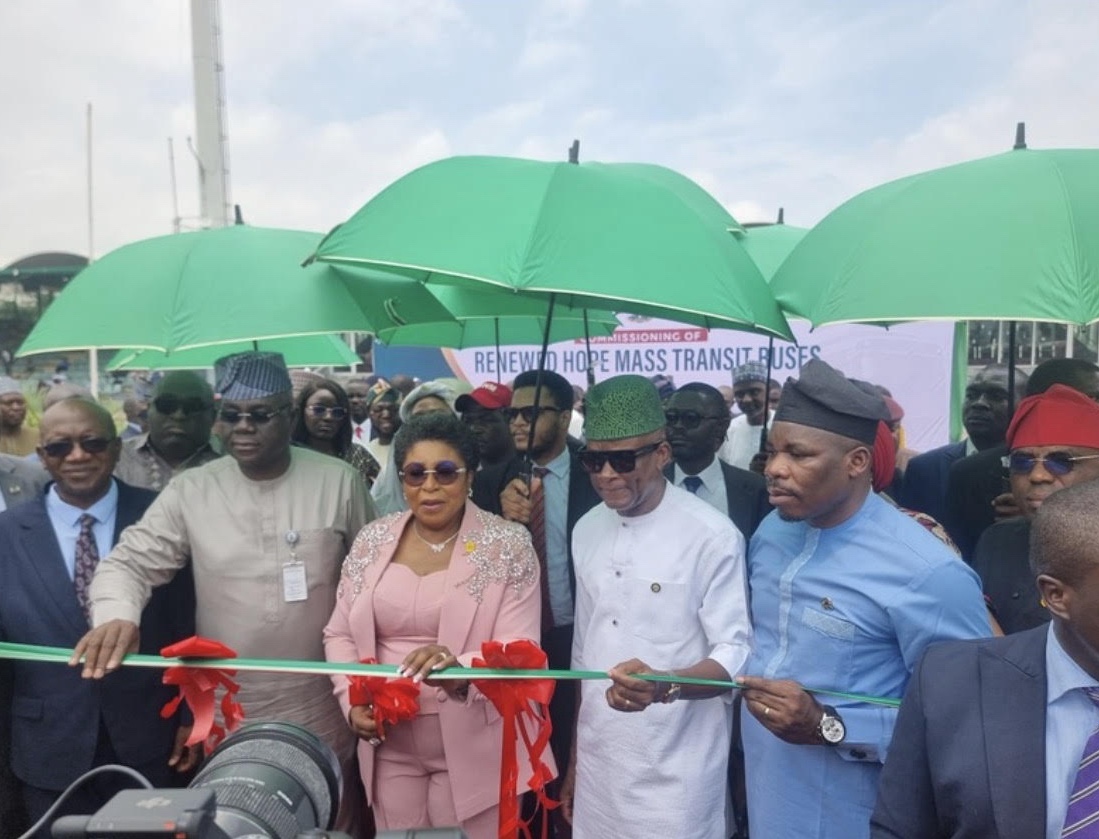
The Federal Government on Wednesday handed over the first batch of electric mass transit buses to the Federal Civil Service as part of its Renewed Hope Mass Transit Programme, an initiative that will ultimately provide 100 buses for civil servants nationwide.
The ceremony, held at Eagle Square, Abuja, marked the rollout of a programme aimed at improving the welfare, safety and productivity of civil servants by providing safer, more reliable and affordable transportation to and from work.
Head of the Civil Service of the Federation (HCSF), Didi Walson-Jack, who bows out of office on Thursday, described the intervention as both a major welfare measure and her “parting gift” to the workforce.
Describing the event as a “dream come true,” she said she could not have asked for a more fitting way to end her tenure than to hand over an intervention that would continue benefiting civil servants long after her departure.
“This commissioning is providentially my parting gift to my dearly beloved federal civil servants, as in a little under 24 hours, my time as Head of the Civil Service of the Federation comes to an end,” she said.

“I could not have asked for a more fitting note on which to close this chapter of service than receiving and handing over the keys to something that will keep moving, keep working, long after I have gone home.”
Walson-Jack said transportation was about more than simply moving workers from one location to another, stressing that the daily commute directly affected workers’ finances, safety, punctuality and productivity.
“For many civil servants, the daily commute shapes their finances, their safety, their punctuality and ultimately their productivity,” she said.
According to her, the intervention would ease the financial burden on workers while providing a safer, more reliable and affordable commuting option.
She said the buses represented a practical demonstration that the Federal Government’s Renewed Hope Agenda was being translated into tangible benefits for workers.
“An intervention that makes transportation safer, more reliable and more affordable is therefore not a peripheral welfare gesture; it is an investment in a more productive civil service,” she said.
Walson-Jack linked the mass transit programme to other Federal Government interventions, including the upward review of the national minimum wage, wage awards following the removal of fuel subsidy, digitalisation of government services, improved pension administration, promotions, employee compensation and health insurance.
She said the acquisition of the buses was made possible through the Renewed Hope Infrastructure Development Fund and commended President Bola Tinubu for supporting the initiative and prioritising the welfare of civil servants.
Walson-Jack also praised the Minister of State for Industry, John Enoh, for his support, as well as officials of the Ministry of Industry, Trade and Investment, the Service Welfare Office, the National Automotive Design and Development Council (NADDC) and other stakeholders involved in bringing the project to fruition.
She said operations would commence with a pilot phase on selected routes before a full rollout across the Federal Civil Service.
She urged the authorities to ensure that the buses were deployed under a transparent and sustainable operational framework, with clearly defined routes and schedules, regular maintenance, qualified drivers, passenger safety, cleanliness and effective monitoring.
According to her, the buses would also be deployed, where appropriate, to federal secretariats across the states, while a special-purpose vehicle had been established to oversee their management, maintenance and long-term sustainability.
Walson-Jack urged civil servants to protect the buses as valuable public assets and reciprocate the government’s investment through improved punctuality and productivity.
“They are yours to use, but also yours to protect,” she said. “Treat these buses as your own personal assets.”
Speaking briefly to reporters after the ceremony, Walson-Jack said she was grateful that the initiative she had long envisioned had become a reality on the eve of her departure from office.
“I’m happy that as I bow out of the Federal Civil Service tomorrow, what indeed for me is a dream come true is taking place, and that Federal Civil Servants will now have the benefit of a luxurious ride from home to the office and back,” she said.
She expressed hope that the intervention would improve productivity and safety while reinforcing the message that the welfare of civil servants remained a priority of the Tinubu administration.
The HCSF also endorsed a proposal that the Federal Civil Service anthem should be played on the buses, saying it would reinforce the identity and pride of civil servants and help them connect with the Service during their daily journeys.
For Enoh, the programme represented more than a transportation intervention. He described it as a practical demonstration of President Tinubu’s commitment to the welfare of Nigerian workers and an expression of the government’s “Nigeria First” industrial policy.
“Today is an important day for the Federal Civil Service and another practical demonstration of the commitment of the administration of His Excellency, President Bola Tinubu, to the welfare of Nigerian workers,” Enoh said.
He said the 100 electric buses would provide safe, comfortable and affordable transportation while complementing broader government reforms aimed at reducing the cost of living and improving workers’ welfare.
The minister said the project also represented welfare, productivity, industrialisation and technology, stressing that government procurement could be used to strengthen local automotive manufacturing and create jobs.
Other News
He noted that the buses were assembled in Nigeria, arguing that local production would retain jobs, incomes and economic value within the country.
“When we support a credible Nigerian manufacturer, we are not simply buying a vehicle. We are supporting factories, creating jobs, developing engineers and technicians, encouraging local component production and keeping more economic value within Nigeria,” he said.
Enoh said the partnership involving the Ministry of Industry, Trade and Investment and NADDC demonstrated how government procurement could stimulate local manufacturing.
He added that the 100 buses were about “welfare, productivity, industrialisation” and translating the Renewed Hope Agenda into tangible benefits for Nigerians.
He said each bus could accommodate up to 200 passengers and travel a minimum of 200 kilometres on a full charge.
Enoh said Nigeria could not afford to remain merely a market for imported electric mobility technologies, stressing the need to develop domestic expertise in battery technology, power electronics, software, charging infrastructure and modern vehicle systems.
“Nigeria must not arrive late to this transition. More importantly, we must not become simply a market where everybody else comes to sell the technologies of the future. We must build capacity here,” he said.
He said the Federal Government’s long-term objective was to see Nigerian factories produce thousands of modern buses, local companies manufacture components, charging infrastructure expand across the country and Nigerian engineers develop and maintain electric mobility systems.
The minister envisioned Nigeria eventually emerging as an automotive manufacturing hub for Africa.
The Director-General of NADDC, Otunba Osanipin, said the buses represented a major step in Nigeria’s transition towards clean and modern transportation.
He explained that electric vehicles offered significant environmental and maintenance advantages.
“All the vehicles that are going to be presented today, they are all electric vehicles. What does electric vehicle bring to us? It means that there is zero emission. Our environment will be better off for it,” Osanipin said.
According to him, the maintenance cost of electric vehicles was substantially lower than that of conventional vehicles.
He disclosed that the buses were equipped with modern monitoring and security technologies, including cameras and systems capable of tracking their location and monitoring operations.
Osanipin said the council had also developed a 10-module electric vehicle technical training manual and commenced specialised training for engineers, technicians and university students to build the skills required for electric vehicle assembly, maintenance and high-voltage diagnostics.
According to him, charging infrastructure had already been deployed in about 15 universities across the country, while plans were underway to establish additional charging stations around Federal Government offices.
The NADDC boss said the initial rollout would serve as a model for wider adoption of clean and efficient mass transit across the country.
“We are not simply placing buses on the road. We are establishing a structured, zero-emission mass transit system,” he said.
The Permanent Secretary, Service Welfare Office, Garba Sule, described the handover of the buses to civil servants as a practical demonstration of the Federal Government’s commitment to improving workers’ welfare and productivity.
He said the provision of the buses was not merely about transportation, but an investment in creating a more conducive working environment for public servants.
He commended the leadership of the Federal Government, ministries, departments and agencies, as well as other stakeholders whose contributions facilitated the realisation of the initiative.
According to him, the project reflected the government’s commitment to building a more productive, responsive and welfare-oriented workforce.
Sule expressed optimism that the beneficiaries would deploy the buses effectively and responsibly, describing the handover as a significant milestone and a legacy of the administration.
Government said the 100 buses approved under the Renewed Hope Mass Transit Programme were intended to respond directly to the cost-of-living pressures confronting public servants.
The initial deployment will operate on designated routes across the Federal Capital Territory, linking major residential corridors with the federal secretariat complex. The pilot phase will allow the government to test the programme under real operating conditions and establish the framework for eventual expansion across the Federal Civil Service.
Officials said the remaining buses would be delivered in the last batch in December 2026.
Senior government officials, representatives of organised labour and stakeholders in the Nigerian automotive sector attended the ceremony.