Follow Us on Google
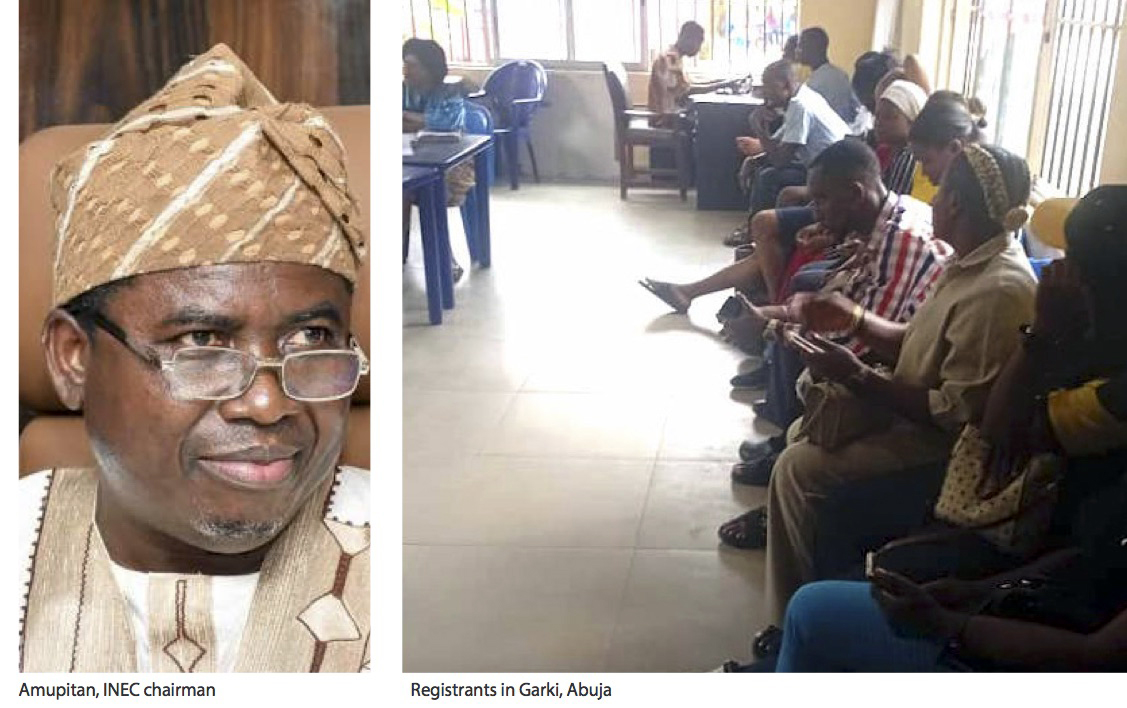
• Query INEC’s readiness to conduct free, credible elections
From Fred Itua, Okwe Obi, Abuja; Femi Folaranmi, Yenagoa; Ighomuaye Lucky, Benin; Stanley Uzoaru, Owerri; Scholastica Hir, Makurdi; Aniekan Aniekan, Calabar; and Tony John, Port Harcourt
Network failures, long queues and frustrated citizens have marked the ongoing Continuous Voters’ Registration (CVR) exercise across Nigeria, raising concerns about the readiness of the Independent National Electoral Commission (INEC) to conduct a credible general election in 2027.
Daily Sun correspondents who monitored the third and final phase of the exercise across seven states and the Federal Capital Territory found that persistent server outages were forcing would-be registrants to abandon queues, return for multiple consecutive days and, in some cases, give up entirely on the process.
The exercise, which commenced on May 11, 2026, was expected to end on July 10, 2026. However, it has been extended by INEC. The exercise has recorded large public turnout in several states, but INEC’s own officials have admitted to network and server problems that have repeatedly disrupted registration proceedings at centres across the country.
In Edo State, a lawyer, Nosa Uwagboe, who registered at Garrick Memorial Primary School in Oredo Local Government Area, told Daily Sun that while officials were on ground and turnout was high, network connectivity problems slowed down accreditation considerably and forced registrants to spend far more time at the centre than was necessary.
He called on INEC to extend the registration window to accommodate the level of public interest.
In Imo State, INEC’s head of the Department for Voter Education and Publicity, Mrs. Emmanuella Ben Opara, disclosed that over 11,839 new voters had been registered in the state in recent months, with the commission extending the exercise to schools, churches and markets to widen access.
However, she also announced that registration had been suspended entirely in Egbema, within Ohaji/Egbema Local Government Area, citing security concerns, even as network failures continued to force prospective registrants in other parts of the state to abandon queues and return the following day.
Citizens and civil society groups who spoke to Daily Sun questioned whether INEC, which by its own admission has struggled with recurring technical difficulties during a registration exercise that unfolds over several months at a fraction of the pressure of a general election, can be relied upon to successfully process close to 100 million registered voters on a single election day in 2027.
A Commission Under Scrutiny
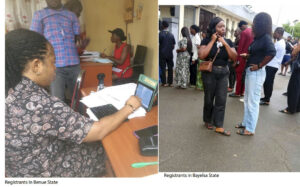
Benue State, also covered by Daily Sun, offered perhaps the most candid public acknowledgement of the problem from within INEC itself. At the commission’s state office in Makurdi, applicants described long queues compounded by poor network service.
Two registrants, Simon Ortega and Peter Anchov, said the major obstacle was simply that the network often prevented officials from attending to applicants promptly, complaining that they were repeatedly told the server was down. Anchov disclosed that he had visited the office for a second consecutive day without success, adding that rainfall often worsened the network problems, a detail that underscores how exposed Nigeria’s electoral infrastructure remains to the most basic environmental disruptions.
Another resident, Oryiman Jude in Makurdi, said church based mobilisation had encouraged him to register, but he too described the process as slow on account of connectivity troubles. The state’s INEC Public Relations Officer, Peace Ogoli, was unusually forthright in her assessment. She confirmed that the third and final phase began on 11 May and would end on 10 July 2026, and acknowledged candidly that the commission faced challenges from time to time having to do with issues of network, stating that there had been some server issues, even as she insisted that the commission’s technical team worked to fix them.
Ogoli explained that INEC had expanded registration beyond local government headquarters into rural communities, many of which have limited or no network coverage at all, a fact that all but guarantees recurring disruption for as long as the exercise continues.
Cross River: A rare success story
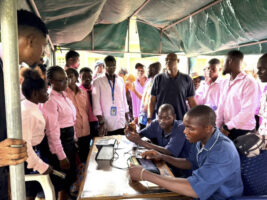
Cross River State presented something closer to a genuine success story, though one achieved only after INEC adjusted its own approach. By moving the CVR exercise from local government offices to all 196 political wards in the state, the commission appears to have addressed one of the most persistent complaints heard elsewhere, namely the cost and inconvenience of travelling long distances to register.
Mercy Effiong of Calabar South recounted how she had failed repeatedly to register at the INEC office on Etta Agbor Road owing to transport costs and long queues, only to stumble upon a mobile registration point at Ekpo Abasi Junction while returning from the market, joining the queue and completing her registration within minutes.
Etim Okon, registered at the New Airport axis of Calabar South without ever visiting the commission’s office, described the process as seamless. A community leader in Ndabo Okposin credited the ward level approach with making mobilisation considerably easier.
The state’s Resident Electoral Commissioner, Professor Gabriel Yomere, explained that the decentralisation followed the commission’s own observation that voters were avoiding local government offices because of distance and cost. He disclosed that INEC provided two machines per local government area, plus between four and five extra machines, with at least one extra reserved for remote communities.
Rivers State: Late surge, but cards sit uncollected
In Rivers State, Daily Sun conducted an independent field assessment in Port Harcourt. Findings indicated that the registration exercise was experiencing a late surge in participation as citizens became increasingly aware that the final phase would close on 10 July 2026. Turnout in earlier phases had been comparatively low, with some centres attending to fewer than 100 registrants daily, but participation had since climbed to almost 200 persons daily at some centres, occasionally forcing officials to carry registrants over to the following day.
Other News
On a single day, Wednesday 24 June 2026, the Obio Akpor headquarters alone recorded 57 fresh registrations, 35 transfers and 10 record reviews, while across the wider local government area fresh registrations exceeded 400 and total transactions surpassed 600. The process itself was found to be orderly, with registrants issued numbers on arrival, and the exercise remained entirely peaceful.
Yet, the same intermittent network disruption noted everywhere else in the country surfaced again as the most frequently reported operational challenge, slowing processing and reducing the daily capacity of registration centres.
An advocacy group, the Rivers Peace Initiative, urged INEC to strengthen its registration infrastructure in the remaining days of the exercise. Its convener, Obinna Ebogidi, told Daily Sun plainly that the right to vote begins with registration, but the responsibility to protect democracy requires much more.
Perhaps the most troubling finding to emerge from Rivers State, however, had nothing to do with network failure at all. It concerned the staggering number of Permanent Voters’ Cards that remain uncollected across the state, with collection rates described as alarmingly low in some locations despite INEC’s practice of transporting printed cards to ward level registration points specifically to ease collection.
While registration numbers climb and transfer requests multiply, thousands of cards already printed and waiting sit unclaimed, raising the prospect that additional cards will eventually be produced while a substantial stock already in circulation remains abandoned.
Abuja: Queuing in rhe rain
In the Federal Capital Territory, eligible voters braved persistent rain to secure their cards, with those arriving earliest numbered up to 105 at the last count. Tellingly, those who had registered as far back as 2011 and were merely seeking their cards outnumbered fresh applicants. An INEC official who spoke on condition of anonymity explained that cards had not been distributed to the wards, particularly for those who had registered between 2020 and 2022.
At the Garki office, one applicant said she had been arriving before 7 in the morning for two consecutive days, holding number 20 on the attendance list yet still unattended, and admitted she was beginning to consider abandoning the process altogether because she could no longer justify the daily cost of transport. Another applicant, who had completed his pre-registration online, said he had waited from Tuesday until closing time without being attended to.
The Administrative Secretary of INEC in the territory, Mrs Abimbola Oladunjoye, appealed for patience and acknowledged that the commission had experienced network challenges the previous week, though she maintained the problem had since been resolved. She suggested the commission might begin publicising the movement schedule of its mobile registration units more aggressively on social media so that residents know in advance where the machines will be operating on any given day.
Bayelsa: Deserted centres and unheeded complaints
In Bayelsa State, poor network coverage badly marred the exercise, with many residents finding it difficult to participate at all. Mrs Flora Ebimuna said she had been compelled to keep returning to the INEC office in Yenagoa because other registration points across the state had effectively been deserted owing to poor network coverage in those areas, and even at the Yenagoa office itself, the process remained very slow because of both the network and the personnel assigned to the work.
A second registration point at Kpansia stood deserted entirely, prospective voters in the area having abandoned it after their complaints went unattended. The Head of Department for Voters Education and Publicity at INEC Yenagoa, Mr Awajionyi Christian Utong, confirmed that poor network coverage was affecting the exercise, stressing that INEC does not have the power to control how the network functions, though he disclosed that the commission’s headquarters in Abuja had been duly briefed on the situation.
A nationwide pattern, not a local glitch
Beyond the documented accounts from Edo, Imo, Benue, Cross River, Bayelsa, Rivers and the Federal Capital Territory, similar complaints have surfaced in other parts of the country, lending weight to the suggestion that this is not a localised technical hitch but a nationwide pattern.
Reports from Lagos and Oyo have echoed the same grievance heard in Benue and Rivers, with applicants told repeatedly that registration could not proceed because of network outages, and with footage shared widely online showing long queues of frustrated citizens enduring hour after hour at registration centres, some for several consecutive days.
In Borno State, the commission has gone further still, formally suspending the exercise altogether in four local government areas, Abadam, Guzamala, Kala Balge and Marte, after the state’s Resident Electoral Commissioner cited prevailing insecurity. It is a stark reminder that in parts of the North East, the challenge facing voters’ registration is not merely technical but existential, a question of whether the state can guarantee safety for its own electoral officials in the first place.
A poser: Can INEC be trusted with 2027?
Taken together, these accounts from across the federation paint a picture of an exercise that is, in the words of INEC’s own officials in Benue, progressing well despite occasional technical difficulties, yet one whose occasional difficulties have, in practice, become a near constant feature of the citizen experience rather than an exception to it.
The defenders of the commission point reasonably to genuine successes. Turnout has clearly exceeded expectations in several states, with citizens showing a degree of civic enthusiasm that ought to be celebrated rather than dismissed. Innovations such as ward level deployment in Cross River, mobile units in the Federal Capital Territory, and outreach to schools, churches and markets in Imo demonstrate that INEC is not entirely indifferent to the logistical burden it places on ordinary citizens, and that where the commission has adapted its delivery, results have generally improved.
Yet, the criticism gathering force across the country cannot be waved away as mere impatience. Some Nigerians who spoke to Daily Sun described INEC’s recurring network failures as a deliberate attempt to frustrate willing citizens, while others were more charitable, suggesting the commission simply lacks the technical capacity to deliver what is being asked of it. Whichever explanation one accepts, the practical effect on the ground is the same. Citizens turned away, queues abandoned, registration days lost to a server that will not connect.
It is this practical effect that lies behind the sharper political question now being asked with increasing frequency. If INEC struggles to deliver a continuous registration exercise that does not require simultaneous nationwide voting, that unfolds over many months rather than a single day, and that involves only a fraction of the electorate at any one centre, what realistic confidence can Nigerians have that the same commission will smoothly mobilise and process close to 100 million registered voters on a single election day in 2027, under far greater logistical pressure and far less room for error?
This is not an idle or rhetorical question. The commission’s own historical record offers little comfort. The 2023 general election was itself marked by widely reported technical difficulties with the Bimodal Voter Accreditation System and delays in result transmission through the INEC Result Viewing portal, frustrations that fed directly into public disputes over the credibility of that contest. Critics following the current registration exercise argue that the network failures of 2026 are simply the latest instalment of a familiar story, one in which technical explanations are offered after the fact while the underlying causes go largely unaddressed between election cycles.
What emerges from this nationwide snapshot is a commission caught between genuine public enthusiasm for civic participation and an infrastructure that has, time and again, proved unequal to the demand placed upon it. The willingness of Nigerians to queue in the rain, to return for a second or third consecutive day, to travel to a market junction on the off chance that a mobile unit might be passing through, speaks to an electorate that has not given up on the democratic process, whatever its disappointments with those administering it.
Whether INEC can match that willingness with the technical reliability and logistical foresight the moment demands remains, with little more than two weeks before the registration window closes and considerably less than seven months before the country goes to the polls, an open and increasingly urgent question. The commission has time, just, to demonstrate that the glitches of this registration exercise were a passing inconvenience rather than a preview of what awaits Nigeria in 2027.
Whether it uses that time wisely will determine far more than the fate of a single registration drive. It will shape whether millions of Nigerians believe their vote, once finally cast, will actually be counted.