Follow Us on Google
By Bianca Iboma-Emefu
Education and technology leaders have called for a radical shift in how computer science is taught across African universities, warning that the traditional “degree-to-job” model has collapsed amid shrinking employment opportunities and rapid technological change.
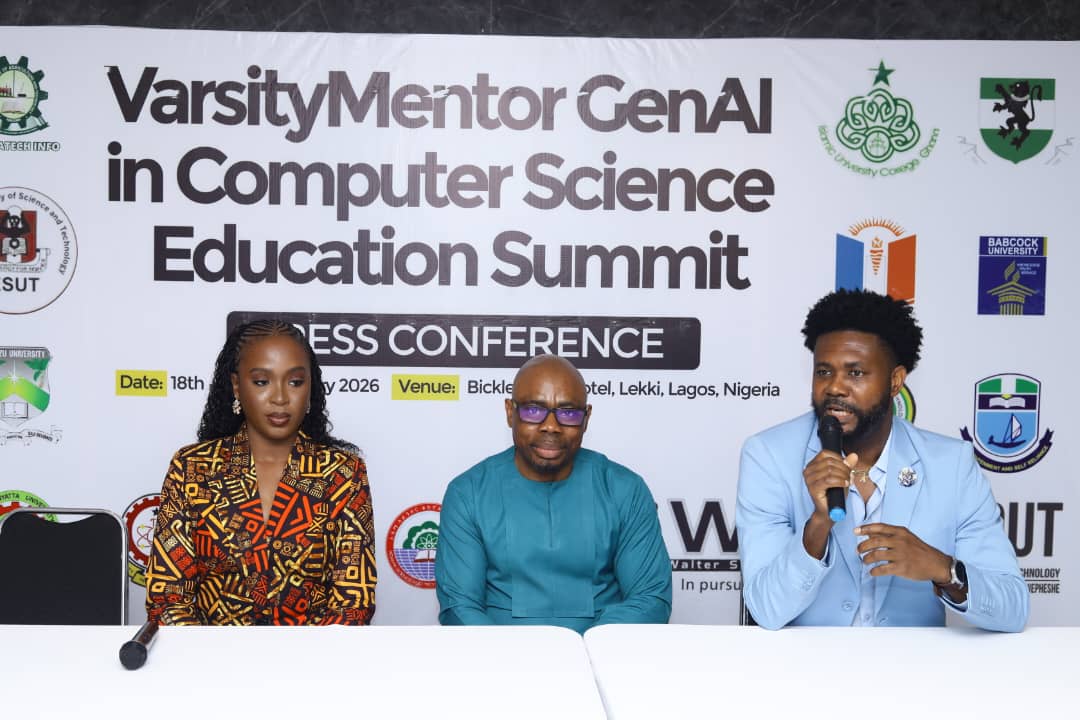
The call was made at a press conference held on Tuesday, ahead of a major Computer Science and Artificial Intelligence (AI) Summit scheduled to hold in Lagos from February 18 to 20, 2026.
Speaking at the briefing, Obinna Anya, a Senior UX Researcher at Google working on enterprise cloud AI solutions, said African universities must move beyond colonial-era education frameworks and begin equipping students with practical, problem-solving, and entrepreneurial skills that can translate directly into innovation, startups, and self-employment.
Anya explained that insights from global hiring practices at companies such as Google show that many leading universities in the United States now prioritise teaching students how to identify real-world problems, package their skills, build applications, and even write compelling CVs and résumés that appeal to recruiters.
“Our education system still assumes that once you graduate, jobs will be waiting for you. That worked in the 1980s and 1990s. Today, the jobs are simply not there,” one speaker said. “When graduates confront that reality, the question becomes: what next?*”
The summit highlighted the need to help students recognise opportunities within their immediate environments and convert everyday challenges into viable startup ideas. Speakers stressed that many Nigerian students already possess strong foundations in calculus, statistics, physics, and chemistry—disciplines that underpin data science and AI—but often fail to see how these translate into industry applications.
“We want students to connect what they are learning in class to real-world use cases—how statistics becomes data science, how mathematics feeds into AI, and how these skills can open doors beyond conventional employment,” an organiser explained.
Organisers revealed that the impact of previous programmes is already visible, with at least two to three students having gone on to found startups—an early milestone in their long-term goal of producing job creators rather than job seekers.
Unlike earlier editions held in Ghana and Kenya, which focused largely on students, this year’s summit deliberately targeted universities and policymakers for broader, systemic impact. Faculty members from multiple African countries gathered in Lagos for the multi-day event, which ran from Wednesday to Friday.
According to the organisers, engaging directly with universities and ministries of education will create a ripple effect, as participating lecturers return to their institutions to train colleagues and redesign curricula. Prior to the summit, faculty members had already participated in surveys and virtual conferences to outline challenges facing their departments.
They also disclosed ongoing collaboration with the Generative AI Consortium at the University of San Diego, which delivered*virtual classes to African faculty as part of the preparatory engagements.
Speaking at the Varsity Mentor Generative AI in Computer Science Education Summit, Valerie Ehimhen, a Technical Programme Manager at Google, called for urgent and coordinated investment in Africa’s computer science education. She said the continent must transitionfrom being a passive consumer of artificial intelligence to an active creator of AI solutions tailored to its realities.
Ehimhen urged African universities and governments to embrace generative AI in redesigning curricula, assessments, and teaching methods, while simultaneously investing in critical infrastructure such as functional computer labs and widespread student access to technology. She noted that such investments are essential to producing graduates capable of building AI systems that understand Africa’s languages, cultures, and unique challenges through initiatives like VarsityMentor.
Addressing concerns that AI could make students lazy or undermine academic rigour, Adekunle Adeyemi, a Site Reliability Engineer at Google, said speakers dismissed the fears as a misunderstanding of technological progress. Drawing parallels with the introduction of calculators and computers, they argued that AI enhances efficiency and allows researchers and students to focus on higher-level thinking.
“AI helps compress months or years of work, especially in areas like literature reviews. It doesn’t replace thinking; it redirects it,” a panellist said. “More importantly, we don’t just want students to use AI tools—we want them to build AI models.”
Adeyemi added that the summit also confronted harsh realities around infrastructure gaps. Organisers acknowledged that they currently lack the resources to fully equip universities with hardware, platforms, and paid AI tools but maintained that awareness and advocacy are critical first steps. They noted that some global technology firms are already offering free credits to universities, with discussions ongoing to expand access.
With projections suggesting that Africa will account for one in every three people in the global workforce by 2040, speakers warned that failure to reform education could deepen unemployment and inequality.
“This is about the future of Africa,” one organiser said. “What are we going to do with the world’s largest workforce if we don’t prepare them with relevant skills?”
Government engagement featured prominently in the summit’s agenda, with invitations extended to ministries of education across participating countries to hear directly from professors, review survey findings, and understand the urgency of investing in digital and AI infrastructure.
Responding to media questions, organisers said the summit will not only expose universities to AI tools and platforms but also provide adaptable models institutions can tailor to their local contexts.
Ultimately, speakers emphasised that Africa must build AI solutions rooted in its own languages, cultures, and realities, warning that technologies developed elsewhere often reflect foreign biases and priorities.
“If we don’t build our own systems, others will build for us—and not necessarily for our needs,” a speaker concluded. “This summit is not a one-off. It marks the beginning of a long-term effort to reshape African education for a digital future.”