Follow Us on Google
By Rita Okoye
Nigerian youths have once again been placed at the centre of a global conversation on innovation, technology, and the future of work, following an online STEM robotics workshop that connected secondary school students in Nigeria with Livonia Warriors High School Robotics Team from Michigan in the United States.
This was the position of a number of speakers who spoke at the virtual event, describing it as a clear demonstration of what is possible when young minds are exposed early to practical science and international collaboration.
The online STEM Robotics event saw Nigerian secondary school students collaborate in real time with a US-based robotics team via Google Meet, jointly assembling and programming robots despite being thousands of miles apart.
The session blended live instruction, demonstrations, and interactive problem-solving, turning the virtual space into a shared laboratory of ideas and innovation.
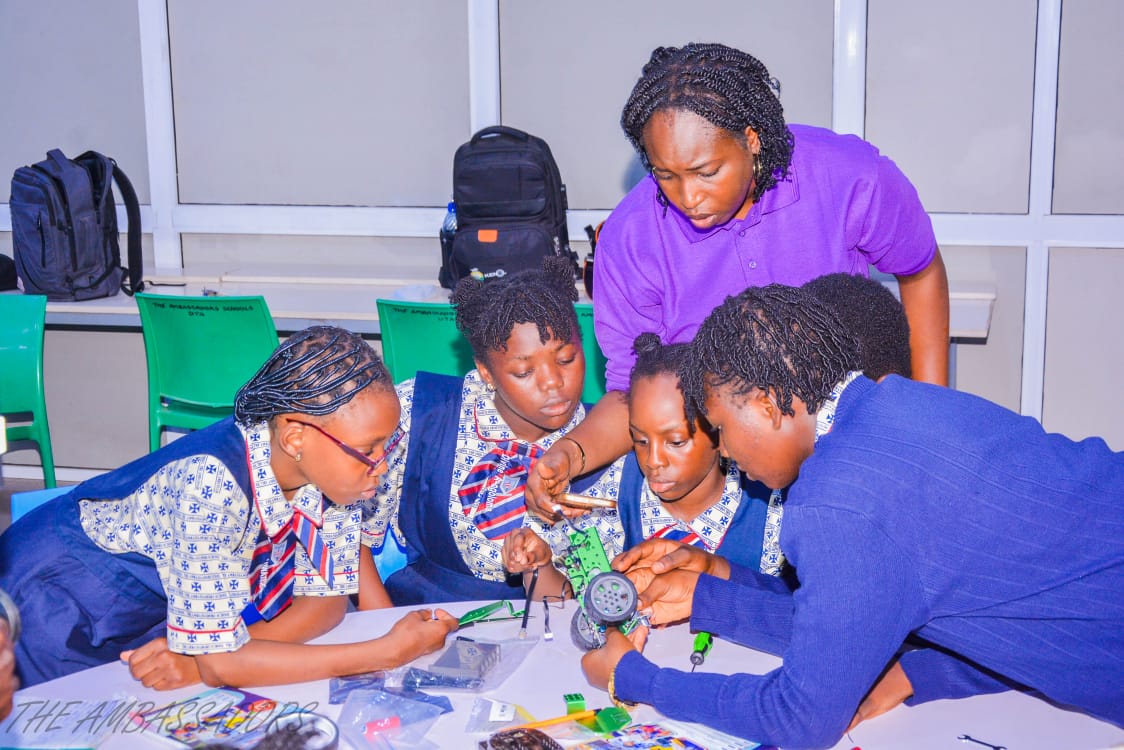
The training workshop was hosted for 25 high school girls of Ambassadors College, Ota, Ogun State, with a strong focus on breaking gender barriers in science and technology. Participants were guided through hands-on robotics concepts designed to spark curiosity, confidence, and creativity in STEM-related disciplines.
The event was put together under the First Livonia/SWE/APWEN Robotics Outreach initiative and was led by Engr. Dr. Imhade Princess Okokpujie, MNSE, an Associate Professor of Mechanical Engineering at Afe Babalola University, Ado-Ekiti (ABUAD). As Team Leader of the outreach in Nigeria, Dr. Okokpujie has been at the forefront of initiatives aimed at increasing female participation in engineering and technology.
Speaking during the workshop, Dr. Okokpujie described the programme as “a deliberate effort to catch young girls early and show them that engineering and robotics are not abstract ideas, but practical tools they can master.” She noted that confidence, not intelligence, is often the missing link for girls in STEM, adding that exposure is key to closing that gap.
“This training is designed to introduce these girls to the fascinating world of robotics in a practical, engaging, and inspiring way,” she said. “When they see themselves building and controlling robots, they begin to imagine themselves as future engineers, innovators, and problem-solvers.”
Several facilitators joined the session virtually from the United States, providing technical guidance and encouragement. Among them were Jenifer Morikawa, Patty Novak, Isiah Hon Tony, and Reagan Spurlock, which make up the First Livonia Warriors Robotic in USA, who worked closely with the Nigerian students as they assembled components and tested robotic functions. Engr. Sylvia Kelechi PhD was also present Virtually as the APWEN/SWE representative in USA for this program.
The APWEN Robotics Outreach team in Nigerian was fully on ground, has the Technical Team to guide the students in this training which include Engr. Dr. Tolulope Erinosho FNSE, Engr. Dr. Olufunmilayo Joseph, and other APWEN Ota member
Morikawa commended the students for their enthusiasm and quick learning, noting that “the level of engagement we saw from the girls in Nigeria shows that talent is universal, even when opportunities are not.” She added that virtual collaboration has made it easier to bridge gaps and share knowledge across borders.
Another facilitator, Reagan Spurlock, described the experience as deeply rewarding. “Watching these students collaborate, ask questions, and solve problems in real time was inspiring,” he said. “It reinforces why early STEM education, especially for girls, matters so much.”
Beyond technical skills, The APWEN President Engr. Chinyere Nnenna Igwebe FNSE emphasised that the workshop was structured to strengthen teamwork, communication, and critical thinking. Students were encouraged to work in groups, troubleshoot errors, and jointly arrive at solutions, mirroring real-world engineering environments.
Organisers also highlighted that by participating in the programme, Ambassadors College is positioning itself as a strong advocate for gender-inclusive STEM education. The collaboration was described as a foundation for future partnerships between the school, the Society of Women Engineers (SWE), and the Association of Professional Women Engineers of Nigeria (APWEN).
According to the organisers, the initiative is not only about enriching classroom learning but also about opening students’ eyes to career possibilities in engineering, robotics, and technology-driven fields. They noted that early exposure helps demystify these careers and makes them feel attainable.
In closing, speakers agreed that the impact of the workshop extends far beyond the virtual classroom. By equipping young girls with essential technological skills and confidence, the programme contributes to building a more innovative, knowledgeable, and equitable society, while nurturing a new generation capable of addressing both local and global challenges through science and technology.