Follow Us on Google

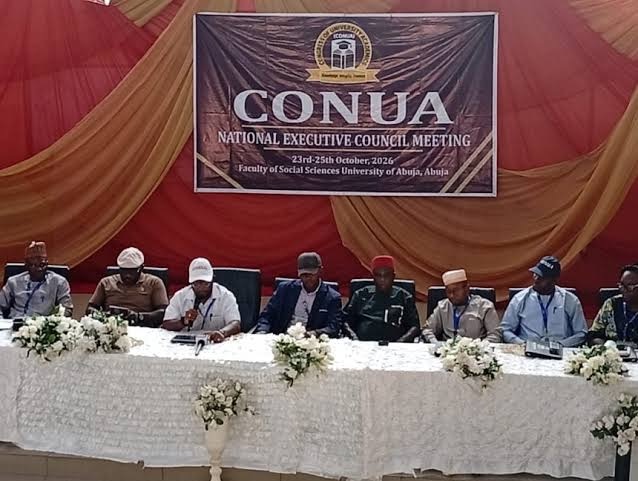
From Juliana Taiwo-Obalonye and Francis Onyedikachukwu, Abuja
The Congress of University Academics (CONUA) has warned the Federal Government of possible industrial action over its failure to conclude a collective bargaining agreement with the union and settle outstanding salaries and other entitlements owed to university lecturers.
The union, which demanded immediate payment of three and a half months’ withheld salaries, promotion arrears and outstanding benefits arising from the 25 and 35 per cent wage awards, declared that its preference for dialogue should not be mistaken for weakness or unwillingness to defend its members.
Its National President, Niyi Sunmonu, issued the warning on Saturday, October 24, following the union’s National Executive Council (NEC) meeting at the University of Abuja, where members reviewed the prolonged negotiations with the government and unresolved welfare issues affecting university academics.
The union expressed dissatisfaction with the handling of the proposed Federal Government of Nigeria–CONUA Agreement, whose latest draft was produced in September 2026, accusing the authorities of failing to demonstrate sufficient commitment to its conclusion.
“The welfare and legitimate entitlements of academics are obligations to be honoured, not favours to be granted,” the union declared.
It maintained that the recognition of CONUA as a trade union must go beyond official pronouncements to meaningful collective bargaining and a binding agreement that guarantees the rights and welfare of its members.
Sunmonu said the union had consistently demonstrated its preference for peaceful engagement but warned that continued delays could undermine industrial harmony in the university system.
“Our commitment to dialogue must not be mistaken for a lack of resolve,” the union stated.
He urged the Federal Ministries of Education and Labour and Employment, alongside other relevant negotiating authorities, to conclude the agreement without further delay.
The union insisted that university lecturers should not continue to suffer financial uncertainty arising from unpaid salaries, promotion arrears and the inconsistent implementation of approved benefits.
It demanded the immediate settlement of all verified outstanding entitlements, including arrears from the 25 per cent and 35 per cent wage awards, while urging government authorities and university managements to maintain transparent payment records and communicate clearly with affected staff.
CONUA argued that the failure to honour approved financial obligations had compounded the economic difficulties confronting university academics and weakened confidence in the collective bargaining process.
The union warned that continued delays in resolving the outstanding issues could compel it to explore lawful industrial options to protect the interests of its members.
However, it maintained that its immediate priority remained the conclusion of negotiations and peaceful resolution of the dispute.
Other News
The Trade Union Congress (TUC) also backed CONUA’s demands, calling on the Federal Government to conclude and sign the proposed agreement without further delay.
TUC Secretary General Nuhu Toro, who expressed solidarity with the union, insisted that collective bargaining agreements were serious commitments that must be honoured rather than treated as political favours or administrative conveniences.
He warned that the wider labour movement would not tolerate unnecessary delays by government agencies and university authorities responsible for concluding the agreement.
Beyond the salary dispute, CONUA raised concerns over what it described as the exclusion of its members from important university education programmes and consultative structures.
It specifically demanded fair representation in initiatives associated with the Tertiary Education Trust Fund (TETFund) and the Needs Assessment intervention programme, arguing that excluding recognised academic stakeholders undermined institutional fairness, transparency and accountability.
The union also called for increased public investment in university education, warning that inadequate funding and deteriorating infrastructure continued to undermine teaching, learning and research.
It identified reliable electricity, internet connectivity, functional laboratories, modern teaching facilities and accelerated digital transformation as essential requirements for improving the quality of university education.
CONUA further condemned reported cases of institutions temporarily hiring or renting academic staff and equipment to satisfy accreditation requirements.
It warned that such practices could create a misleading impression of institutional capacity while concealing deficiencies in staffing, facilities and equipment.
The union urged university managements and regulatory authorities to ensure that accreditation exercises reflected the actual and sustainable capacity of institutions to deliver approved academic programmes.
On national issues, CONUA called for peaceful, free and credible elections, urging political parties and candidates to prioritise security, electricity, education, employment and economic development in their campaigns.
It also urged the Independent National Electoral Commission (INEC) to conduct an impartial electoral process that would reflect the will of voters.
Expressing concern over insecurity, the union called on governments and security agencies to strengthen intelligence gathering, improve operational coordination and respond more effectively to terrorism, banditry, kidnapping and communal violence.
CONUA reiterated its commitment to defending the welfare and professional interests of university academics through collective bargaining and lawful means, warning that industrial harmony could only be sustained when the government honoured its obligations and treated recognised unions fairly.