Follow Us on Google
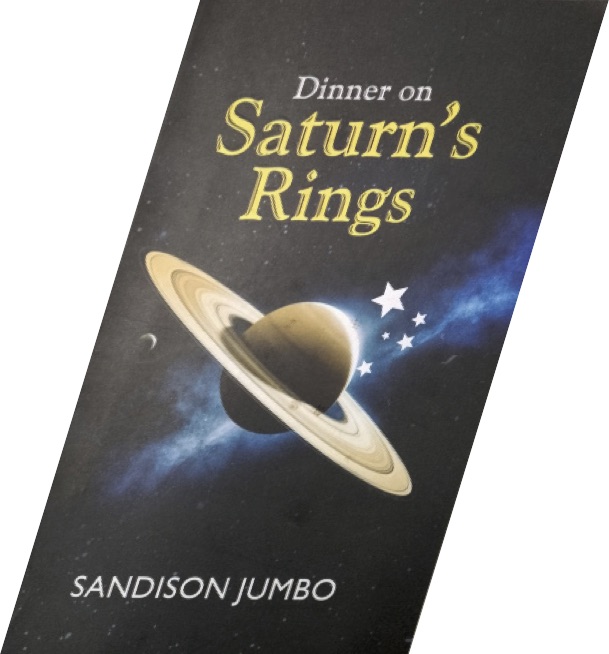
title: Dinner on Saturn’s Rings
author: Sandison Jumbo
publisher:Kraft Books
pagination: 86
Year opublication: 2024
reviwer: Henry Akubuiro
A book in five parts, Dinner on Saturn’s Rings teems with poems written by a cultured mind. From philosophical thoughts, religion, reflections, celebration of nature to love and joy, Sandison Jumbo’s poetry unfurls verses and layers that bellows attraction. Life is a journey, and a traveller encounters ups and downs – never forget. But a touch of philosophy can yield a flight of cogitation for the bard with a flourish.
Jumbo sees himself, in the opening poem, “In Thrall”, as a minstrel with an unchained mind, one who subscribes to taking life easy in the midst of topsy-turvy. The thread continues in “The Power”, where the bard, in a philosophical note, lifts up the hope of anybody going down hill – “fate will not forever hatch/Dark patches to make life an unrelenting stringer”. The poem sanctions looking within, when in a maze, to draw from your inner strength. It echoes that “Adversities may visit but will not forever linger.” It is catechism that formed a robust poetic explorations.
Other personal lyrics in the first part include poems that appeal to our emotions. Jumbo’s “Unbound” and “Counsel of the Night Birds” are redemption songs for mortal man. The voice carols about unfettered freedom and blissful abandon. Jumbo varies his diction with Pidgin English. With this, he speaks to an audience in West Africa and Central Africa, familiar with this lingo. In “Make We Chop Life”, Jumbo blends lightheartedness with seriousness, adding rhyme schemes deliberately to enhance the euphony of the poem. The same lightheartedness is replicated in “Hope”, a one-verse poem that harps on replacing sorrow with joy.
For Jumbo, the world is big enough for everybody. He wants a world without rancour. In “Big Enough”, the bard advances peace, unity of purpose, selflessness, care for one another and compromise to make the world a better place. Hence:
Our humanity can change the world
Only if we all honestly discuss,
And realise as its power is unfurled,
That this world is big enough for all of us (p.19).
Jumbo uses mild pillories in some of his poems like “I Want to Stop Being a Nigeria” and “Should We?”. The former appears to suggest he wants to renounce his Nigerian citizenship. Ironically, he wants to be a Nigerian but one that doesn’t have any baggage attached to him, an exemplary citizen. The poet doesn’t feign all is well in “Should We?”, where he bemoans that abnormality has taken precedence over the normal. The poem is an indictment on the laxity of Nigerians to overcome recurring adversities carried over from one political party at the helm of national affairs to the other. The poet suggests that the power to redeem the image lies in the voting power of the electorate.
The second part of the poem, with overt religious themes, recognises that there are forces residing outside the human province with spiritual powers. Witticism is an embroidery that Jumbo uses to fly the kite of the opening poem, “Prayer”, in this section – an admonition to Christian against hypocrisy, using self-criticism as a lamp. The speaker in this poem, criticises himself for praying too loud when God isn’t hard of hearing and speaking in tongues when he barely understands what he is saying. He makes a case for genuine repentance and evangelism in “The Call”. Jumbo’s descriptive power magics enchanting symbols, drawing a nexus between the soul and the temple in “The Old Village House”. The decrepit building hangs on an iron headstock like an oversized fruit on a sturdy branch. In this building, “The way to heaven begins at cracked steps”, with many people not bothered by its structural shortcomings. The main path is a worn, dusty-brown rug…”flanked by long rickety pews”. The pretentiousness of man before the pulpit is illustrated in: “Men try to appear blameless before ‘God’s men’.”
The poet uses “Fate of the Faithful” to indict the putridity of the church, the very antithesis Christendom disparages. Describing the church as “the lighthouse” that once guided ships – the spiritual essence of man – with sacred truth, the poet laments it has been replaced with lies and mockery. Thus: “The holy place of service and congregation, /Where redemption was taught to be by grace,/ Is now a marketplace for trading salvation,/ With the wealthiest crowned winners of the race.” The poet decries that men of God are playing God to earn perpetual loyalty from the congregation. He laments that the devil is now cohabiting with the church, miracles laced with magic, plus the exploitation of gullible congregations by preachers now rife.
The Memories section of the collection teems with reflections and recollections. Regeneration echoes in “Three Generations”. Procreation and the joy of having offspring that birth another generation is recreated with delight. Many of the poems in this collection are experiental. The poet draws from his sociological homebase to offer snippets of life, past and present. He entrals the reader with bewitching tropes. Take for instance, “Bonny Island”, an ode dedicated to Bonny, his hometown. It revisits the fragile topography of the locale and its invisibility to natural aggression due to its proximity to the Atlantic Ocean, which “Laugh and make vain in perpetuity/ Her attempts to blot you out of sight.” The defiance of the island to bulk before the elemental prey is further highlighted by “taunting, thundering (the) waves”. In spite of the routine rainfalls on the island, Bonny, says the poet, has remained unrattled by the deluge; rather, it has contributed to a rich vegetation. He, however, lampoons Bonny that, unlike in the past, when the town was a thriving trade center, its contemporary, modest development is just a reflection of crumbs from multinational companies. It charges Bonny, therefore, to “create its own trade winds.”
Jumbo’s array of images is like a soothing balm on a calloused hand. Without saying much in elliptic verses, he speaks volumes with symbolic objects at his disposal. A coquettish persona in the poem, “Stiletto Life”, passes from being a spellbinder to being a rickety wheel. As she dances on the street with high heels, cars passing by do not care to give her a lift. The poet colours the poem with striking images, like “Sashaying in simple harmonic motion”, “cool, breezy drizzle”, “age-stiffened necks creak and turn”, ” horizontal trail of hair”, “pencil-thin heels,” etcetera. h
The concluding parts of Dinner on Saturn’s Ring are dedicated to nature and love. From the monstrous dragonfly on a grassy field to icebergs – “looming in white and glorious might” … ( which) “heralds of the god of showers” – and delicate and ravishing little butterflies, the poet celebrates God’s creations, many which do not have the same voice like humans. The Clock, the best timekeeper in the world and the Kite that soars high in the sky, are venerated, too.
For love stirs different emotions, the poet talks about salted kisses, beauty and the beast, the bough and Myra. “Corona-ted” recalls the tragedy that visited the world a few years ago, when humanity was imprisoned, unable to mingle on account of the killer virus exported to every nook and cranny, mistakenly, from Wuhan, China. This poem, written in anticipation of the end of the pandemic, tells us that nothing compares to freedom. There are no shackles to limit everybody at the same time, naturally; but the vulnerability of man to external visitations runs deep in the fabric of this poem, a testament to the fact that man isn’t supreme. For sure, Jumbo has gifted the literati with a new poetry collection that seduces and amazes. It makes a good reading for both the young and old.