Follow Us on Google
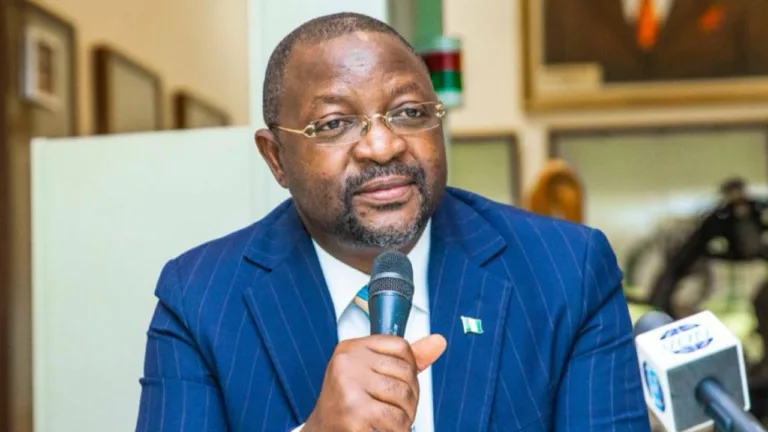
President Bola Tinubu’s reforms are breathing life into Nigeria’s economy, though the road to recovery is far from smooth.
Special Adviser to the President on Media and Public Communication, Mr. Sunday Dare, stated this at a lecture.
Delivering a public lecture on Nigeria’s Fourth Republic, Dare pointed to the significant strides made by the Tinubu administration in correcting economic distortions and promoting fairness.
However, he emphasised that unity and democratic maturity are crucial to sustaining progress.
Dare cited several positive indicators, including a decline in inflation from 33.38 per cent in 2024 to mid-teens (around 15%), improved GDP growth, and a non-oil trade surplus of ₦6.1 trillion.
He also mentioned the removal of fuel subsidies, unification of exchange rates, and increased foreign reserves that have contributed to the economic turnaround.
On the Gross Domestic Product (GDP), he stated that growth improved from 3.2 to 3.4 per cent to around 4.0 to 4.1 per cent, with the World Bank projecting about 4.4 per cent if reforms continue.
“According to the IMF 2026 projections, Nigeria’s 4.4 per cent growth compares favourably with:
United States (2.4 per cent), Germany (1.1 per cent), United Kingdom (1.3 per cent).
Other News
‘Nigeria now ranks in the upper tier of emerging-market growth, achieved through correction rather than commodity windfalls,” he stated.
Despite the gains, Dare acknowledged that Nigerians still face significant challenges, including poverty, unemployment, and insecurity.
He emphasised the need for sustained reforms, national cohesion, and effective governance to address the issues.
“President Bola Ahmed Tinubu did not inherit a neutral economy. In fact, he did not inherit a perfect economy. He inherited a structurally unjust system—marked by elite currency arbitrage, subsidy capture, and fiscal indiscipline.
‘He dared to pull the trigger on the subsidy on oil and that on forex, and unleashed a regime of Reforms in several sectors of the economy,” he disclosed.
Dare noted that the country’s First Republic was marked by intense regional, tribal, and ethnic tensions, which ultimately led to the Nigerian Civil War.
The Special Adviser stressed that Nigeria’s history teaches a clear lesson of when soldiers entered politics when civilian leadership failed politically and economically.
He stressed that reform is not anti-democratic, but rather democracy’s insurance policy.
Dare urged Nigerians to join hands with the government to build a greater Nigeria. He also reiterated that unity is not an event, but a continuous policy choice, and that Nigeria’s future depends on leadership willing to reform systems, confront historical grievances, and build a democracy that works for all Nigerians.