Follow Us on Google

Former presidential spokesman, and member of the All Progressives Congress (APC) Presidential Campaign Council, Ima Niboro, has described President Bola Ahmed Tinubu’s newly unveiled 2027 election manifesto as a departure from traditional campaign promises, saying it represents a transition from difficult but necessary economic reforms to prosperity for ordinary Nigerians.
Niboro, also a former Managing Director of the News Agency of Nigeria (NAN), made the remarks during an extensive interview on TVC Breakfast on Wednesday, where he defended the administration’s economic record, outlined the government’s plans for employment and electricity, and dismissed suggestions of divisions within the President’s re-election campaign.
According to him, the manifesto, themed around the transition from reforms to prosperity, is fundamentally different from conventional political manifestos because it builds on policies and achievements already recorded by the administration.
“This manifesto is not your traditional manifesto. It is not a manifesto that simply says, ‘This is what I want to do.’ On the contrary, it is a kind of reverse manifesto,” he declared.
“It says, ‘This is what I have done, and this is what you are going to get from what I have done.’”
Niboro explained that the administration’s immediate priority was to translate macroeconomic stabilisation into improvements in the everyday lives of Nigerians.
“We are not moving into uncharted territory. This territory has already been charted. It has been mapped. Significant achievements have been recorded in the macroeconomic stabilisation of the country. The question now is: How do we move from the macroeconomy to the microeconomy?”
Addressing concerns about the cost of living, the campaign spokesman identified exchange rate stability as one of the administration’s most consequential achievements.
He recalled a period when unpredictable foreign exchange movements made it virtually impossible for traders to plan, with prices sometimes doubling within days.
“There was a period when you could buy a phone for ₦100,000 today and return the following morning to discover that the same phone was selling for ₦250,000. It was chaotic,” he said.
“Am I saying that things have become cheap? No. But I am saying that inflation has trended down from over 30 per cent to less than 14 per cent. And the target under this manifesto is 8 per cent.”
He argued that the President’s willingness to confront longstanding economic distortions, particularly the foreign exchange regime, demonstrated a commitment to Nigeria’s long-term future.
“Politicians look towards the next election, while statesmen look towards the next generation,” Niboro said, maintaining that Tinubu could have preserved a system that enabled privileged individuals to profit from foreign exchange arbitrage but chose instead to pursue reforms.
On the manifesto’s target of achieving 6 per cent annual GDP growth, Niboro expressed confidence that improved economic predictability would attract investment and accelerate expansion.
“The most important fundamental in a thriving economy is stability. Stability is predictability,” he said.
“If your external partners know that they are dealing with an economy that is stable and predictable, growth follows naturally. People will bring their money. They will bring their resources. They will invest.”
He cited improved assessments by international rating agencies and growing interest from major financial institutions as evidence of increasing investor confidence.
Asked whether the 6 per cent growth target was overly ambitious, Niboro responded that Nigeria possessed the potential to surpass it.
“If I were the one setting the target, I might even add another one or two percentage points,” he remarked.
Turning to employment, the former presidential spokesman said the administration’s plans to train two million young Nigerians and create one million export-linked jobs would be driven principally by private-sector expansion rather than direct government recruitment.
“Government is not the employer of choice. Government’s primary responsibility is to create the enabling environment in which employment can thrive,” he explained.
“To export, you must first produce. To produce, you must employ people. That is how employment is generated.”
He argued that the growth of non-oil exports, alongside reforms aimed at reducing multiple taxation and arbitrary levies, would strengthen businesses and encourage job creation.
Drawing from his experience as a business owner, Niboro said excessive levies had previously placed enormous pressure on small enterprises, particularly in Abuja and Lagos.
“If I am no longer spending half of my income paying levies whose destinations I cannot even explain, I can use that money to expand my business. I might even employ another 40 people,” he said.
He nevertheless acknowledged the government’s role in direct employment, citing plans to recruit additional military and police personnel.
On electricity, Niboro attributed Nigeria’s persistent power challenges to decades of underinvestment, arguing that successive administrations had failed to expand generation capacity sufficiently to meet the country’s growing needs.
“If every government, over all those decades, had added just 1,000 megawatts of electricity generation capacity every year, where would we be today? We would have been producing more than 60,000 megawatts,” he said.
Using a building analogy, he explained that the administration was confronting the difficult task of rehabilitating an ageing power system while simultaneously expanding capacity.
“It is easier to build a new house than to renovate an old one. When you are renovating an old house, you must first break down sections of the existing structure. You spend money demolishing what is defective, and then you spend more money rebuilding.”
He said the administration was pursuing alternative energy sources, including solar power, while addressing legacy debts that had undermined investment and financial viability in the electricity industry.
Although acknowledging that electricity remained expensive for many households and businesses, Niboro maintained that resolving structural problems would ultimately improve reliability and affordability.
On the political front, the campaign spokesman dismissed suggestions that rivalry between state governors and the Rainbow Coalition associated with Federal Capital Territory Minister Nyesom Wike was undermining Tinubu’s re-election campaign.
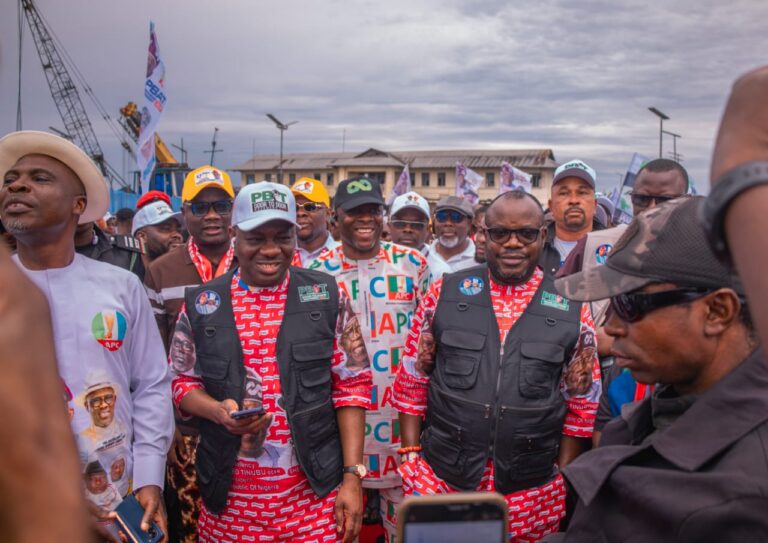
He pointed to the APC presidential rally in Port Harcourt as evidence of growing unity among the President’s supporters.
“Have you seen any friction? Or have you not seen the tremendous show of unity across the country?” he asked.
“Look at what happened in Port Harcourt. Everybody was working together in one direction. Whether it was Governor Siminalayi Fubara or Nyesom Wike himself, everybody was united in support of the President.”
Niboro said he had predicted that disagreements among political stakeholders would eventually give way to cooperation once the campaign gathered momentum.
He urged governors and other political leaders to concentrate on grassroots mobilisation rather than public disagreements.
“Don’t just go to television stations and blow grammar. Go to your base and deliver. That is what matters,” he declared.
In his closing remarks, Niboro rejected suggestions that the President’s political courage alone was insufficient justification for another term, insisting that the administration had already demonstrated measurable progress.
“You don’t change a winning team! That is my answer,” he declared.
“This team has done fantastically well. It has pulled Nigeria back from the edge of the precipice.”
He contrasted the financial difficulties faced by previous administrations with what he described as improved fiscal conditions under Tinubu, particularly increased resources available to state governments.
“Governors now have substantially more money. They can pay salaries. They can pay pensions. They can pay gratuities. And they still have resources to build flyovers, construct highways and undertake other development projects.”
Niboro concluded that the President’s second-term campaign would be anchored on consolidating economic stability, expanding opportunities and ensuring that Nigerians increasingly experienced the benefits of reforms.
“It is a big, bright new day for Nigeria,” he said.