Follow Us on Google

By Chukwuma Umeorah
Afrinvest West Africa has cautioned that President Bola Tinubu’s $1 trillion economy target by 2031 faces significant structural challenges that could derail progress unless decisive reforms and institutional discipline are enforced.
In its 2025 Nigeria Banking Sector Report (BSR), themed “ACT-BOLD: Beyond a Trillion-Dollar Economy” and released in Lagos recently, Afrinvest explained that with a rebased GDP nominal size of N372.8 trillion ($251 billion at N1,484.99/$1 in 2024), the country requires an annual growth rate of at least 21.95 per cent or a stronger exchange rate to achieve the trillion-dollar milestone.
The report warned that without addressing longstanding impediments such as insecurity, large-scale oil theft, fiscal opacity, and weak institutional execution, the economy will continue to deliver uneven growth. “Without such intermediation, banks would only deliver, at best, uneven and subpar growth across a few services-based sectors, while the overall economy continues to grow at a slow pace,” the report stated.
Speaking at the event which also marked the 30th Anniversary of the firm, Afrinvest Group Managing Director, Dr Ike Chioke, described the report as a guide for policymakers, investors and institutions navigating the Nigerian economy.
“Each of the past 20 editions provides clarity in moments of uncertainty and ambition in times of reform. This 20th edition is both a call to action and a framework for Nigeria’s growth,” he said.
Afrinvest noted that while the financial services sector expanded by 15.9 per cent in Q1 2025, agriculture and manufacturing grew by only 0.1 per cent and 1.7 per cent respectively, reflecting weak performance in labour-intensive industries critical to job creation.
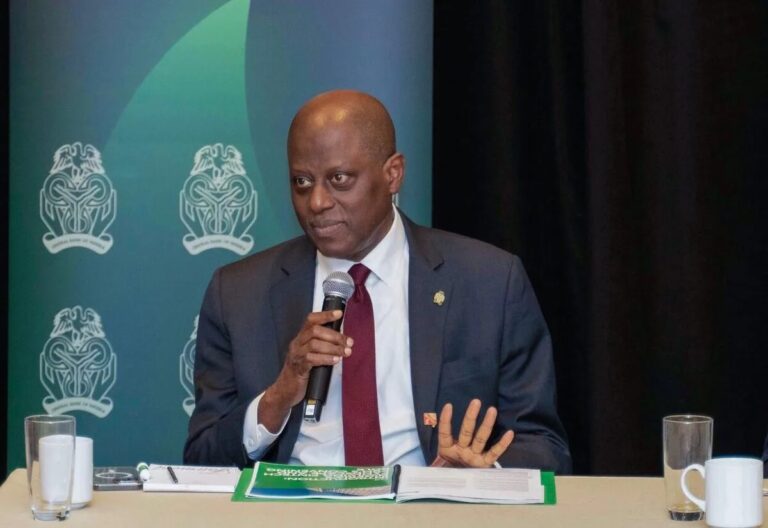
On monetary policy, the report highlighted that the Central Bank of Nigeria (CBN), under Governor Olayemi Cardoso, raised the Monetary Policy Rate (MPR) by 875 basis points to 27.5 per cent in 2024, alongside increasing the Cash Reserve Ratio (CRR) to 50 per cent. These measures tightened liquidity and slowed credit growth but helped restore some stability to the foreign exchange market.
The report further underscored the importance of the ongoing recapitalisation exercise in strengthening banks’ capacity to support economic expansion. “As of mid-2025, our estimate suggests that banks have collectively raised over N2.5 trillion through rights issues, public offerings and private placements,” it stated. It added that at least four lenders including Access Corporation, Zenith Bank, Ecobank and Lotus Bank, have already met the new capital thresholds, while others are expected to comply before the June 2026 deadline.
Despite the tougher operating climate, Afrinvest reported that banks under its coverage delivered strong results in 2024. Pre-tax profit rose by 65.7 per cent to N6.2 trillion, while gross earnings increased by 85.6 per cent to N24.7 trillion. Interest income surged 122.9 per cent to N15.4 trillion, although operating expenses also rose sharply by 86.4 per cent to N7.5 trillion, with the non-performing loan ratio climbing to 5.5 per cent.