Follow Us on Google
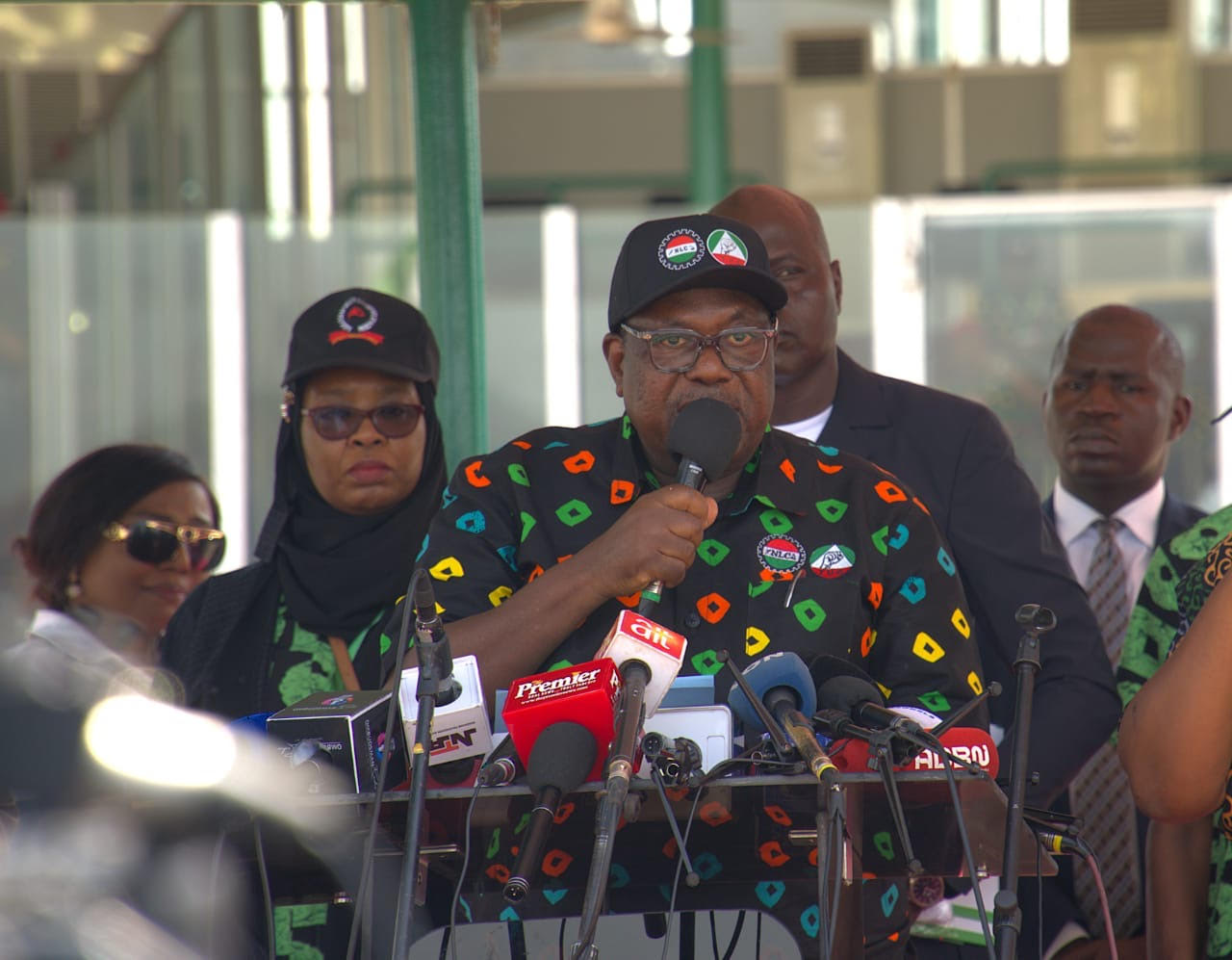
From Juliana Taiwo-Obalonye, Abuja
As labour unions threaten nationwide strikes over unpaid wages and deteriorating living conditions, President Bola Tinubu on Friday declared insecurity and poverty a “national emergency” that is crippling workers’ productivity and livelihoods, and called for dialogue over industrial action.
Speaking through the Secretary to the Government of the Federation (SGF), George Akume, at the 2026 Workers’ Day event in Abuja’s Eagle Square, Tinubu aligned his address with the International Labour Organization’s Decent Work Agenda theme.
In a statement by the Special Adviser, Media and Publicity to the SGF, Yomi Odunuga, President Tinubu told thousands of workers and labour leaders, including those from the Nigeria Labour Congress (NLC) and Trade Union Congress (TUC), that “there cannot be decent work where workers fear for their lives or where wages cannot feed a family.”
The plea comes amid escalating strike tensions, with the NLC and TUC recently issuing ultimatums over minimum wage implementation delays and rising insecurity disrupting farms, factories, and markets—issues workers say have fuelled job losses and hunger despite government interventions.
Tinubu acknowledged these as “significant obstacles” to a peaceful Nigeria where citizens can “sleep with their eyes closed,” but insisted his Renewed Hope Agenda is delivering results. He highlighted the Community Protection Guards Initiative, recruiting 45,000 youths for community security and job creation, alongside expanded cash transfers to 15 million households, lifting 7.5 million from poverty.
Tinubu explained that infrastructure projects, such as the Lagos-Calabar Coastal Highway and the Ajaokuta-Kaduna-Kano Gas Pipeline, have generated over 600,000 jobs, while workers’ welfare measures include a new national minimum wage, cleared pension arrears, gratuity payments from January 2026, micro pensions for 800,000 informal workers, and a ₦200 billion MSME fund.
Other News
Yet, in a direct appeal to strike-prone unions, Tinubu warned: “Strike should be the last resort, not the first.” He urged “sustained dialogue and restraint in industrial disputes,” commending security forces whose sacrifices have improved safety for economic growth.
The President reaffirmed multi-pronged anti-poverty efforts, including the National Agricultural Growth Scheme-Agro-pocket (NAGS-AP), Dry Season Farming Schemes, mechanisation drives, post-harvest management, Bank of Agriculture support, and 10,000 NSCDC Agro-Rangers protecting farmers in 19 states.
“There cannot be decent work where workers fear for their lives, where wages cannot feed a family, or where insecurity disrupts farms, factories, markets, and other economic activities. These hydra-headed challenges, the government notes, have been treated as a national emergency due to their impact on productivity, livelihoods, and the confidence of both workers and employers,” he stated.
“The administration also acknowledged that insecurity and poverty remain major obstacles to building a peaceful Nigeria where citizens can ‘sleep with their eyes closed,’ and to achieving the Decent Work Agenda as envisioned by the International Labour Organization.”
Despite challenges, Tinubu promised Nigeria is “on course to defeat insecurity and reduce poverty,” vowing “decent work is not a privilege for a few, but a reality for all.”
“To you our dear workers, I say this clearly; your welfare remains a priority. We are committed to improving working conditions, promoting fair wages, and ensuring that every Nigerian worker enjoys dignity, safety and equal opportunity in the workplace; hence, the recent reactivation of the payment of gratuity to Nigerian workers with effect from January 2026.”