Follow Us on Google
N4.5trn additional revenue’ll support economic diversification –Bagudu
By Adesuwa Tsan, Abuja
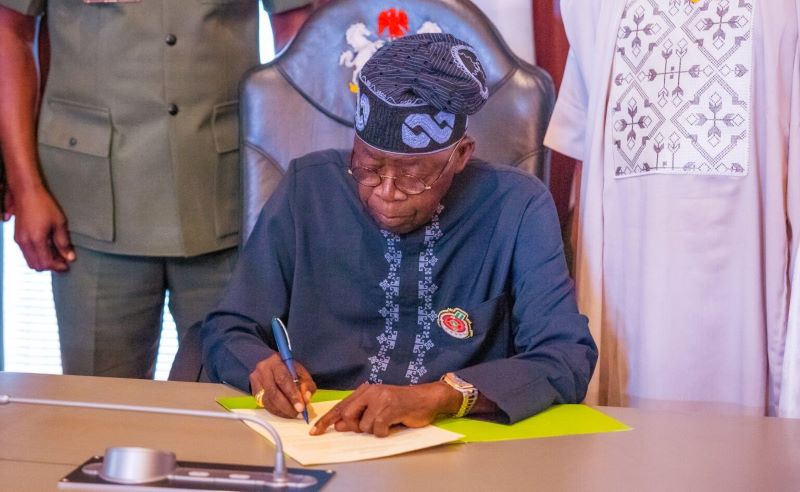
President Bola Tinubu has officially notified the Senate of an increase in the proposed 2025 Appropriation Bill from N49.7 trillion to N54.2 trillion, following the discovery of an additional N4.53 trillion in revenue.
The President communicated this adjustment in separate letters to both chambers of the National Assembly. It was read during plenary by Senate President Godswill Akpabio, yesterday.
The increase, he explained, was due to additional revenues generated by the Federal Inland Revenue Service (FIRS) (N1.4 trillion), Nigeria Customs Service (NCS) (N1.2 trillion), and other Government-Owned Enterprises (GOEs) (N1.8 trillion).
In his remarks, Akpabio said Tinubu’s move on the budget increase was ‘totally uncommon’.
“The transparency must be applauded; this could have been done even at the level of the ongoing committees on appropriation, both in the Senate and the House of Representatives without Mr President naturally writing to us.
”But as a sign of respect for the hallowed chambers, he decided to put it in writing, exposing the additional revenue, explaining areas of interest, and at the same time justifying it.
“So we commend Mr President for this level of transparency, and we assure him that within this month of February, we will incorporate this and ensure that the 2025 budget is passed.
“So Mr President, I’d like to commend you,” he said.
Akpabio consequently referred the document to the Committee on Appropriations for further expeditious legislative inputs.
A breakdown of the proposal shows N4.53 trillion to key sectors to drive economic diversification, infrastructure development, and national security. The solid minerals sector was allocated N1 trillion “to unlock Nigeria’s vast mineral resources, reduce reliance on oil, and create alternative revenue streams.”
Bank of Agriculture recapitalisation got N1.5 trillion to enhance food security, empower smallholder farmers, and promote agro-industrial value chains while Bank of Industry recapitalisation got N500 billion to support small and medium enterprises (SMEs), boost local manufacturing, and reduce import dependence.
Infrastructure development got N1.5 trillion while irrigation development got N380 billion to support year-round farming and ensure water security.
N700 billion was allocated for transportation infrastructure including N300 billion for roads and N400 billion for urban rail networks. Border communities infrastructure got N50 billion to enhance security and foster economic development while security, military barracks accommodation was allocated N250 billion to improve housing for security personnel and military aviation was allocated N120 billion to modernise military air capabilities.
Other News
President Tinubu justified the allocations to the military, stating that no progress can be made without security. He emphasised that investing in the armed forces was a moral and economic necessity as national security remains the foundation of economic stability and development.
He urged the National Assembly to adopt and integrate the revised budget proposal, reaffirming his administration’s commitment to inclusive growth, economic diversification and national security.
Meanwhile, Minister of Budget and Economic Planning, Atiku Bagudu, has said the N4.5 trillion additional revenue would support the diversification programme of the administration including strengthening the Bank of Agriculture (BoA), Bank of Industry (BoI) and support the diversification programme by putting more money in the solid minerals sector as well as infrastructure projects.
“You will recall Mr President submitted a N49 trillion budget to the National Assembly and legislative work commenced.
“The legislative work continued with interactions between the executive and the National Assembly, and the National Assembly and the Economic Management Team continued to interrogate all the figures.
“In that process, the Senate Committees on Appropriation, National Planning and Finance established that we can generate more revenue by tasking all the institutions to do more.”
The minister said the Federal Inland Revenue Service confirmed that the government-owned enterprises as well as the Customs Service could contribute more revenue.
“So, additional revenue amounting to over N4.5 trillion was established, and this was taken to the President.
“He directed that this additional revenue be used to further strengthen the Bank of Agriculture, Bank of Industry, and support the diversification programme by putting more money in the solid minerals sector and infrastructure projects.”
On the Medium Term Expenditure Framework (MTEF) adjustment, he said even when the budget was submitted, the MTEF was amended.
“The MTEF that was initially approved was for a budget of less than N49 trillion. So, it goes together and so the consequential amendment to the MTEF will certainly follow,” he said.
The 2025 budget prioritises key areas such as defense and security (₦4.91 trillion), infrastructure (₦4.06 trillion), education (₦3.52 trillion), and health (₦2.48 trillion). It also aims to reduce inflation from 34.6 percent to 15 percent and stabilise the naira exchange rate at ₦1,500 per dollar.
The 2025 budget reflects a 41.9 percent increase from the previous year’s ₦35 trillion allocation. However, it comes with challenges such as a projected deficit of ₦13.39 trillion, which will be financed through debt (69 percent), loans (28 percent), and asset sales (2 percent). Despite these hurdles, Bagudu expressed confidence in the government’s ability to meet its ambitious revenue target of ₦36.35 trillion through improved tax administration and reforms in revenue-generating agencies.
“This is an ambitious but necessary budget to secure our future,” President Tinubu had remarked during its presentation in December 2024