Follow Us on Google
From Juliana Taiwo-Obalonye, Abuja
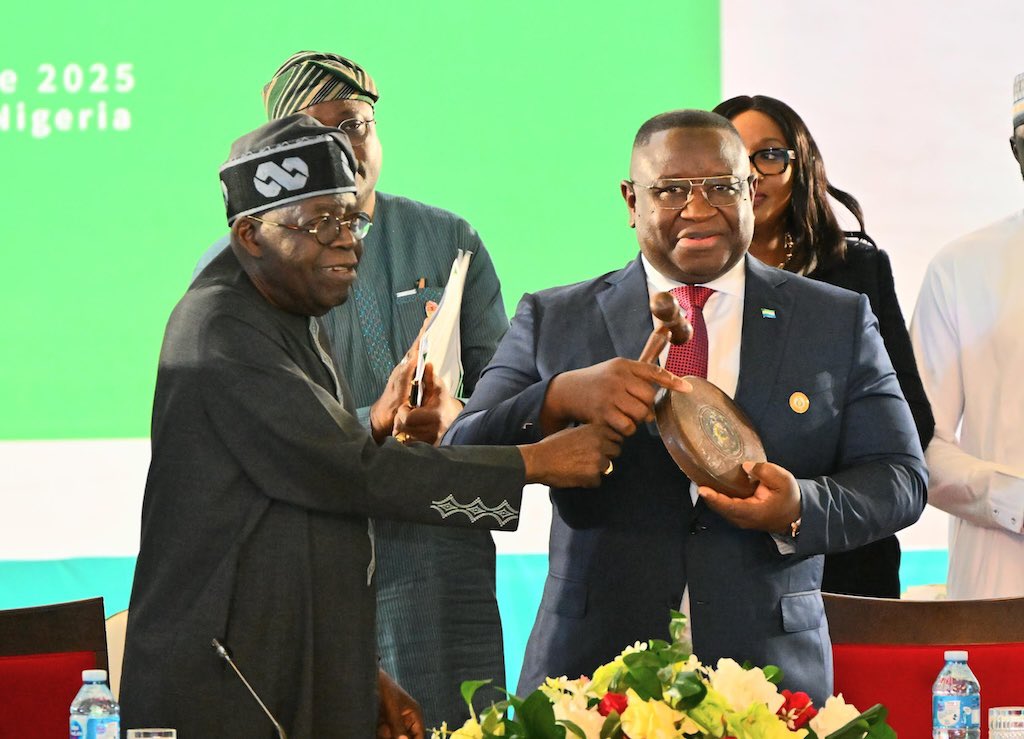
Nigeria’s President Bola Tinubu has formally handed over the chairmanship of the Economic Community of West African States (ECOWAS) to President Julius Bio of Sierra Leone during the 67th Ordinary Session of ECOWAS held at the Conference Centre, State House, Abuja yesterday.
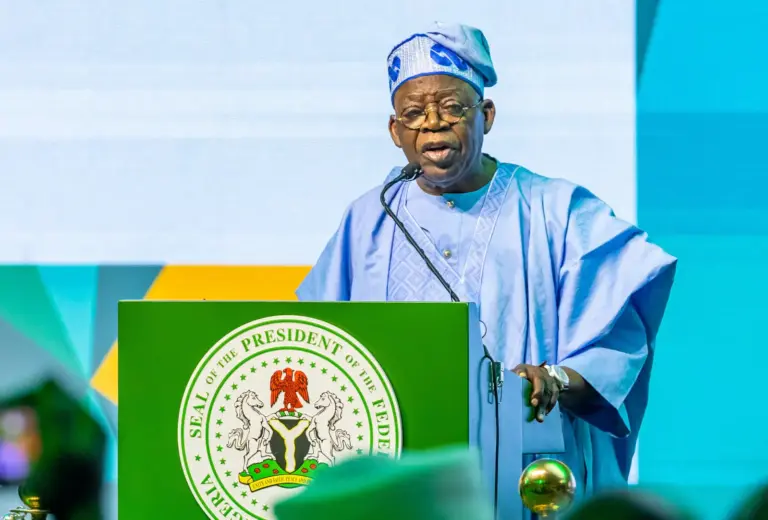
President Tinubu presented the ECOWAS chair emblem to President Bio, assuring the regional bloc of continued unity and growth. Reflecting on his tenure, Tinubu said: “The era of warm pit to the port must end. We must turn our mineral wealth into domestic economic value, jobs, technology and manufacturing. To be resource-rich is not enough, we must become value chain smart and invest in local processing and regional manufacturing.”
He began by expressing his deep gratitude for the trust placed in him. “Please permit me to express my profound gratitude for the confidence you’ve placed in me to serve as chair of the Authority, not once, but twice. It has been a profound honour and privilege to lead this esteemed body, and I remain deeply humbled by this trust and support you have extended to me throughout my tenure,” he said.
Before handing over leadership to President Bio, Tinubu conveyed a strong sense of fulfilment and optimism, saying, “I do so with a deep sense of fulfilment and optimism for the future of West Africa. I remain confident that with the continued cooperation of all its members, ECOWAS will scale over greater heights in our collective pursuit of peace, security, stability and prosperity for our people and for our region.”
Reflecting on the challenges faced during his tenure, President Tinubu acknowledged the complex political transitions and security threats confronting the region. “In the course of the past few years, we have faced complex regional challenges, political transitions and security threats. I thank every one of you,” he remarked.
Looking ahead, he urged member states to remain vigilant and responsive to the evolving needs of their citizens. “As we look to the future, I urge all of you to remain vigilant and responsive to the evolving need of our people. Let us deepen the cooperation, uphold diplomatic principles and foster inclusive growth that leaves no one behind, especially our youth, women and vulnerable population who remain central to the future of our region.”
President Tinubu highlighted the delicate balance ECOWAS must maintain between economic integration and addressing political, security and governance challenges. “Our organisation must continue to strike a fine balance between its core regional mandate of economic integration and the complex political security and governance challenges, including democratic values in our region. Economic integration cannot be superimposed on an untenable political environment. That is why we must remain steadfast in our resolve to rise to this and emerging challenges.”
He also expressed appreciation for the ECOWAS Commission and all supporting staff, acknowledging their tireless efforts in organising the session and advancing the bloc’s mission. “Let me also thank the ECOWAS Commission, the community institution and all technical and administrative staff for their tireless work in organising this session and supporting the work of our organisation,” he said.
He, therefore, called on all member states to remain committed to the shared vision of a prosperous and united West Africa. “As you return to your respective countries, let us remain resolute in our shared mission to deepen our integration, protect our people and build a prosperous, secured and united West Africa.”
Tinubu’s leadership was marked by a strong push for economic integration, peace-building, and regional cooperation.
He served two consecutive terms as chairperson of the ECOWAS Authority of Heads of State and Government, first elected on July 9, 2023, in Guinea-Bissau, and re-elected on July 7, 2024, in Abuja.
His re-election was a consensus among West African leaders to ensure continuity in the bloc’s efforts to tackle peace, security and economic challenges.
In his acceptance speech, President Bio vowed to prioritise restoring constitutional order, enhancing regional security and accelerating economic integration as he takes over the chairmanship of the Economic Community of West African States (ECOWAS) from President Tinubu.
He expressed deep gratitude and humility in accepting the responsibility. He said: “I accept this responsibility with full awareness of the magnitude and of the task ahead and also the complexity of the moment.”
Acknowledging the achievements of his predecessor, Bio praised Tinubu’s leadership, stating, “Your tenure was marked by unwavering commitment to regional dialogue, economic recovery and peace building. I’m humbled to build upon the strong foundation you have established. Thank you for your experience, leadership.”
President Bio painted a sobering picture of the current challenges facing West Africa, highlighting ongoing insecurity, political instability and economic difficulties. He said: “Our region is at a crossroads. We are still confronting insecurity in the Sahel and coastal states, terrorism, political instability, illicit arms flow and transnational organised crimes continue to test the resilience of our nations and the effectiveness of our institutions.”
He further noted the strain on democratic governance, observing, “The democratic space is under strain. In parts of our region, the constitutional order has been disrupted. Yet, across West Africa, citizens, especially our youths, are demanding not just elections, but accountability, transparency and a fair stake in national life.”
On the economic front, Bio acknowledged the multiple external shocks affecting the region, including inflation and food insecurity, saying, “Economically, our region is recovering from external shocks, including global inflation, food insecurity, energy constraint and debt vulnerabilities. These and many others continue to challenge us.”
He also underscored the urgent threat of climate change, warning, “The effect of climate change, coastal erosion, floods, droughts are no longer distant threats. They are disrupting livelihoods today and demanding bold adaptation strategies and sustainable investment.”
Despite these challenges, President Bio expressed optimism about the region’s potential, emphasising the strength of its people and resources, saying, “Our vibrant and youthful population, abundant natural resources and entrepreneur spirit remains our strongest asset.”
Looking ahead, he outlined his vision for ECOWAS as a “proactive, people-centred vehicle for peace, inclusion and opportunity.” He pledged to restore constitutional order and deepen democracy, emphasising the need to “engage transitional governments constructively and support member states in building stronger democratic institutions rooted in the rule of law.”
On security, he said he was committed to revitalising regional cooperation, stating, “We must overhaul our collective security architecture from intelligent sharing to rapid response to confront new threats with unity and resolve.”
Regarding economic integration, he highlighted the importance of regional trade and infrastructure, saying, “The ECOWAS liberalisation scheme, regional infrastructure and cross border value chains must become engines of job, trade and resilience, especially for our women and our youth.”
He also promised institutional reforms to enhance transparency and efficiency, declaring.
“ECOWAS must reform itself and become more transparent, efficient and responsive to its people’s needs. This is how we will rebuild the trust in regional cooperation,” he said
He called for unity and decisive action, saying, “I believe West Africa’s future is not one of decline, but of possibility if we act with courage, urgency, unity and moral clarity. Let us rise to the moment together, not as separate nations, but as a unified community of destiny. Thank you all, and may God bless us and our region, West Africa.”