Follow Us on Google
•As FG proposes N58.18trn budget for 2026 •Debt service to gulp N15.52 trillion •Defence and Security: N5.41 trillion; Infrastructure: N3.56 trillion; Education: N3.52 trillion; Health: N2.48 trillion
From Ndubuisi Orji and Adesuwa Tsan, Abuja
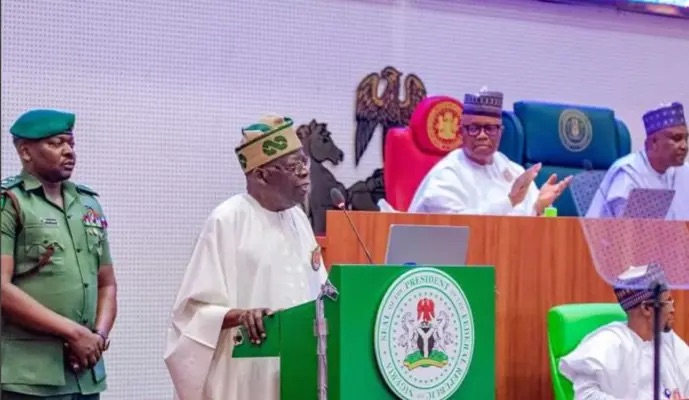
President Bola Tinubu has unveiled a budget of ₦58.18 trillion for the 2026 fiscal year, with an assurance that the Federal Government will reset the national security architecture.
President Tinubu, while addressing a joint session of the National Assembly, said the new security architecture would change how the country confronts terrorism and other violent crimes. He noted that going forward, non-state actors, who wield lethal weapons and their enablers would be treated as terrorists.
The President, who explained that ₦58.18 trillion estimate, consists ₦15.52 trillion for debt servicing; recurrent (non debt) expenditure, ₦15.25 trillion; and capital expenditure, ₦26.08 trillion, stated that ₦34.33 trillion is expected total revenue, with a budget deficit of ₦23.85 trillion, representing 4.28% of Gross Domestic Product (GDP).
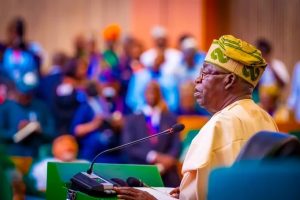
“These numbers are not just accounting lines. They are a statement of national priorities. We remain firmly committed to fiscal sustainability, debt transparency, and value for money spending,” he stated.
According to him, the budget projections are based on crude oil benchmark of US$64.85 per barrel; crude oil production of 1.84 million barrels per day; and, an exchange rate of ₦1,400 to the US Dollar.
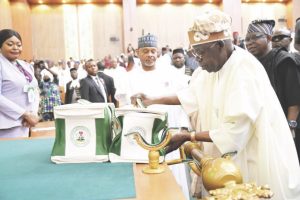
The President said the 2026 Appropriation Bill is guided by four objectives, including consolidation of macro economic stability, improved business and investment stability, promotion of job rich growth and poverty reduction; and strengthening of human capital and protecting the vulnerable.
According to him, “key sectoral provisions include: Defence and Security: ₦5.41 trillion; Infrastructure: ₦3.56 trillion; Education: ₦3.52 trillion; Health: ₦2.48 trillion.
“These priorities are interlinked. Without security, investment will not thrive. Without educated and healthy citizens, productivity will not rise. Without infrastructure, jobs and enterprise will not scale. This is why the Budget is designed as one coherent programme of national renewal.”
He noted that 2026 Appropriation with the theme “Budget of Consolidation, Renewed Resilience and Shared Prosperity” is not about promises but geared towards “ a more secure, more competitive, more equitable, and more hopeful Nigeria.”
The President, while giving an overview of the 2025 budget performance, noted that “our 2025 budget implementation faced the realities of transition and competing execution demands. As at Q3 2025, we recorded:₦18.6 trillion in revenue—representing 61% of our target; and ₦24.66 trillion in expenditure—representing 60% of our target.
“Following the extension of the 2024 capital budget execution to December 2025, a total of ₦2.23 trillion was released for the implementation of 2024 capital projects as at June 2025.
While fiscal challenges persisted, government met its key obligations.
“However, only ₦3.10 trillion—about 17.7% of the 2025 capital budget—was released as at Q3, reflecting the emphasis on completing priority 2024 capital projects during the transition period.”
Nonetheless, he added that “Let me be clear: 2026 will be a year of stronger discipline in budget execution. I have issued directives to the Honourable Minister of Finance and Coordinating Minister of the Economy, the Honourable Minister of Budget and Economic Planning, the Accountant General of the Federation, and the Director General of the Budget Office of the Federation to ensure that the 2026 Budget is implemented strictly in line with the appropriated details and timelines.” President Tinubu added that the 2026 budget would strengthen support for modernisation of the Armed Forces; intelligence driven policing, and border security, among others.
According to him, “we will invest in security with clear accountability for outcomes—because security spending must deliver security results. To secure our country, our priority will remain on increasing the fighting capability of our armed forces and other security agencies by boosting personnel and procuring cutting-edge platforms and other hardware.
“We are also pursuing a new era of criminal justice system to stamp out terrorism, banditry, kidnapping for ransom and other violent crimes. Our administration is resetting the national security architecture and establishing a new national counterterrorism doctrine—a holistic redesign anchored on unified command, intelligence, community stability, and counter-insurgency.
“This new doctrine will fundamentally change how we confront terrorism and other violent crimes that have become existential threats to our corporate survival and have heightened anxiety among our people.
“Henceforth, and under this new architecture, any armed group or gun-wielding non-state actors operating outside state authority will be regarded as terrorists. These include bandits, militias, armed gangs, criminal networks with weapons, armed robbers, violent cult groups, forest-based armed collectives, and foreign-linked mercenaries. Groups or individuals conducting violence for political, ethnic, financial, or sectarian objectives are also classified as terrorists.
“Members of any group extorting communities, kidnapping civilians, occupying or seeking to occupy territory within Nigeria will be classified as terrorists. The denominator is that if you wield lethal weapons and act outside the state’s authority, you are a terrorist.
“Any individual or entity that enables the listed groups as financiers, money handlers, harbourers, informants, ransom facilitators, and negotiators will also be classified as terrorists.
“Political protectors and intermediaries, transporters, arms suppliers, and safe-house owners will be declared as terrorists. Politicians, traditional rulers, community leaders, and religious leaders who facilitate and encourage violent actions and terror within Nigeria and against our citizens are also terrorists.”