Follow Us on Google
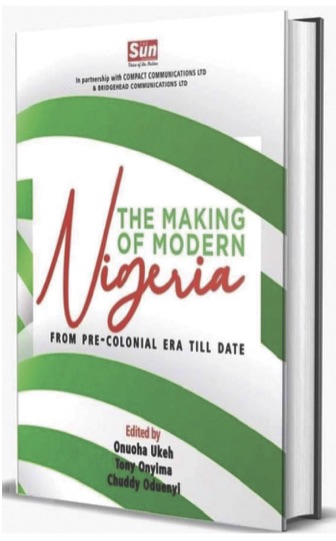
Title: The Making of Modern Nigeria: From Pre-colonial Era Till Date
Editors: Onuoha Ukeh, Tony Onyima and Chuddy Uduenyi
Reviewer: Kingsley Osadolor
Publisher: The Sun Publishing Limited
The Making of Modern Nigeria is the latest addition to the trove of publications on and about Nigeria’s history. The arrival of the newest entrant to the bookshelves might provoke the question whether there is a surfeit of published works on Nigeria’s history. The obvious answer is: No. History is perpetually in motion, on the run, as it were. New actors, significant events and occurrences, as well as the stimulation of scholarship, provide justification to hark back, to better illuminate what went on before, and in some cases set guideposts for future navigators.
The style of the authors of the work under review is not a deep-dive into each of the sub-themes of the principal subject matter. Rather, in capsule form, the authors provide nuggets of information and facts across a range of issues in history, politics, international affairs, governance, education, business, industry, sports, the media and arts. The work is largely descriptive and does not verge on the analytical. It is pacy, and therefore easy to read. The book refreshes the memory and bestirs nostalgic feelings about people, places and things long gone by. The Making of Modern Nigeria is a valuable quick-reference publication. Students, teachers, researchers and the general interest reader will find the book beneficial about Nigeria’s history.

The book is divided into six sections, and, save for sections five and six, which have two chapters apiece, the other sections are each sub-divided into three chapters. There are 332 pages in total, including the preliminary pages, and a very useful 10-page alphabetical index. The prestige of the work is leveraged by the Foreword, written by Atiku Abubakar, former Vice President of the Federal Republic of Nigeria, whose optimistic conclusion is that “the future is bright.” The Acknowledgement page discloses that The Making of Modern Nigeria was conceived to coincide with the country’s Diamond Jubilee in 2020, but that was blighted by the rage of COVID-19, which sent humanity into unprecedented lockdown mode.
Although it is indicated that the current work is a logical sequel to The Golden Book, also published by The Sun, in commemoration of Nigeria’s 50th independence anniversary, that organic linkage is missing in the absence of an introduction that briefly summarises the earlier publication and invites attention to the gaps the new book fills. But that does not in any way diminish the true worth of the latest work, which can conveniently be a stand-alone edition. The task the authors set for themselves is an immense editorial assignment. Having to comb a multiplicity of sources, identify which facts and data to accommodate, arrange them into relevant chapters and sections and make a meaningful bound volume is, without doubt, deserving of commendation.
Expectedly, Section One begins with a brief on the cobbling together of the disparate entities that in 1914 became Nigeria. The evolutionary story quickly transits to the current political administrative structure of the country of 36 states and the Federal Capital Territory. Memorable events after the country became a republic in 1963 are also featured in a nutshell. A dateline version of these national events is presented at a glance at pages 48 to 51; but some proof-reading errors are evident. Whereas at page 40, it is stated that Nigeria’s seat of government moved from Lagos to Abuja in December 1992, the relocation was, in fact, in December 1991. At page 50, the military Head of State, Gen. Ibrahim Babangida, who formally moved the capital to Abuja, is stated to have overthrown the military regime of Major-Gen. Muhammadu Buhari on August 25, 1985. The palace coup actually occurred on August 27, 1985.
Chapter 2 describes the structure and texture of the federal government since 1960. It achieves this by detailing the evolution of the three arms of government, both during civil democratic rule and under military regimes. The Executive Branch gets disproportionate attention because during military rule the legislative and executive arms are fused into one, and under the Republics, the powers of the Executive Branch remain enormous. Apparently, it is for the convenience of nomenclature that the authors chose to refer to the Executive Branch as the Presidency, whether under Parliamentary democracy of the First Republic, or under subsequent military regimes. The chapter is spiced with the bio-briefs and milestones of all former Heads and State and Government since independence.
In the same vein, Chapter 2 traces the leadership of the federal legislature from 1960. In particular, it records succinctly, and accurately, the turbulence in the leadership cadre of the National Assembly with the advent of the Fourth Republic in 1999. That account includes the era of the notorious banana peels and how Executive meddlesomeness in the choice of presiding officers of the National Assembly undermined separation of powers and bred needless acrimony. The remainder of the chapter is a deadpan presentation of the hierarchy and jurisdiction of courts as the third arm of government.
An aspect of Nigeria’s Afrocentric foreign policy enunciated after British colonial rule is the pith of Chapter 3, which recounts Nigeria’s pivotal role in the formation and continuing sustenance of the Economic Community of West African States (ECOWAS), as well as the vexed issue of lack of reciprocity of Nigeria’s Big Brother disposition. However, Nigeria’s relationship with her immediate neighbours, who are all Francophone, is the central issue in the chapter. These are neighbours, the authors note, who have little independence of action in foreign relations, relying on cues from Paris, the capital of their erstwhile colonial authorities. Coupled with the neighbours’ perceived perennial fear of domination by a bigger and richer Nigeria, engagement with the neighbours is engagement invariably with France, which has been testy on occasion and actually hobbled sub-regional consensus on matters such as ECOWAS single currency. With the oft-reported instances of Francophone countries opposing Nigeria’s candidature, the authors’ claim that these countries have at various times backed Nigerian candidates for very important positions at the United Nations and other international organisations will, most likely, elicit disapproval of informed commentators.
In Section Two, Chapter 4, begins with the assertion that “Agriculture is as old as man.” That, I think, will be queried by anthropologists, because the trajectory of the human race recorded an earlier epoch during which humankind was depicted as hunters and gatherers, with the concept of agriculture emerging later, following the domestication of some flora and fauna. Nevertheless, the chapter walks the reader back in time to a period when agriculture was the fulcrum of the country’s economy through the cultivation, sale and export of a range of cash crops, among which were rubber, palm produce, gum arabic and groundnuts, whose pyramidic stacking was a definitive feature of the skyline of Kano. But rather than the groundnut pyramids and other cash crops being the true symbol of the nation’s economy, they symbolized the primary produce economy that side-stepped value-addition that could have accelerated industrialisation. The authors slam the deliberate colonial agriculture production system and argue that the use of quotas and tariffs in agricultural production hampered food crop production.
With the oil boom of the 1970s, agriculture regressed as a prime revenue earner. The reader is reminded of subsequent intervention programmes such as Operation Feed the Nation, Green Revolution and Agriculture Transformation Agenda that were intended to rejuvenate agriculture. Two of the photographs that illustrate the chapter show the rice pyramids that were a parody display in Abuja sometime ago, whereas the markers of progress in rice production are the volume in strategic reserve and retail cost to the consumer, which is one of the critical elements in food security.
Chapter 5 follows sequentially with a focus on The Crude Oil Effects. It briefly traces the history of crude oil discovery and production in Nigeria, exposes the harm occasioned by oil spill and theft, and then looks to a future without oil enabled by other identifiable key drivers of economic growth. It is useful that the chapter highlights the debate around the Resource Curse Thesis and Dutch Disease, which the book deals with at pp. 106-108 under the sub-title Oil Boom: Blessing or Curse? However, considering what knowledgeable players in the industry regard as its catalyst role, its long gestation notwithstanding, the Petroleum Industry Act (PIA) receives perfunctory treatment in the chapter, whereas a few paragraphs could have highlighted the governance, fiscal and regulatory issues that are embedded in the PIA.
Nigeria’s financial services sector, specifically, money deposit banks, regulation of the sector by the Central Bank and protection of depositors by the Nigeria Deposit Insurance Corporation (NDIC) are among the matters spotlighted in Chapter 6. Neither the capital market, nor insurance business is discussed. While summarily treating the industrial and maritime sectors, the book condenses into a few paragraphs the antecedent history of Post and Telecommunications (P & T), which at its peak boasted no more than 420,000 telephone landlines, before the phenomenal explosion in telephony access provided by GSM whose key players are also referenced in the book.
Although the narration of the growth of western formal education and educational institutions isn’t chronological, the patient reader will benefit from the historical information contained in Chapter 7. It illuminates issues around the take-off of tertiary education and the establishment of public universities amid the healthy regional rivalries. Among others, the reader is reminded that while private universities are aplenty in the country today, the early beginnings were hardly auspicious. The first private university was established in 1980, after successful constitutional litigation. In 1984, the military government, which ousted the Second Republic, outlawed the setting up of any private university in the country. It would take another military regime to legalise private universities.
One of the sub-titles in Chapter 7 focuses on Unstable Academic Calendars with the years that the Academic Staff Union of Universities (ASUU) went on strike listed therein. ASUU will justifiably be miffed that it has not received due acknowledgement for its instrumental role, through agitation and recommendations, in the creation of what is now TETFUND, an intervention agency discussed at pp. 135-136 of the book. I should also add that an academic user of the book will have to grapple with the referencing style adopted in the chapter. The endnotes at pp. 137 and 138 are unconventional, which might have been obviated with a simple alphabetical ordering of the works cited in the chapter.
In Chapters 8 and 9, there is generous devotion of space to the evolution of the Nigerian media—print, broadcast, and online. The Rev. Henry Townsend and Iwe Irohin, the pioneer newspaper that began in 1859, get due recognition. The story of the arrival of radio during the colonial era and later television is told concisely, including the first television station to broadcast in colour. The scoping of the media history covers the use of newspapers as a potent tool in the nationalists’ struggle for the country’s independence. It also highlights the deregulation of the broadcast industry, beginning from 1992, as well as the crackdown suffered by the media in the hands of the colonial authorities and military regimes.
The book takes on a truly celebratory tone in Sections 4, 5, and 6. Thus, Chapter 12, which is in Section 4, is a captivating showcase of Nigeria’s diverse cultural and tourism offerings. Chapters 10 and 11 pay glowing tribute to the heroes and heroines of Nigerian sports, even though only soccer and boxing are chosen for the purpose. All the big names, past and present, in Nigerian soccer, merit their space along with a gushing recollection of the Olympic soccer gold medal won at the Atlanta Games of 1996. Soccer enthusiasts will be equally delighted about the recap of the unforgettable 1989 Miracle of Dammam, when the Nigerian Under-20 team—Flying Eagles—at the FIFA World Youth Championship in Saudi Arabia, came from 4-0 down against the Soviet Union team, levelled the scores, and went on to win the penalty shoot-out. In addition, Hogan ‘Kid’ Bassey, Dick Tiger, Nojim Mayeigun, Sam Peter, Anthony Joshua, and other pugilists, receive respectable entries. Obisia Nwakpa’s name is missing. But the long jumper, Chioma Ajunwa, who won Nigeria’s first individual gold medal at the Olympics, gets a deserved mention in another chapter.
Chapters 13 and 14 celebrate Outstanding Nigerians and Pre-eminent Institutions—in business, industry, education, and healthcare, some of which have since gone into oblivion. Among the outstanding Nigerians featured in the section are former Heads of State and Government, political leaders, champions of the cause of independence, renowned authors and academics, business moguls, and legal luminaries. At p. 247, there is an entry that might regenerate yet again a bitter controversy over who is The Father of the Internet. Success has many fathers, it is said. With his stellar accomplishments in micro-computing and super computers, the entry could simply have referred to the Nigerian as one acclaimed to have contributed to the development of the Internet. The definite article in, “The” Father of the Internet, is not unlikely to spark rage at the other end of the spectrum, no matter if they are labelled traducers.
The last two chapters of the book are more or less supplements, under a special section. Chapter 15 features the achievements of Ifeanyi Okowa as Governor of Delta State, while Chapter 16, which leads the reader into the activities of the Sovereign Wealth Fund, could very well have been part of the section on Pre-eminent Institutions, against the backdrop of the Fund’s mandate to reverse the Resource Curse Thesis, and the book highlights evidence of the agency’s impactful interventions.
There is as yet no known antidote to the proverbial printer’s devil, because even with the most painstaking editing and proof reading, the devil rears its head here and there. And this book is no exception. Hopefully, a revised edition will exorcise the devil. For example, at p. 75, it is stated that the Mid-Western Region was created in 1964. The correct year is 1963, after the plebiscite in August of that year. Thrice on p. 79, “banana peels” is misspelt “banana pills”. Who were the goal scorers when Nigeria defeated West Germany to win the FIFA/Kodak U-16 World Cup hosted by China in 1985? At p. 168, the book states that the scorers were Babatunde Joseph and Jonathan Akpoborie. Not quite, because the scorers were Jonathan Akpoborie and Victor Igbinoba. And at p. 282, it is indicated that Okada Air was Nigeria’s first private airline. No doubt, Okada Air blazed a trail when it began operating scheduled commercial flights; but the first private airline is Aero Contractors which was established in 1959.
The authorship of the work is attributed to three Editors. But this is not a book of readings, and there is no list of contributors whose work the Editors pored over to produce the volume. What is evident, however, and this is indicated under the Acknowledgement in the preliminary pages, the Editors utilized a plethora of sources some of which are duly referenced within the text, or as endnotes in the chapters where they appear. It is doubtful if anyone will read this book and not marvel at the sheer plenitude of information and facts crammed into the volume in an educative excursion into the past.
In an age of miniaturisation, where less space accommodates more, and is therefore lighter and handy, the printed copy that I received is bulky with unusual dimensions in length and breadth. The book is heavy on account of the grammage of the paper on which the inside pages are printed. Otherwise, other technical attributes are in order, namely, the point sizes of the text, sub-titles, and sectional titles are reader-friendly, especially with the leading, so readers do not have to strain their eyes.
The Making of Modern Nigeria is a praise-worthy reminder that while we are flagellating ourselves over current developmental maladies, arising sometimes from abject misgovernance, our earlier years of nationhood were typified by the remarkable exploits of heroes and heroines, and the presence of pre-eminent institutions across business, education, and industry. The book should temper the prevailing national angst and motivate new achievers to explore new trajectories of accomplishments.
• Osadolor, Esq is host, Good Morning Nigeria on Nigerian Television Authority (NTA)