Follow Us on Google
From Adetokunbo Pears
Public Forum
In the days leading to independence, more than most countries on the African continent, Nigeria had every reason to be optimistic. Between 1950 and 1960, the country registered many achievements in education, health, agriculture, sports and infrastructure. The Nigerian currency was as strong as the British pound, and the American dollar. The country’s economy was formidable!
On account of these achievements attained by the decentralized regional system of government, Nigeria came to be known as the Giant of Africa. Unfortunately, the situation would change dramatically when, on January 15, 1966, five army majors led by Nzeogwu and Ifeanjuna staged a coup d’etat with the declared intention of ridding the country of corrupt government officials and bad governance.
Major General Aguiyi Ironsi, who was then invited by Orizu, the Senate President, to take control of the Nigerian Federal Government, promptly consolidated all authority to himself by suspending the Nigerian Constitution and the Constitution of the Regional Houses of Assembly.
Therefore, it can be said unequivocally that General Aguiyi Ironsi initiated Nigeria’s decline in the direction of a unitary system of government.
Northern military officers who saw the January 15, 1966, event as an Igbo coup, carried out a counter-coup and, on July 29, 1966, handed power to Lt. Col. Yakubu Gowon, a northerner. Gowon ruled Nigeria through the civil war years, 1967 to 1971.
Murtala Muhammed, who succeeded Gowon, was assassinated on February 13, 1976, and his second in command took over power, continuing the military system, until Alhaji Shehu Shagari was elected President on October 1, 1979.
Shagari’s administration, though civilian, was encumbered by the same centralized system that the previous military administrations utilized.
On December 31, 1983, Shagari’s elected government was terminated, and General Muhammadu Buhari was imposed as the new Head of State. General Ibrahim Babangida ousted Buhari and initiated democratic rule with Chief Ernest Shonekan as chairman of an interim government. However, in less than a month, the military was back. General Sani Abacha set Shonekan aside and announced the proscription of all democratic institutions.
Throughout Abacha’s reign, civil rights groups, most notably, the National Democratic Coalition (NADECO), condemned him as a brutal dictator and demanded an immediate return to civilian rule.
On July 20, 1998, General Abdulsalam Abubakar, Abacha’s successor, announced that he would hand over to a civilian government on May 29, 1999. Widespread rejection of the Abdulsalam 1999 Constitution was instantaneous. That notwithstanding, it was with this undemocratic 1999 Constitution that Olusegun Obasanjo (1999-2007), Musa Yar’Adua (2007-2009), Goodluck Jonathan (2009-2015), and Buhari (2015-2023), all administered Nigeria.
The result of governing the country with the over-centralized 1999 Constitution has been virtually the same for all the administrations: a weak economy, deepening insecurity, disunity and growing ethnic tensions. In an effort to reverse these negative trends President Jonathan organized a National Conference in 2014 on the 100th anniversary of the 1914 Amalgamation of Northern and Southern Nigeria.
The confab came up with the idea that Nigeria must be restructured along the lines of true federalism, the decentralization of governance, including the judiciary, and the devolution of powers to the states as federating units.
The idea has been endorsed by all of the country’s major sociopolitical groups: Afenifere, PANDEF, Ohanaeze Ndigbo, Middle Belt Forum, Northern Youth Movement, and Council of Yoruba Elders. Also, former Heads of State Gowon, Babangida, former Speaker, House of Representatives, Yakubu Dogara, former Governor of the Central Bank and one-time Emir of Kano, Mohammadu Sanusi II, elder statesmen Chief Falae, Ahmed Joda, Professor Attahiru Jega, former INEC chairman, as well as all sitting governors from the South East, South West and the South South geopolitical zones have all expressed a desire for a restructured Nigeria.
This year, Chief Emeka Anyaoku, former Secretary General of the Commonwealth Institute, and Chief Olanipekun, SAN, convinced that the President Bola Ahmed Tinubu administration will find it impossible to achieve much under the 1999 Constitution, suggested that the country needs a new constitution, not just a review of the old one!
It is in solidarity with this school of thought that I present the following aspects of governance and how they can be restructured:
Restructure for enhanced security
The main internal security challenges of the country are banditry, kidnapping and armed robbery. In order to meet these security challenges, the nation needs to increase the quality and quantity of its police force. United Nations-recommended police-to-citizen ratio is one police man to 50 citizens. In Nigeria, the average ratio is one police to 200 people. In densely populated cities like Lagos, the ratio is much higher: more like one to 500.
Each state should have three layers of security personnel: State Police, Local Government Police and Community Police. Increased police presence will enhance security as well as create employment for the youth population.
Restructure for economic prosperity
The country’s revenue can be greatly increased by bringing other minerals into the national coffers other than oil. This can be achieved by the federal government devolving fiscal powers to the states. Abuja must allow the states to explore, develop and market the mineral resources within their borders. If this is done, Ondo State, with the third largest deposit of bitumen in the world, Enugu State, with the ninth largest deposit of natural gas in the world, and the high deposit of lithium in Kwara and Kaduna, as well as uranium from Borno, gold from Oyo and Zamfara, will make Nigeria one of the wealthiest countries in the world.
In addition to minerals, the states will have the latitude to develop their agriculture sector to world standards, working directly with local and international investors.
The country’s employment rate will increase exponentially because multiple business activities will employ workers. The government will be able to meet its obligation to provide subsidy in critical sectors. It would be in a position to sustain a national minimum wage of N100,000 per month.
Restructure for ethnic equity
Since the current democratic dispensation in 1999, Nigeria has elected five Presidents: Obasanjo, Yar’Adua, Jonathan, Buhari and Tinubu. Obasanjo and Tinubu are from South West, Yar’Adua and Buhari are from the North West, and Jonathan is from the South-South. So far, three geopolitical zones, North East, North Central and South East have not managed to produce a President.
In order to provide a level playing field in the presidential race, the 2014 confab decided to borrow from the Federal Character concept, which was designed to establish a level playing field for the nation’s ethnic groups. The confab suggested a six-year one term rotational presidency for Nigeria.
Restructure for geopolitical party
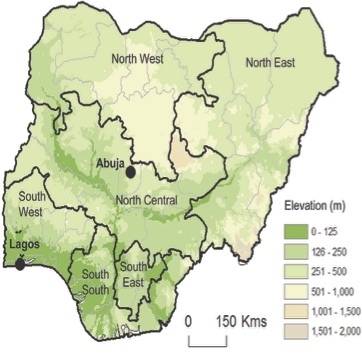
Since 1999, the disparity in the number of states allotted to each of the six geopolitical zones has been a source of disaffection between the zones. The South East zone with five states has felt particularly disenfranchised, considering that the North Central, South South and South West each have six states.
The three northern zones combined have 19 states, while those in the south have 17. This uneven distribution poses a threat to democracy in the country as it becomes manifest in terms of disparity of representation at the National Assembly; the nation’s highest legislative body.
With its two states advantage, the northern states are represented at the National Assembly by more senators, and more members of the House of Representatives. The North is also able to access more monthly subvention for their multiple local government areas.
Restructure INEC for electoral credibility
The position of INEC chairman and INEC commissioners should be abolished. The fact that the President who is an interested party in elections is the one who appoints the INEC chairman and commissioners nullifies the integrity of the process.
All state local election boards as appointed by state governors should be abolished.
The federal election board should be decentralized, its responsibilities devolved to the 36 states and Federal Capital Territory (FCT).
A similar structure, remodelled with the peculiarities of Nigeria in mind, is hereby presented.
Every state should have a state election commission, which will be responsible for the conduct of all elections, local government, state and national.
The state election commission should be comprised of three representatives, each of them appointed by the major political parties in the state. Political parties which qualify for commission board membership shall be the ones that have scored a minimum of 25 percent in state, or national election since 1999.
The chairmanship shall be rotational among the political parties in the commission, and shall be for a duration of five years only.
After the election results have been collated by the state election board, the result of each state shall be handed over to the appropriate committee of the National Assembly by the state electors, each of whom shall be representatives of the winners and runner-up political parties in the election.
When the appropriate National Assembly committee has received the results, it will present it to the Senate President whose responsibility it would then be to announce the result to the nation from the floor of the National Assembly.
Restructure National Assembly to reduce cost of government
Nigeria’s economy cannot afford the two-tier system of the National Assembly. The category of House of Representatives should be abolished and replaced by increasing the number of senators to four for each senatorial district.
In this way, the National Assembly will constitute a total of 235 members instead of 559 as presently. Additionally, the emoluments of senators should be reduced by at least 10 percent.
This reorganized arrangement would save the nation a minimum of N400 billion annually!
Conclusion
The retrogression of the economy, the mounting insecurity to life and property, and the corruption and inefficiency of government make a resetting of the system imperative.
Many of the recommendations of the 2014 National Conference provide us with a foundation to build a better and more productive union.
The onus is now on us, “We the People.” We must put pressure on the President and the National Assembly. Let the process of decentralization begin with a nullification of the undemocratic unitary Constitution of 1999!
•Pearse, PhD, public affairs analyst, convener, Reset Lagos PDP, member, PDP National Presidential Campaign Council (2023)