Follow Us on Google
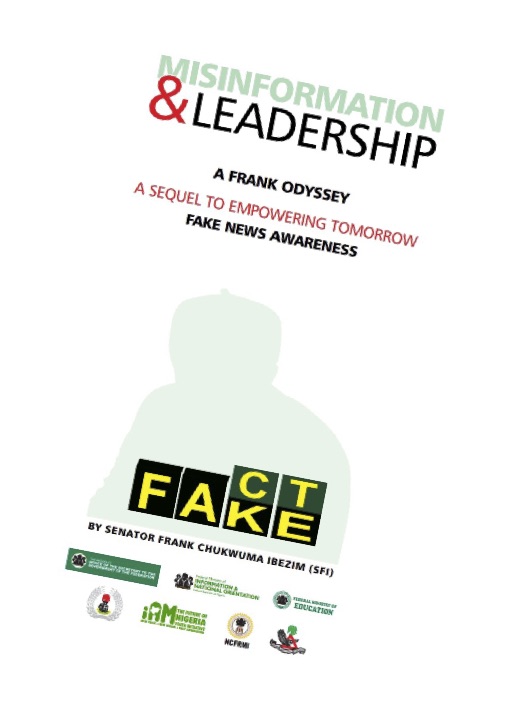
Title: Misinformation and Leadership
author: Frank Chukwuma Ibezim
author: Frank Ibezim Foundation, Abuja
year : 2024
pagination: 269
Reviewer: Henry Akubuiro
We have seen the adverse effects of coronavirus in the last few years around the globe. We have witnessed unimaginable devastations in the Ukraine and Gaza wars, farreaching global implications. But nothing compares to the misinformation pandemic sweeping through the media space and the world right now. Since information has been democratised, most internet users now possess the capacity to assess and disseminate information from their comfort zones, thanks to digitalisation.
Online media has, thus, become the primary source of information for a large portion of the global population. But the sheer volume of available content has made it increasingly difficult to distinguish between credible sources and misinformation. The rapid normalisation of unverified or misleading information on public domain has affected the perception of reality in this digital age. The repercussions for individuals and public office holders have been devastating, sometimes almost impossible to remedy.
After publishing Empowering Tomorrow/Fakenews Awareness, Senator Frank Chukwuma Ibezim has come out with a new book, Misinformation and Leadership, a topic with a global resonance. The author has faced many challenges in his political life, but none is as insidious as the waves of misinformation that “sought to distort my truth and undermine my reputation,” he concedes in the book’s prologue. The author points out that misinformation has evolved into a powerful weapon capable of destroying reputations, dividing communities, and destabilising societies. He has, thus, written this book as a testament to the resilience required of any leader to stand for truth when buffeted by adversities.
Other News
Senator Ibezim ‘s Misinformation and Leadership is a call to action for all who value honesty, trust, and respect. Through his experiences, the author aspires to use this book to inspire others to engage with the truth, fight against the spread of misinformation and appreciate the importance of media legacy in navigating the world. It behoved on the leader to protect the truth, no matter the odds against him.
Misinformation and Leadership is a book in 26 chapters. It treats a variety of topics, such as the Rise of Misinformation, Battling False Accusations, How Propaganda Thrives, The Instigators of Misinformation, Integrity as a Shield, Restoring Public Trust, Silencing the Noise, Lessons for Future Leaders, Consequences of Misinformation, The Personal and Social Impact of Fake News. The writer also writes on Misinformation vs SDGs, Rebuilding Community Trust, The Role of Education in Combating Fake News. Peace Building and Countering Misinformation, Misinformation and the Nigerian Police, the Ministry of Information and the Role of Effective Communication, among others.
In the first chapter, the author roves around his constituency – politics – and tells us about the negative consequences of fake news. Among other effects, he says it influences voter behaviour, undemines trust in institutions, stirring social and political unrest, manipulating political discourse. “In politically diverse countries like Nigeria, where tribal and religious identities are deeply ingrained, fake news can even be more harmful when it exploits these divisions. Tribalism and religion are potent forces that can easily be manipulated to stoke tension, create fear, and promote hatred,” he writes. Senator Ibezim attributes the surge in fake news, particularly in politics, to digital communication, lack of regulation, political polarisation, emotional engagement, confirmation bias.
The author uses the examples of some African leaders, including Nelson Mandela of South Africa, Ellen Johnson of Sirleaf of Liberia, and Kwame Nkuruma of Ghana, who battled false accusations as illustrations. Senator Ibezim also cites his own case during his senatorial campaign, where political opponents questioned his educational qualifications to poison the minds of voters. He was accused of falsifying his credentials. He admits the accusations were politically motivated, but he took pragmatic steps to address the allegations, including using transparency, public communication, and campaigning with integrity.
Writing on “The Instigators of Misinformation” in the fourth chapter, the author says traditional media can only be used as a tool for misinformation through sensationalism, incomplete reporting, and bias and partisanship. Also, with the influence of WhatsApp groups, they can also contribute to spreading false information through rapid sharing, echo chambers, and the influence of community leaders in these online groups. The author also enlightens us that content creators and influencers, the reality of gullible viewers and listeners, the drive for clout and monetisation have contributed to rapid misinformation and effective communication.
This unputdownable book highlights effective strategies to counter unfounded accusations in politics. He advises us to, first of all, to understand the nature of the accusation and source, remaining focused, resorting to positive action, avoiding temptation to overreact, developing effective crisis management, focusing on service delivery, and building a resilient support system, etcetera.
As young, future leaders, the author says in the eight chapter we must embrace continuous learning, cultivate emotional intelligence, work with integrity, foster inclusivity and diversity, adapt to change, practice effective communication, build a strong network, prioritise community engagement, and stay focused to personal growth, etcetera. The author has experienced misinformation, firsthand, which explains why, in the ninth chapter, he echoes the consequences of misinformation from a personal perspective. The author tells us how misinformation and misinformation left profound scars on him, his family members, political allies and the community at large. What’s the difference between misinformation and misinformation? Flip to pages 90 for the answer.
Fake news is not just a nuisance – the author tells us that it has profound personal and societal repercussions. He echoes: “The emotional impact of fake news can be profoundly damaging for families and political allies. When false information spreads, it fosters an atmosphere of distrust, anxiety, and fear. Families may find themselves divided as misleading reports give rise to accusations. Friendships can spur, and political allies may feel pressured to distance themselves from those targeted by negative narratives.”
The author has written an engrossing book that we can’t do total justice to in a newspaper review. We encourage readers, leaders, political scientists, aspiring politicians and everybody to lay a hand on this book to deconstruct the appetising broth Senator Ibezim has cooked in Misinformation and Leadership. This is a sizzling read.