Follow Us on Google
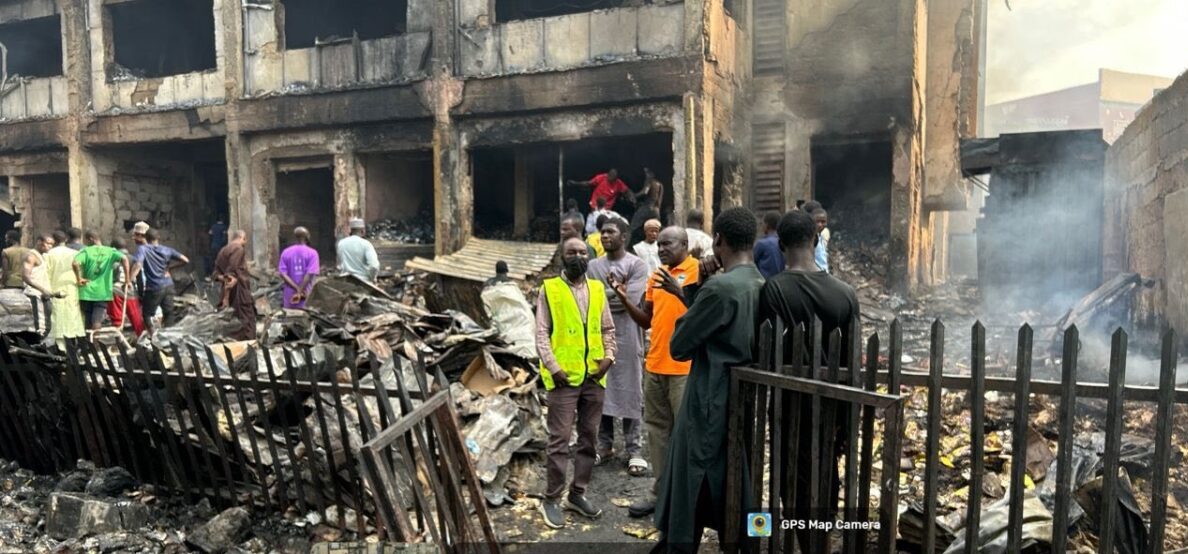
In barely a week, flames recently tore through the popular Singa and Fatima Simra markets in Kano State, reducing goods and dreams to ashes. For thousands of traders, these were not just fires; they were economic disasters, wiping out years of sweat and investment in a matter of hours. About 1,000 stalls were affected by the fire while the losses were estimated in billions at the Singer Market alone. Seven people were reported missing.
Governor Abba Yusuf has promised to support the traders while Vice-President Kashim Shettima announced a N5billion relief package with an addition N3billion donation by governors from the ruling All Progressives Congress (APC). The Kano blaze is not an isolated tragedy. Across Nigeria, especially in Lagos, market fires have become alarmingly frequent. From Balogun Market on Lagos Island to Tejuosho Market in Yaba, from Mile 12 to Alaba International Market, infernos have repeatedly gutted stalls and warehouses.
In many cases, entire sections of these sprawling commercial hubs have been consumed. Many traders have lost billions of naira. Families have been thrown into sudden poverty. The ripple effects spread far beyond the charred stalls, affecting suppliers, transporters, and consumers. Nigeria must find an answer to these incessant blazes.
Electrical faults top the list of causes. Tangled webs of substandard wiring snake across overcrowded stalls. Power fluctuations and illegal connections overload fragile power systems. A single spark is often all it takes. Markets, many of which evolved organically without proper planning, are packed so tightly that access roads are narrow or completely blocked. When fire breaks out, firefighters struggle to reach the source. In some cases, fire trucks cannot even enter the premises.
Compounding the risk is the widespread storage of flammable substances—petrol, chemicals, cooking gas, textiles, plastics, often in poorly ventilated spaces. Traders, desperate to maximise limited space, stack goods from floor to ceiling. Safety is sacrificed for survival. This is a recipe for disaster, which, when it happens, spreads the loss from the traders to the states and the entire country. This must stop. Decisive action should be taken now.
This is not the first time Singer Market has suffered such devastation. About three years ago, fire destroyed parts of the same market. What changed after that incident? What lessons were implemented? The recurrence of such disasters points to a systemic failure. It is a failure of enforcement, of planning and of political will.
Other News
There are calls for probes into the Kano market fires. Committees may be set up. But Nigerians have seen this script before. Too often, probes end as mere paperwork exercises. Reports gather dust. Recommendations are ignored. No one is held accountable. No structural reforms follow. This cycle must end. Still, a thorough and transparent investigation is necessary—not as a ritual, but as a foundation for reform. The findings must be made public. Where negligence is established, sanctions must follow. Accountability is the beginning of prevention.
Better planning and redesign of markets is non-negotiable. Many of Nigeria’s major markets were not built with modern safety standards in mind. Authorities at the state and local levels must embark on phased restructuring. This includes creating wider access lanes, enforcing building codes, ensuring proper ventilation, and limiting the density of stalls. Urban planning authorities must resist the temptation to regularise unsafe expansions simply because they generate revenue.
Also, firefighting equipment must become mandatory infrastructure in all markets. Functional fire extinguishers, water hydrants, smoke detectors, and alarm systems should be installed Market associations, in partnership with state governments, should establish fire safety committees responsible for routine checks. Fire stations should be strategically located near large commercial hubs, with guaranteed water supply and well-maintained equipment.
It is equally important that traders themselves be part of the solution. Regular firefighting drills and safety training should be compulsory. Many fires escalate because initial outbreaks are mishandled or ignored. With basic knowledge—how to use extinguishers, how to cut off power supply, how to raise alarm effectively—traders can contain small incidents before they become catastrophic. Market days could begin, periodically, with short safety briefings rather than mere announcements about sanitation fees.
Electrical systems in markets must be overhauled. Illegal and hazardous connections must be dismantled. Authorities and financial institutions should collaborate to create affordable micro-insurance products tailored to traders. While insurance does not prevent fire, it can cushion the effect and enable faster recovery.
Market fires should not be treated as inevitable acts of fate. They are predictable and, therefore, preventable. Nigeria’s markets are the heartbeat of its informal economy. They sustain millions who have no other safety net. Allowing them to burn repeatedly without lasting reform is not merely administrative failure—it is moral failure. The authorities in Kano, Lagos, and across the federation must rise above rhetoric and put measures in place to avert recurring market infernos.