Follow Us on Google
By Adebowale Johnson
Governments naturally speak well of their records. They commission projects, publish statistics, announce achievements and explain why particular policies were necessary. There is nothing unusual about that.
But the stronger test of public policy begins when government steps away from the microphone.
What do researchers see? What does independent data reveal? Where has progress actually occurred? And perhaps more importantly, where do people outside government say substantially more work is still required?
On the environmental challenges confronting Lagos, the independent evidence presents neither a story of spectacular triumph nor one of hopeless failure.
It presents something more useful: a city confronting extraordinary environmental pressures, building significant resilience infrastructure, but still racing against rapid urbanisation, behavioural problems and a changing climate. That distinction matters.
In July 2025, researchers from Obafemi Awolowo University published a systematic review of flood resilience strategies in Lagos in Frontiers in Climate. Rather than simply accepting official claims, they reviewed existing academic literature, government data and other published material to assess the city’s response to flooding.
Their conclusion was instructive. The researchers documented substantial interventions, including stormwater drainage construction, shoreline protection, river and stream maintenance, channelisation and expansion of technical personnel responsible for drainage management.
But they also concluded that current resilience efforts remain inadequate for the scale of the challenge, identifying weaknesses in planning enforcement, community participation, early-warning systems and infrastructure.
That is precisely how a serious environmental legacy ought to be examined. Progress and insufficiency can exist simultaneously. Indeed, the scale of Lagos’s exposure makes that almost inevitable.
A World Bank assessment of flood risk in coastal cities across sub-Saharan Africa found Lagos to have the largest overall population exposure to flooding among the coastal cities examined.
Its analysis of a 10-year flood-hazard zone estimated about 1.36 million people exposed to either coastal or rainwater flooding in Lagos — ahead of Dakar, Abidjan, Dar es Salaam and other major coastal cities.
That statistic changes the context in which drainage performance should be discussed.
Lagos is not confronting the environmental conditions of an inland city.
It is a low-lying Atlantic megacity, with extensive lagoons and waterways, unusually intense development and extraordinary pressure on available land.
Its climate vulnerabilities are also increasing.
The Lagos Climate Adaptation and Resilience Plan identifies sea-level rise, extreme rainfall and extreme heat among the principal climate-impact drivers facing the state.
Independent researchers have reached similar conclusions.
Other News
A 2025 study examining urban growth and flood resilience in Lagos argued that rapid physical expansion has increased the exposure of communities and infrastructure to flooding, particularly where development collides with inadequate drainage and vulnerable natural environments.
This partly validates one of the more controversial elements of recent environmental policy: enforcement against construction on drainage alignments, floodplains and waterways.
It does not mean every enforcement decision is automatically justified. Far from it. Government must demonstrate that its surveys are accurate, procedures fair and regulations applied consistently regardless of who owns a property.
But the underlying environmental principle is difficult to dispute.
A rapidly urbanising coastal city cannot continuously build over the spaces through which water must move and expect engineering alone to compensate forever. Waste presents a similar challenge.
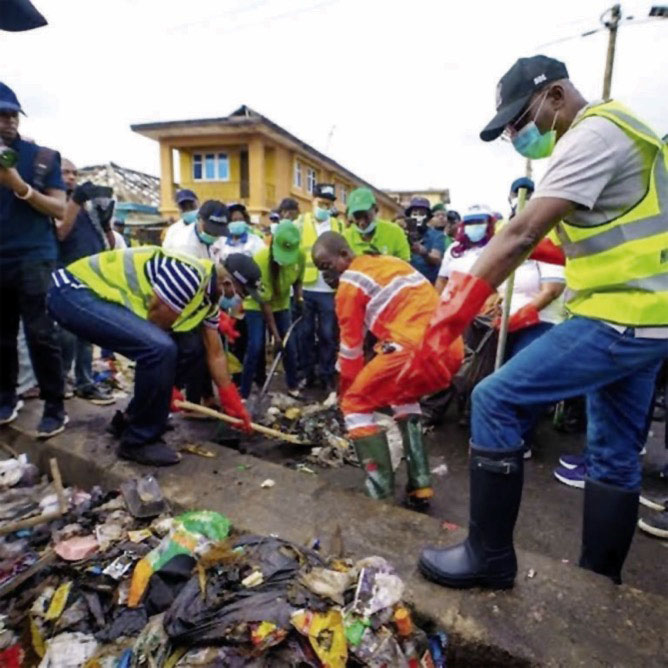
A World Bank diagnostic on Lagos identified the waste sector as an important contributor to particulate pollution and greenhouse-gas emissions, while also linking inadequate waste management and blocked stormwater systems with urban flood risk.
Government has responded by increasingly promoting recycling, resource recovery, waste conversion and a movement away from simple landfill dependence.
Again, the external evidence does not say the work is finished. Government’s own data have acknowledged important shortcomings, including incomplete formal waste-collection coverage and illegal disposal practices.
That actually strengthens rather than weakens the case for reform. There is no point pretending Lagos does not have a waste problem.
The meaningful question is whether the architecture being developed — recycling, PSP reform, enforcement, waste conversion and citizen education — is capable of steadily reducing it.
Perhaps the most important lesson from independent research is therefore that Lagos cannot engineer its way out of every environmental problem.
The systematic flood-resilience review specifically emphasised a multi-stakeholder approach, combining physical infrastructure with stronger community engagement, better waste practices, adaptation policy and planning enforcement. That is significant.
A drainage channel is structural resilience. A community that refuses to fill that channel with refuse is social resilience. An accurate weather alert is informational resilience.
A planning authority refusing permission to build on a floodplain is institutional resilience.
A wetland left intact is natural resilience. A genuinely resilient city requires all of them.
This perhaps provides the fairest independent verdict on Lagos. The environmental legacy cannot credibly be that government has defeated flooding, eliminated pollution or solved waste management. It has not.
The stronger argument is that Lagos has begun constructing a more comprehensive environmental-response system while the size and complexity of the challenge continue to grow.
Researchers are effectively saying two things simultaneously: there has been movement; and there must be much more. Government should welcome both conclusions. Because the true validation of a legacy is not praise. It is evidence.