Follow Us on Google
By Rita Okoye
The pharmaceutical industry stands at a transformative juncture. Traditional drug synthesis generates between 25 and 100 kilograms of chemical waste for every kilogram of drug produced.
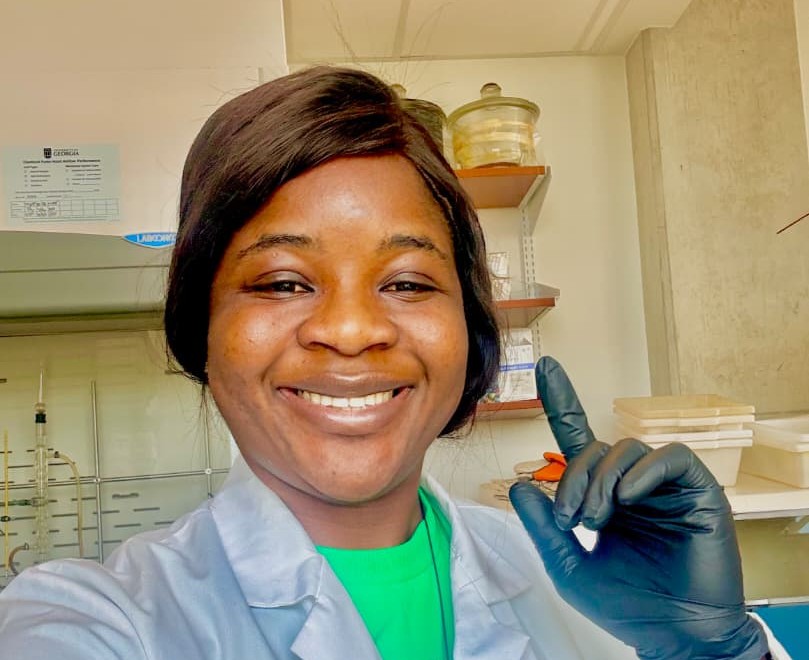
Oluwaseun Ajayi, presently a doctoral researcher in Chemistry at the University of Georgia, is pioneering solutions that are expected to fundamentally reshape pharmaceutical manufacturing by harnessing biology’s own precision chemistry.
Ajayi’s research focuses on pyridoxal phosphate-dependent enzymes, which are basically proteins that catalyze complex chemical transformations at ambient temperatures using water as the solvent, with virtually zero waste. Her work demonstrates a principle that is gaining momentum across the pharmaceutical sector: nature has already optimized many of the chemical processes that industry is now working to improve.
Biological systems have evolved highly efficient catalytic pathways over millions of years. Ajayi’s challenge lies in understanding these mechanisms well enough to adapt them for industrial applications. Her research employs advanced analytical techniques, including X-ray crystallography, spectroscopy, cryogenic electron microscopy, nuclear magnetic resonance, and mass spectrometry, to reveal the structural basis of enzymatic precision. This fundamental knowledge enables the engineering of enzymes for practical manufacturing applications, offering alternatives to conventional synthetic routes.
Enzyme-based synthesis offers several advantages: reactions that traditionally require multiple steps and harsh conditions can often be completed in a single enzymatic step at room temperature in aqueous media. As pharmaceutical manufacturers face increasing pressure to reduce environmental impact while controlling costs, these biological approaches offer a compelling path forward.
Ajayi’s expertise has positioned her as an influential voice in sustainable biotechnology. Her recent appointment to the Communications Committee of the International Society for Evolution, Medicine, and Public Health reflects her ability to translate complex enzyme biology into actionable strategies for pharmaceutical development and environmental health policy.
According to Ajayi, sustainability works best when integrated as a core design principle from the outset. The pharmaceutical industry is increasingly recognizing that environmental responsibility and economic efficiency can advance together, a principle that guides her research work.
Her perspective is informed by her Nigerian background and understanding of global health inequities. Pharmaceutical manufacturing practices affect different regions unequally, with developing nations often bearing disproportionate environmental burdens while facing limited access to the medicines being produced. Enzyme catalysis offers pathways toward both cleaner production and more equitable distribution.
Beyond laboratory research, Ajayi has authored multiple book chapters and peer-reviewed articles on enzyme engineering and sustainable biocatalysis that serve as reference materials for academic researchers and industrial scientists worldwide. Through these contributions, she has established herself as a thought leader in translating enzymatic science into practical manufacturing strategies.
Ajayi sees a particular opportunity for developing nations to adopt clean biotechnology from the beginning, potentially bypassing the environmental challenges that industrialized nations are now working to address. She observes that countries building pharmaceutical infrastructure today have an advantage: they can incorporate sustainable approaches as foundational elements rather than later additions.
Her vision includes enzymatic alternatives for antibiotic production, specifically. While current synthetic routes rely on hazardous reagents and energy-intensive conditions, enzymatic approaches can yield identical compounds more efficiently while enabling local manufacturing where antibiotics are most urgently needed.
Ajayi explains that many countries facing the highest burdens of bacterial disease import all their antibiotics. Enzyme-based production could enable decentralized manufacturing, reducing costs, improving access, and minimizing environmental impact simultaneously.
She acknowledges that transitioning to biological manufacturing requires investment in research and infrastructure, yet views the long-term benefits, economic, environmental, and social, as far outweighing initial costs.
Ajayi notes that multiple technologies have now matured sufficiently to make this transition feasible. The scientific foundations are established. What is needed now is coordinated investment and implementation strategies that can bring these biological manufacturing approaches to scale.
As environmental regulations evolve and sustainability becomes increasingly central to pharmaceutical operations, Ajayi’s research offers the industry concrete pathways forward. Her work bridges fundamental discovery with real-world application, advancing both human health and environmental sustainability on a global scale.
Through her research, publications, and international committee service, Ajayi exemplifies the type of scientific leadership needed to transform pharmaceutical manufacturing for the 21st century.