Follow Us on Google
By Ade Alade
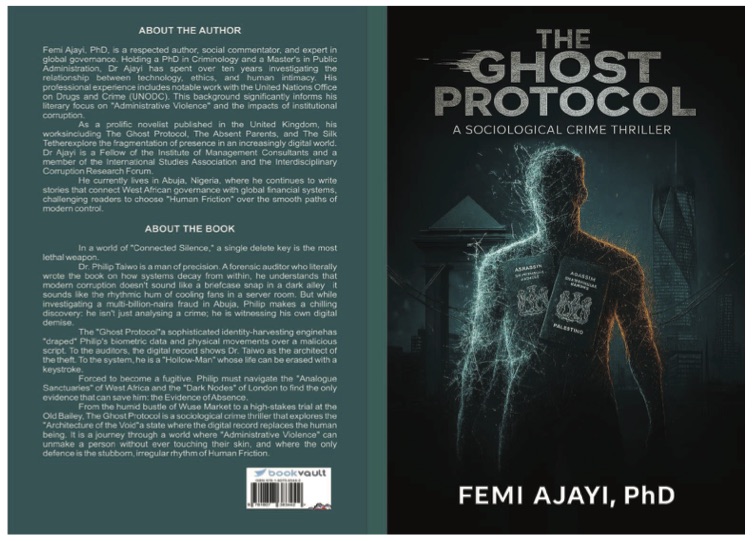
I view Dr. Femi Ajayi’s “The Ghost Protocol” not just as fiction but as a compelling critique of the “Nigerian Factor” that reflects the harsh realities of the digital age.
This novel addresses our readership directly—a public weary of “Ghost Workers” and bureaucratic opacity, yet increasingly linked to the very digital systems that facilitate these crimes.
The editorial critique
1. Theme and Relevance: A mirror to the Nation
Dr Ajayi has achieved something rare: he has turned the dry, academic idea of “Administrative Violence” into a compelling, high-stakes thriller. For a Nigerian audience, the “Ghost Worker” syndrome is a story we hear about every week. Yet, Ajayi raises this beyond just a theft tale to a philosophical dilemma. By depicting corruption not merely as a series of bribes but as a “Silk Tether” of digital disappearance, he captures the modern anxiety faced by the middle class: the fear that everything — bank accounts, identity, and future — can be erased with a single keystroke in a windowless office in Abuja.
2. Narrative Structure and Pacing
The shift from the claustrophobic bureaucracy of Abuja’s Ministry of Works to the sterile, high-pressure environment of London’s Old Bailey is smoothly handled. The pace mirrors the protagonist’s desperation; it starts with the slow, deliberate progression of a forensic audit and speeds up into a frantic chase of “Human Friction.”
However, from an editorial standpoint, the middle act set in Benin and the transition to the UK sometimes lean too heavily on technical explanations. While the details of VPNs and crypto-wallets add to the book’s “techno-thriller” credentials, the story is at its best when it focuses on the emotional strain felt by the Taiwo family.
3. Characterisation: The Everyman Hero
Dr Philip Taiwo is a compelling protagonist because he is an intellectual thrust into an analogue world. He is the “Academic as Action Hero.” His specialisation in “Work Ethics” makes his framing for cyber-terrorism particularly poignant — it is a subversion of his life’s work.
The antagonist, Julian, and the Lumina Infrastructure group exemplify a new type of villain in African literature: the corporate-bureaucratic hybrid. They don’t wield guns; they utilise “Administrative Liquidity.” This shift from the “Big Man” trope to the “Big System” trope reflects a sophisticated evolution within the genre.
4. The “Human Friction” Philosophy
The book’s core message—that human flaws act as a defence against digital tyranny—is its most vital contribution. In an era where Nigeria promotes full NIN integration and digital banking, Ajayi’s warning about the “Deep-Fake of the Soul” is particularly timely. He argues that the very aspects the state seeks to “clean up”—such as chaos, physical presence, and the “irregular variables”—are exactly what make us human.
Final verdict
The Ghost Protocol is a “Sociological Crime Thriller” that meets its ambitious label. It is a must-read for anyone interested in the connection between African governance and the Fourth Industrial Revolution.
Dr Ajayi has expertly utilised his background with the UNODC to craft a story that feels disturbingly credible. At The Sun, we often refer to the “Ghost” within the system; Dr Ajayi has finally given that ghost a name, a face, and a sinister purpose.
Rating: 4.5/5 stars – an essential addition to the modern Nigerian literary canon.