Follow Us on Google
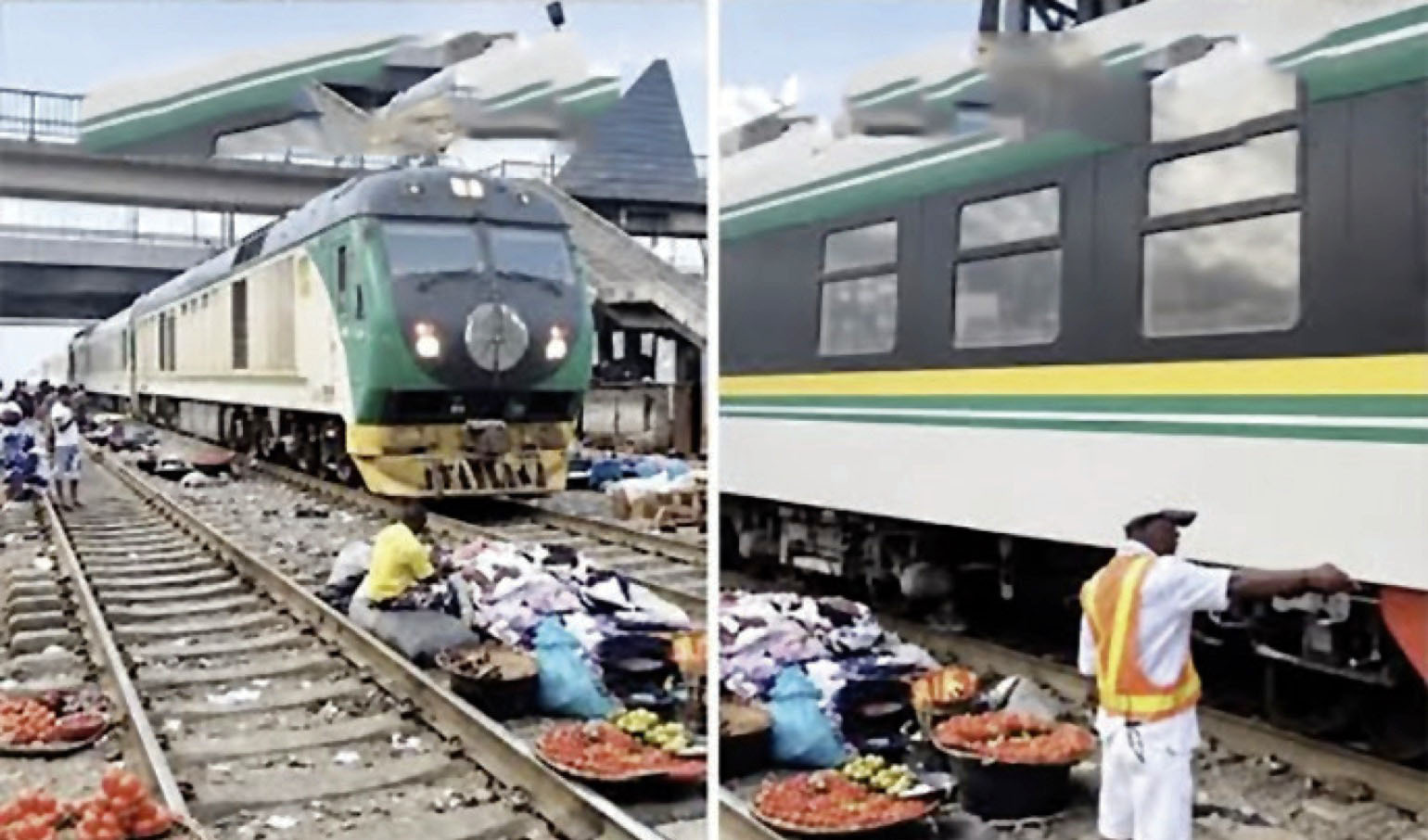
…Traders brave danger, sell beside moving trains
By Uche Usim
Some call it desperation for survival. Others say it is luck stretched too far. Many insist it is sheer madness to establish mini-shops a few inches from an active train track.
In Nigeria, life itself is a risk and taking deeper risks to survive is non-negotiable, especially when better options are not on the horizon. This is the playbook in Oshodi, Lagos, where the line between making a living and courting danger is very narrow.

The rail track is always busy as traders display clothes, shoes, food items and other goods, waiting for customers.
In sane climes, the railway is not a market. But in Nigeria, parts of rail corridors have, over the years, become places where people buy and sell.
For safety and economic experts, the tortuous sight is common in struggling economies like India, Bangladesh and the likes where poverty levels are frighteningly high.
When a train approaches, the calculation changes swiftly. Goods have to be pulled away quickly. Sellers and buyers must move back.
The space that moments earlier served as a marketplace suddenly becomes a passage for a heavy machine travelling on steel tracks.
Then, as the train disappears, business resumes.
For the traders, it is another working day. For safety experts and railway authorities, however, the practice represents a serious risk that cannot be managed simply by relying on people’s ability to hear a horn or see an approaching train.
The problem is not new and accidents from it no longer make news.
Reports from Oshodi and other parts of Lagos have repeatedly documented traders operating on or close to railway tracks despite warnings from authorities.
In 2024, the Lagos State Government cleared traders from the rail tracks at Bolade, Oshodi, opposite the Arena Shopping Complex, after a video showing trading activities dangerously close to a passing train went viral.
The clearance was carried out in collaboration with soldiers from Ikeja Cantonment.
Social scientists say the recurrence of the problem points to a deeper worry of how cheap life has become.
They question why people repeatedly return to places where a moment of miscalculation could cost a life?
For many of the traders, the answer is simply survival.
The rail corridor offers something they struggle to find elsewhere; a location with heavy human traffic and little or no conventional shop rent and the attendant expenses.
At the Oshodi rail market, a petty trader, Shakirat Jimoh, complained that the cost of renting a shop was beyond her means.
“How do you expect a tomato and pepper seller like me to be paying N15,000 for a tiny shop monthly, where do I want to see the money?” she asked, explaining that she preferred the rail area because she paid only a token to the touts managing the space.
Another trader, Mrs Joy Akinfenwa, said she had been trading on the rail tracks for over two years.
She described the traders as vigilant, insisting they watched for warning signs when a train was approaching.
“We’re very vigilant and sharp. A dull person cannot sell on the rail,” she said.
Mrs Agnes Okehi, another trader, similarly said traders relied on flags, headlights and train horns to know when a train was approaching.
For Moses Raymond, agility is the trump card for survivability for railway traders.
“No sick person comes to trade here. You must be sharp and agile.
“Aside from being cautious about a moving train, you also have to be ready to pack your things in a few seconds once the task force storms the railway corridor.
“If not, your goods are quickly confiscated and if you’re apprehended, you can be prosecuted.
“No one wants to sell here but we have no choice. The cost of shop rental is astronomical. I’m a graduate but I can afford it. Life is a risk. Let me ruffle out here”, he said.
These accounts explain the thinking behind the practice, which is that if they (traders) have survived yesterday, they believe they can survive today and tomorrow.
But survival in the past does not remove the danger of the next passing train.
The most obvious danger is being struck by a moving train.
But the risk goes beyond a person standing directly on the track.
A trader with goods spread close to the line may have little room to react if a train approaches unexpectedly. A customer bargaining over a product may be distracted. A child accompanying a parent may wander into the danger zone. A person carrying goods may stumble while attempting to move away quickly.
There is also the danger created when traders, buyers and pedestrians become accustomed to the railway environment.
For safety experts, familiarity can create a false sense of security.
A trader who has watched dozens of trains pass without incident may become less fearful. A customer may assume that because others are trading there, the place must be safe. Over time, an illegal or unsafe activity can become normalised.
That is one of the most dangerous aspects of the Oshodi situation.
The railway is designed around predictable movement, controlled access and clear right-of-way.
A marketplace introduces people, goods, conversations, distractions and movement into an environment where trains cannot simply stop or swerve to avoid an obstacle.
For years running, the Nigerian Railway Corporation has repeatedly warned against walking, hawking and trading on railway tracks.
In 2018, NRC spokesman, Yakub Mahmood, described such activity as unlawful and warned the public to stay away from the tracks.
In 2021, former NRC Managing Director, Fidet Okhiria, also warned that trading on the tracks contravened the law. He said the corporation had directed police commands to clamp down on traders and announced plans to fence the railway corridor.
The message from the railway authorities has, therefore, been consistent, which is that the tracks are for trains, not trading.
According to reports, Lagos has seen the consequences of trading along rail tracks. It has recorded serious rail-related accidents.
In 2020, a trader and his son were in an SUV parked near the Nigerian Army Shopping Arena in Oshodi when a train collided with a bus nearby. The train subsequently hit the SUV. The trader was killed while his son was seriously injured, according to a report.
In January 2019, a train reportedly derailed around the Ashade railway crossing in the Agege-Ikeja area, killing one person and injuring others.
More recently, concerns about people occupying railway corridors have continued. In February 2026, former presidential candidate Remi Sonaiya raised concerns after seeing people sleeping on sections of the Lagos-Ibadan rail tracks at Agege.
The report also referred to an NRC account of vandalism along the Agege-Agbado corridor.
These incidents underline an important point that the danger around railway infrastructure is not limited to one particular type of activity.
Once people are allowed to live, sleep, trade or gather close to an active railway, the risk becomes difficult to control.
The authorities have carried out several clearance exercises.
In July 2023, the Lagos State Environmental and Special Offences Enforcement Unit, popularly known as the Task Force, moved against traders displaying goods on roadsides, highways and railway tracks. Its operation included Oshodi, where goods worth millions of naira were seized.
In August 2024, Lagos State again cleared traders from railway tracks in Oshodi. In December of the same year, the government carried out another clearance at Bolade, following renewed public concern over traders operating beside the tracks.
The repeated clearances raise an uncomfortable question about what happens after the enforcement officers leave.
If traders return after every clearance, then eviction alone has not solved the problem.
The government, analysts say, has to tackle both sides of the equation involving safety and livelihood.
Solution
One practical solution is to provide affordable alternatives.
With many railway traders complaining about shop rents, the issue is not arguing if the railway tracks were safe.
They know it is not but circumstances brought them there.
A trader who cannot afford a formal shop may return to the railway corridor after an enforcement operation because the economic pressure that brought him there in the first place remains.
The government should, therefore, identify suitable markets or trading spaces around affected communities and make them genuinely accessible to low-income traders.
Affordable stalls, transparent allocation systems, basic sanitation and reasonable rents could make relocation more realistic.
The process should also prevent another problem: traders being pushed from one dangerous location to another.
Fence the corridor and enforce the boundary
Physical protection
Experts say that where railway lines pass through densely populated communities, fencing should be treated as a basic safety barrier, not an optional beautification project. The experience of Lagos shows exactly why because in 2023, former NRC Managing Director, Fidet Okhiria, said barriers at level crossings had previously been vandalised, while Lagos transport authorities had also discussed fencing railway corridors to prevent interaction between trains, vehicles and pedestrians.
A proper railway boundary should make it physically difficult for traders and customers to reach the tracks.
But fencing must be accompanied by regular maintenance. A broken fence that is left unrepaired quickly becomes another invitation to encroachment.
Security personnel should also patrol vulnerable sections, particularly areas where markets, bus terminals and railway stations attract large crowds.
Safety must keep pace with rail expansion as the urgency becomes greater as Lagos expands its rail network.
In July 2026, the NRC granted Lagos State a permanent operating licence and permanent track-access licence for the Lagos Rail Mass Transit Red Line under the existing track-sharing arrangement. NRC Managing Director Kayode Opeifa said the development marked a new stage in Lagos’ rail operations.
LAMATA Managing Director, Abimbola Akinajo, said the state had procured additional rolling stock that would increase Red Line services from nine to 24, with the line expected to carry more than 200,000 passengers daily when fully operational.
More trains and more passengers mean more pressure on railway corridors.
That makes the continued presence of traders and other unauthorised users around active tracks even more concerning.
The authorities cannot build modern rail infrastructure while leaving weak points around the same infrastructure.
The traders also have a responsibility. The government cannot carry the entire burden.
Traders who enter railway corridors also have a duty to protect themselves, their customers and other members of the public.
A train driver cannot stop a train as quickly as a pedestrian can step aside. The size, weight and speed of a train give the railway a very different safety equation from a normal road.
Relying on a horn, a flag or the ability to see an approaching train is, therefore, not a sufficient safety system.
The fact that traders have developed their own warning practices shows that they understand the danger. The next step is to recognise that the safest response is not to become better at escaping the train, but to stay away from its path altogether.
The sight of traders packing their goods as a train approaches and returning moments later may appear routine. But it is not because behind the ‘routine’ lies a dangerous compromise between livelihood and safety.
The traders need income. The railway needs an unobstructed corridor. Passengers need safe access. The government needs to protect public infrastructure. Railway operators need room to run trains without people, goods and makeshift stalls dangerously close to the tracks. These interests, experts note, do not have to conflict.
Authorities can combine enforcement with affordable relocation, permanent fencing, regular patrols, public education and a clear system for managing commercial activity around railway stations.
The NRC is also reviewing more than 150 Standard Operating Procedures in 2026 as part of efforts to strengthen railway safety and reduce operational risks. The corporation says the review is intended to align its operations with international railway standards.
That broader safety drive should extend beyond the train itself.
A safe railway is not simply one with well-maintained tracks and functioning locomotives. It is also one where people know where they should and should not be.
At Oshodi, the choice should not be between earning a living and staying alive.
No trader should have to place a tray of tomatoes, a rack of clothes or a pile of shoes a few inches from a moving train simply because a proper shop is beyond his or her reach.
The real test for the authorities is not how many traders they can chase away in a single enforcement exercise.
It is whether they can make the railway corridor permanently safe, while giving the people who depend on those dangerous spaces a realistic and affordable place to earn a living.