Follow Us on Google
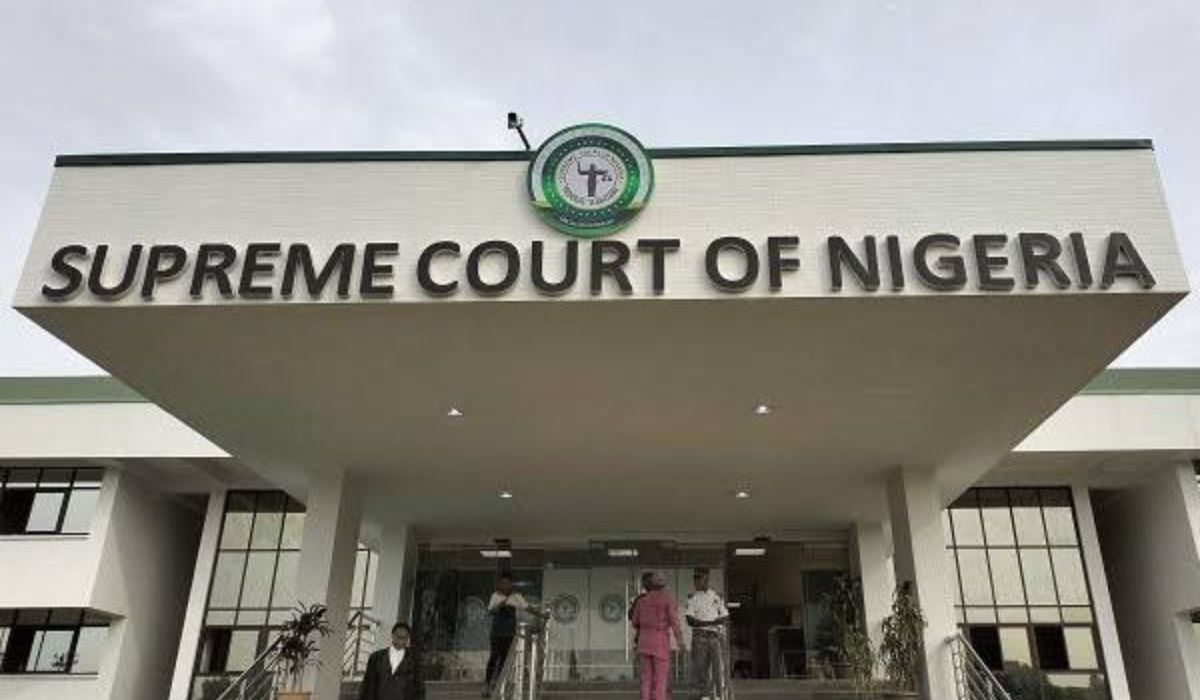
The Supreme Court has affirmed the conviction and death sentence imposed on a Kaduna-based man, Abu Umar, who stabbed another man to death during a fight.
A five-member panel of justices, in a lead judgment delivered by Justice Jummai-Hannatu Sankey, held that the appeal lacked merit.
The panel affirmed the July 22, 2020, decision of the Court of Appeal, Kaduna, which had upheld the death sentence handed down to Umar by the Kaduna State High Court on December 14, 2017, about nine years after the offence was committed.
The apex court agreed with the arguments of counsel to the Kaduna State government, Emmanuel Ekpenyong.
In the respondent’s brief, Ekpenyong, who was granted a fiat to appear for the prosecution by the state’s Attorney General, argued that the evidence led by the prosecution at trial proved its case beyond reasonable doubt.
Although the Supreme Court judgment was delivered on April 17, its Certified True Copy (CTC) was made available to newsmen on Monday in Abuja.
Umar, the appellant, had appealed against the unanimous verdict of the Court of Appeal in Kaduna, which affirmed the judgment of the Kaduna State High Court in charge number KDH/KAD/29C/2016.
The state government had brought against the defendant a one-count charge of culpable homicide punishable with death under Section 221(b) of the Penal Code Law of Kaduna State.
Umar was alleged to have, on June 25, 2015, at Tafa Town in Niger State, stabbed one Abdulkadir Abubakar on the right side of his chest with a knife during a fight. Abubakar reportedly died shortly afterwards at Umaru Musa Yar’adua Hospital, Sabon Wuse, Niger State, where he had been taken.
The appellant was apprehended at the scene and taken to the police station at Tafa, Niger State. Following investigations there, the matter was transferred to the Anti-Homicide Section of the Kaduna State Criminal Investigation Department (CID), Nigeria Police Force, for further investigation.
Upon the conclusion of investigations, Umar was charged at the Kaduna State High Court on February 29, 2016, with culpable homicide and was arraigned before Justice G.I. Kurada.
In proving the charge, the prosecution called three witnesses and tendered three exhibits — including the knife Umar allegedly used to stab Abubakar — before closing its case. Umar, exercising his constitutional right, opted to rest his case on that of the prosecution, neither testifying himself nor calling witnesses or tendering any other evidence.
After evaluating the evidence, Justice Kurada found Umar guilty as charged and convicted and sentenced him accordingly.
Other News
Dissatisfied, the appellant approached the Court of Appeal, filing his notice of appeal on January 23, 2018. In its judgment of July 22, 2020, the appellate court dismissed the appeal and upheld the trial court’s judgment.
Still dissatisfied, the appellant, through his lawyer, Umar Galadima Esq., filed a notice of appeal at the Supreme Court on August 19, 2020.
In his brief of argument, marked SC/CR/499/2022, Galadima raised a sole issue for determination: whether the Court of Appeal justices were wrong to affirm the trial court’s decision on the ground that the prosecution had proved its case beyond reasonable doubt.
Delivering the lead judgment, unanimously concurred in by the other justices, Justice Sankey upheld Ekpenyong’s arguments. She held that the prosecution — through the eyewitness accounts of the second prosecution witness (a police officer) and the third prosecution witness (Abubakar’s father), along with Exhibit 1, Umar’s extrajudicial confessional statement — had proved all three ingredients of the offence.
On the appellant’s argument over the absence of a medical report to establish the cause of death, Justice Sankey noted that the law is settled: where death occurs instantly, or within a short time — generally within 24 hours of the incident — a medical report is unnecessary.
“In the circumstance of this case, medical evidence ceases to take a paramount place, the deceased having died a mere one hour and thirty minutes from his admission in the hospital,” she said.
The judge held that the appellant sealed his own fate by resting his case on that of the prosecution.
“From the entire analysis of the case of the respondent at the trial court, it was clear that the prosecution had discharged the burden placed on it by law to establish the guilt of the appellant beyond reasonable doubt,” she said.
“Unfortunately, the appellant, who was all through the proceedings represented by counsel, was ill-advised to rest his case on the very evidence which conclusively established his guilt.”
This, she said, amounted to a constructive admission of guilt.
“It is for these reasons that I resolve the sole issue for determination against the appellant and in favour of the respondent,” Justice Sankey said.
“Consequently, I find this appeal sorely lacking in merit. It fails and is dismissed. Accordingly, the decision of the court below sitting in Kaduna, in appeal number CA/K/370/C/2018, delivered on July 22, 2020, which affirmed the conviction and sentence of the appellant by the High Court of Justice, Kaduna State, in charge number KDH/KAD/29C/2016, delivered on Dec. 14, 2017, is hereby affirmed.”