Follow Us on Google
By Lukman Olabiyi
Millions of Nigerian mobile subscribers are caught in the middle of a deepening regulatory and legal standoff, as telecommunications operators and government agencies appear to be disregarding court orders mandating the restoration of airtime credit services.
What should have been a straightforward compliance with judicial directives has instead evolved into a prolonged impasse, one that is testing the limits of regulatory authority, corporate responsibility and the rule of law.
At the centre of the crisis are everyday Nigerians who depend on airtime loans not just for convenience, but as a critical financial lifeline.
Despite clear interim rulings from the Federal High Court, airtime borrowing services remain largely unavailable across networks operated by two of the biggest telecommunication giants in the country, leaving subscribers stranded and frustrated.
On April 24, 2026, the Federal High Court in Abuja issued an interim injunction restraining telecom operators from suspending or interfering with services provided to Nairtime Nigeria Limited, a fintech firm offering airtime credit services.
The order followed an ex parte application filed by Nairtime Holdings Limited and its Nigerian subsidiary, which argued that the telcos planned to cut off access to critical telecommunications infrastructure, including USSD channels, SMS, short codes, and billing systems.
In Suit No. FHC/ABJ/CS/779/2026, the court directed all parties to maintain the status quo pending the determination of the substantive suit.
It also emphasised that telecom operators must honour existing contractual obligations and could not bypass agreed dispute-resolution mechanisms under the guise of regulatory compliance.
Similarly, a parallel ruling by the Federal High Court in Lagos on April 15, 2026, restrained the Federal Competition and Consumer Protection Commission (FCCPC) from enforcing key provisions of its Digital, Electronic, Online or Non-Traditional Consumer Lending Regulations 2025 against members of the Wireless Application Service Providers Association of Nigeria.
Presiding over the Lagos case, Justice Ambrose Lewis-Allagoa barred the commission from taking any action that could disrupt services provided by licensed operators pending further hearings.
Both rulings were explicit: services should not be disrupted and any ongoing suspension should be reversed until the courts reach a final determination.
Yet, weeks later, subscribers say nothing has changed.
None of the telecommunication giants has publicly confirmed compliance with the court orders, fuelling concerns about accountability and regulatory enforcement.
The silence has left millions of users, many of whom rely on services such as XtraTime and data credit facilities, in limbo.
“I rely on airtime borrowing almost every week. Sometimes you don’t have cash immediately, but you need to call suppliers or customers. Since this issue started, it has been very difficult,” said Godwin, a trader in Ikorodu, Lagos.
His experience reflects a broader national sentiment.
Across Nigeria, artisans, transport operators, petty traders, and low-income earners are grappling with the sudden disappearance of a service they had come to depend on.
For many, airtime credit is more than a convenience, it is a survival tool in an economy where access to formal credit remains limited.
At the heart of the crisis is a jurisdictional dispute between the FCCPC and the Nigerian Communications Commission (NCC).
The FCCPC introduced the Digital Lending Regulations in July 2025, extending its oversight to digital and non-traditional lending platforms, including airtime and data credit services.
The move was aimed at curbing exploitative practices such as hidden charges and predatory lending. Operators were given until January 5, 2026, to comply, with enforcement actions commencing in April after multiple deadline extensions.
However, industry stakeholders argue that airtime credit services fall squarely within the NCC’s regulatory domain, as they are classified as value-added services within the telecommunications ecosystem.
This overlap has created a regulatory grey area, with telecom operators caught between complying with FCCPC directives and adhering to NCC licensing frameworks.
The resulting uncertainty has now spilled into the courts, placing operators in a difficult position: obey judicial orders or risk regulatory sanctions.
Other News
Beyond the legal and regulatory complexities lies a growing economic concern.
According to industry estimates, the airtime credit market is valued at between ₦300 billion and ₦400 billion annually. It plays a crucial role in Nigeria’s informal economy, where millions lack access to traditional banking and credit facilities.
The suspension of these services has had immediate consequences.
Transport operators who rely on mobile communication for logistics are struggling to stay connected. Small business owners are losing opportunities due to missed calls and disrupted transactions.
For many Nigerians, the inability to borrow airtime at critical moments has translated into lost income.
The Association of Licensed Telecoms Operators of Nigeria has warned that the ongoing impasse could erode trust in Nigeria’s business environment.
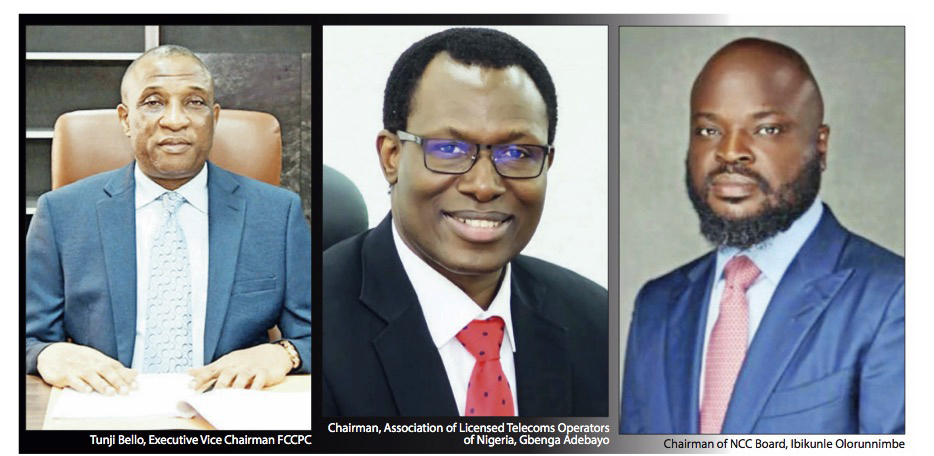
ALTON Chairman, Gbenga Adebayo, described the situation as a “critical test” of the country’s regulatory credibility.
“This is not just a disagreement between institutions. It is about whether businesses can operate with clarity and whether consumers can rely on essential services without disruption,”he said.
Legal practitioners have also expressed concern over the apparent disregard for court orders.
Demilade Atoyebi, a Lagos-based lawyer, noted that compliance with judicial rulings is fundamental to the rule of law.
“When a court of competent jurisdiction issues an order, it is binding, not optional. Failure to comply undermines confidence not just in the judiciary, but in the entire regulatory system,” he said.
The situation, he added, could set a dangerous precedent if left unaddressed.
The FCCPC, which initiated the regulatory framework at the centre of the dispute, has also come under criticism.
While the commission maintains that the disruption is a consequence of non-compliance rather than a deliberate ban, its perceived inaction in enforcing the court’s directive has raised questions about its commitment to consumer protection.
Critics argue that the commission’s stance has contributed to prolonged uncertainty, leaving both service providers and consumers in a state of confusion.
For Nigeria’s over 156 million mobile subscribers, the crisis is less about legal arguments and more about everyday survival.
In a country where many people operate outside formal financial systems, airtime credit often serves as a stopgap, bridging short-term financial gaps and enabling basic communication.
Its sudden absence has exposed the vulnerability of millions who depend on informal financial tools to navigate daily life.
“I missed an important business call last week because I had no airtime and no cash immediately. That call could have brought me a new customer,” said Funmilola, a small-scale fashion designer.
Stories like hers are becoming increasingly common.
As the substantive suits return to court, stakeholders across the telecommunications and financial sectors are watching closely.
The outcome will likely have far-reaching implications not just for airtime credit services but for the broader regulatory landscape governing digital finance in Nigeria.
For now, however, the situation remains unresolved.
The court orders are clear. The services, however, are still largely unavailable.
And for millions of Nigerians, the pressing question is no longer about legal technicalities or regulatory mandates; it is about when, or if, their vital link to communication and commerce will be restored.