Follow Us on Google
By Fidelis Ugbomeh
Stakeholders in transport and logistics business have called on importers and agents to liase with management of Nigerian Railway Corporation, Nigeria Inland Waterways Authority and Nigeria Shippers Council to encourage evacuation of imports/exports in and out of the port terminals through rail and water modes of transportation.
This is coming amidst allegations that some members of Seaport Terminal Operators Association of Nigeria have tilted freight haulage in and out of their port terminals in favour of road thereby causing traffic gridlock and avoidable truck accidents.
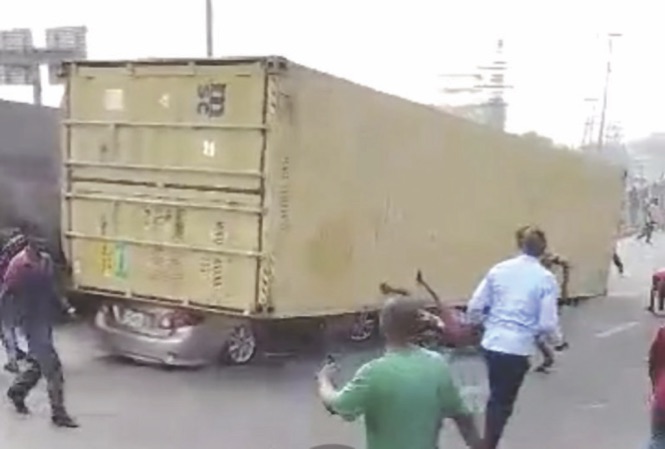
To Burress this, a Freight Forwarder, Mr. Eric Umezurike said a 40-foot loaded container en route Apapa recently fell from a moving truck, on a Toyota Camry with registration number, LSR 293 HJ, at Mile 2 area of Lagos.
Although, driver of the car was rescued alive from underneath the container and rushed to a nearby hospital many believed the accident could have been averted, if the container was carried by rail/barge to Apapa instead of road.
Umezurike averred that the condition of trucks used in evacuating containers in and out of the ports should be checked and certified by representatives of relevant government and private organisations like Nigerian Ports Authority, Association of Maritime Truck Owners and other splinter groups.
General Manager, Lagos State Traffic Management Authority (LASTMA) Mr Olalekan Bakare-Oki reiterated critical importance of proper securing of containers by truck drivers and owners.
He stated further that negligence in this regard endangered lives and property, urging strict compliance with road safety protocols to avert such catastrophic occurrences like the one that happened at Mile 2.
Mr. Paul Ndibe, Director of Operations, BUENO Logistics Limited said that the terminal operators that can maximise the use of intermodal transport to the advantage of public is A.P.Moller Terminal and ENL Consortium because they are linked by rail, water and road modes of transport.
He decried the present trend whereby management of A.P Moller Terminal (A.P.M.T) imposed levies on importers for use of rail and barges to evacuate containers whereas levies are not paid for the same service provided by road.
“The management of A.P.M.T and other terminals linked by rail, should liase with shipping companies with a view to advising them on mode of transport that could make movement of their consignment from the ports to their various destinations seamlessly without delays often caused by congestion on our roads.
“In this way dwell time will reduce, there will be efficiency in the port operation, turn around and clearing time will reduce, more space will be created and cost of goods in the open market will reduce”, he declared.
The director operation spoke about the need for A.P.Moller management to design a time frame for port access through railway and barges into the port which must be strictly adhered to by key players in the port.
Regarding insinuations making the round that Nigerian Railway Corporation does not have capacity in terms of rolling stocks to meet logistics needs of importers/exporters, the Managing Director Nigerian Ports Authority Abubakar Danstoho said one of the constraints hindering the use of narrow gauge railway mode to evacuate goods is double handling charges imposed by terminal operators.
He however explained that the double handling charges does not apply to containers moved on the standard gauge railway line from Lagos to Ibadan.
Dantsoho who was represented by General Manager, Lagos Port Complex Mr. Adebowale Lawal Ibrahim,at 2024 Conference and Awards recently organised by Association of Maritime Journalists of Nigeria in Lagos said that there should be more investment in the development of port infrastructure so as to attract patronage.
He pointed out that the current throughput of barely 200,000 containers offloaded annually through our port terminals is grossly inadequate compared to other ports with about 200 million containers offliaded annually.
He also stated that 85% of consignment at Lome port are Nigeria bound because the port environment is condusive for doing business.
Corroborating, Director Strategic Marine and Research said, Mr. Rotimi Anifowose noted that the port reforms embarked upon in 2006 focused on concessioning of the port terminals adding that the reforms should have been stratified into economic, technological, infrastructural, operational and logistics.
Representing the Executive Secretary and CEO of the council Barr.Pius Akutah he expressed optimism that with the concurrent passage of the Shippers Council Reforms bill by both House of Representatives and Senate the President Bola Tinubu will give assent to the bill.
“There is need for regulatory function to be entrenched in order to create environment for importers and exporters to respect,” Akutah declared.
He decried the present trend whereby the regulation of port agencies are not not properly streamlined adding that “how can you have a reform without regulation”?
The executive secretary reiterated that, the council is working in line with theme of the conference:”Nigeria Maritime Industry Under The Renewed Hope Agenda,” to ensure that latest equipment, infrastructure, technology and operational logistics are properly acquired and deployed for better port efficiency.
Mr. Festus Igwe, a Consultant alleged that some terminal operators are still using the forklifts inherited from Nigerian Ports Authority instead of investing in procurement of modern equipment.
He accused Nigerian Ports Authority and Nigerian Shippers Council for doing less to ensure that the terminal operators comply with terms of agreement and not impose levies arbitrarily under various guises on importers.
Mr.A.C Oguntwase representating Area Comptroller, Federal Operations Unit, Ikeja of Nigeria Customs Service at the conference enjoined agents and importers to make genuine declarations.