Follow Us on Google
From Adanna Nnamani, Abuja
Spain has emerged as Nigeria’s largest export destination in the second quarter of 2025, absorbing goods valued at N2.47 trillion, while China retained its dominance as the country’s biggest source of imports, supplying N4.96 trillion worth of goods.
The National Bureau of Statistics (NBS), in its Foreign Trade in Goods Statistics report, said Nigeria’s trade position strengthened during the period, with the surplus widening by 44.3 per cent to N7.46 trillion, compared to N5.17 trillionin the first quarter.
Total exports stood at N22.75 trillion, up 10.5 per cent quarter-on-quarter and 28.4 per cent higher than the same period of 2024, while imports slipped marginally by 0.9 per cent to N15.29 trillion.
Other leading export destinations included India with N1.98 trillion, France with N1.62 trillion, the Netherlands with N1.54 trillion and Canada with N1.43 trillion. Collectively, these five countries accounted for nearly 40 per cent of Nigeria’s total exports. Europe remained the top regional market, taking in 38 per cent of exports, followed by Asia at 33 per cent, the Americas at 16 per cent and Africa at 13 per cent. Within Africa, ECOWAS countries received goods worth N1.93 trillion, mainly petroleum products.
Crude oil exports contributed N11.97 trillion, or 52.6 per cent of total exports, though this was 5.1 per cent lower than the same quarter in 2024 and 7.6 per cent below Q1. The decline was offset by strong growth in other petroleum products, which almost doubled to N7.74 trillion. Manufactured exports surged by 173 per cent to N803.8 billion, while solid minerals rose by 31 per cent to N77.3 billion, reflecting gradual diversification beyond hydrocarbons.
On the import side, Asia accounted for half of Nigeria’s inflows with N7.65 trillion, led by China. The United States followed with N2.16 trillion, while other major import partners were India, the Netherlands and the United Arab Emirates. Imports were dominated by machinery, refined petroleum products, wheat and pharmaceuticals, with manufactured imports alone valued at N7.88 trillion. Agricultural imports rose to N1.18 trillion, driven largely by wheat from Canada and Russia.
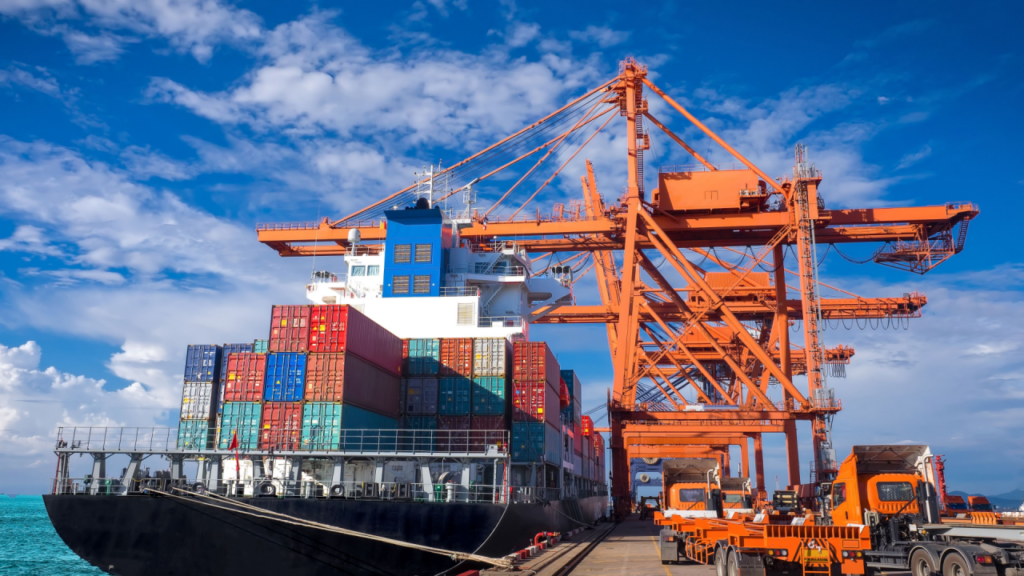
Maritime transport continued to handle the bulk of Nigeria’s trade, carrying 99 per cent of exports and 95 per cent of imports. Apapa Port remained the country’s busiest hub, processing N17.93 trillion in exports and N6.96 trillion in imports, while Lekki Deep Sea Port expanded its role, accounting for more than 10 per cent of exports and 16 per cent of imports in the quarter.
Analysts said the stronger trade surplus offers some relief for Nigeria’s reserves and exchange rate, but cautioned that the country’s heavy reliance on petroleum still leaves it exposed to external shocks. They noted that while gains in manufactured and solid mineral exports point to early progress in diversification, the persistently high import bill underscores the need for deeper industrialisation.