Follow Us on Google
From Juliana Taiwo-Obalonye, Abuja
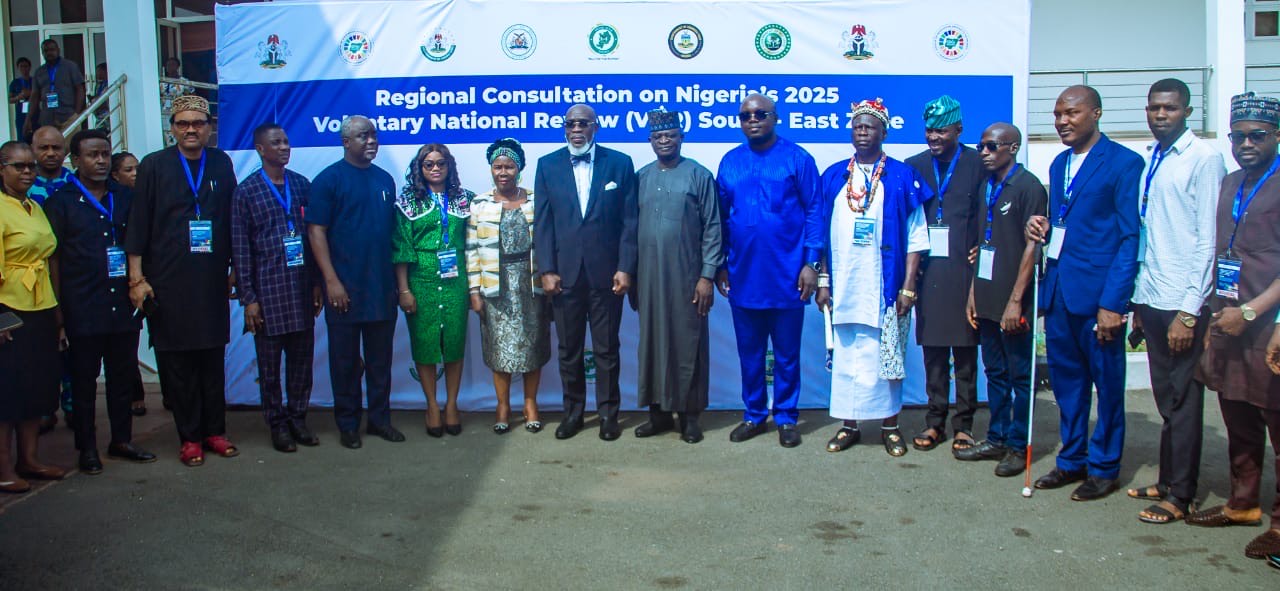
Key stakeholders from the South-East Geopolitical Zone have evaluated the region’s implementation efforts as Nigeria prepares for its third Voluntary National Review (VNR) on the Sustainable Development Goals (SDGs). The assessment emphasises the necessity of strategic cooperation and ongoing peer review to accelerate the SDGs’ implementation.
The assessment was part of the South-East Regional Consultation on Nigeria’s 2025 Voluntary National Review (VNR), convened by the Special Assistant on Media to the Senior Special Assistant to the President on SDGs in Enugu.
According to a statement released by the Special Assistant on Media to the Senior Special Assistant to the President on SDGs, the consultation served as a crucial platform for dialogue, collaboration, and strategic planning, as well as for evaluating progress, challenges, and opportunities in implementing the SDGs.
The Governor of Enugu State, Peter Mbah, represented by the Secretary to the State Government, Chidiebere Onyia, underscored the significance of the consultation in driving inclusive SDG progress.
He emphasised the need to celebrate achievements while identifying gaps and fostering innovation, particularly for rural communities and youth.
‘The SDGs are a call to action for every region, community, and individual. The South-East, with its strong human capital, entrepreneurial spirit, and resilience, has a crucial role to play in accelerating SDG implementation in Nigeria,’ he stated.
Onyia called on stakeholders to ensure that development initiatives prioritise marginalised populations, even as he acknowledged advancements in healthcare, education, and economic opportunities. He urged bold solutions and enhanced cooperation to bring about significant change in the region.
Other News
In her keynote address, the Senior Special Assistant to the President on Sustainable Development Goals, Adejoke Orelope-Adefulire, represented by the Head of the Conditional Grant Scheme in the Office, Ifeyinwa Ukaegbu, highlighted the importance of the 2030 Agenda as a comprehensive framework for addressing economic, social, and environmental challenges.
She noted that Nigeria, having previously presented VNRs in 2017 and 2020, is preparing for its third review in 2025.
‘Effective VNRs rely on inclusive, broad-based, and participatory processes. That is why we are engaging with diverse stakeholders across Nigeria to ensure a “whole-of-government and society” approach to SDG implementation,’ she emphasised.
She further noted that the 2025 VNR aligns with global commitments, particularly following the adoption of the ‘Pact for the Future’ at the 79th United Nations General Assembly (UNGA) in September 2024.
‘The Pact reaffirms world leaders’ commitment to bold, accelerated, and transformative actions to fast-track SDG achievement,’ she added.
The Lead Consultant for Nigeria’s 2025 VNR, Babatunde Ipaye, emphasised the importance of collaboration in exchanging ideas and developing actionable insights for SDG implementation, while the SDG Focal Person for Enugu State, Onyinye Akubuilo, praised the state’s commitment to sustainable development, attributing its progress to the socio-economic policies of the state government, which have facilitated effective SDG implementation.
This year’s VNR, themed ‘Advancing Sustainable, Inclusive, Science and Evidence-Based Solutions for the 2030 Agenda for Sustainable Development and Its Sustainable Development Goals for Leaving No One Behind’, saw participation from government representatives, academia, people with disabilities, youth groups, and civil society organisations across the South-East states.
The outcomes of the consultation will play a vital role in shaping Nigeria’s 2025 VNR, contributing to the nation’s ongoing efforts to achieve the SDGs and ensuring that no one is left behind.