Follow Us on Google

From Jude Chinedu, Enugu
The South-East is taking another step towards addressing one of the region’s most persistent economic challenges: inadequate energy supply for industries and businesses.
The Federal Government has commenced moves to develop a $100m gas distribution pipeline project designed to connect gas resources to industrial and commercial centres across Enugu, Anambra, Imo, Abia and Ebonyi states.

The 400-kilometre pipeline is expected to supply gas to manufacturers, power generation companies, agro-processors and other businesses, potentially reducing energy costs, supporting production and creating employment.
The project, being driven by the South-East Development Commission (SEDC) in partnership with GasSync, is expected to begin construction in the first quarter of 2027, with first gas delivery projected for the second quarter of 2028, subject to the necessary requirements.
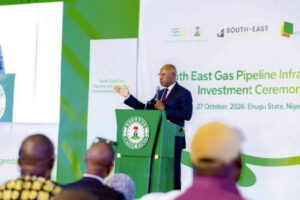
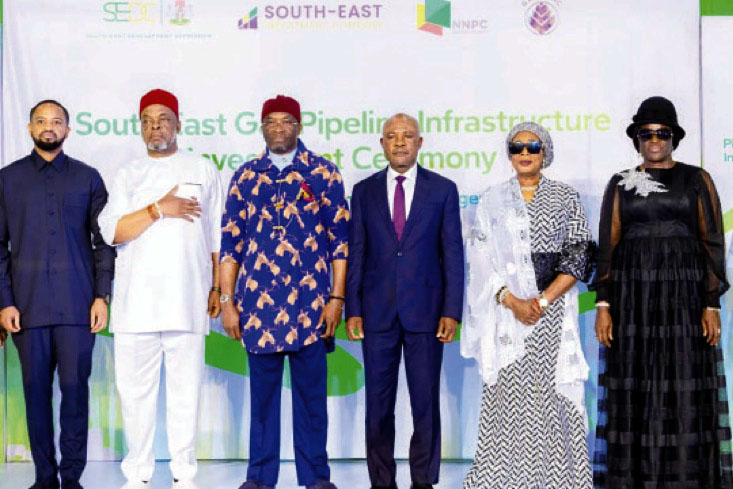
An investment agreement was signed on Tuesday at Hotel Presidential, Enugu, marking a significant step towards the proposed infrastructure.
But beyond the signing ceremony and the promises of economic transformation, the project raises a critical question: can the South-East turn its gas resources into a reliable energy supply that will attract investment and sustain industrial growth?
Tinubu’s industrialisation ambition
President Bola Tinubu, represented at the event by the Deputy Speaker of the House of Representatives, Benjamin Kalu, described the South-East’s entrepreneurial strength as an important national economic asset.
“The South-East’s entrepreneurial spirit is one of Nigeria’s greatest economic assets. I have always believed that the prosperity of the South-East is inseparable from the prosperity of Nigeria,” he said.
Tinubu argued that energy infrastructure should be developed to support economic activity across state boundaries, rather than operate within narrow political interests.
“Gas infrastructure must therefore serve industries and markets, not stop at political boundaries. That is the economic logic of regional integration,” he said.
For a region with a strong tradition of private enterprise, reliable energy could help existing businesses expand and encourage new investments. Manufacturers that depend on expensive alternative energy sources could benefit from a more dependable gas supply, while investors might find the region more attractive for establishing factories and processing facilities.
The President said the project should not be limited to meeting the needs of industries already operating in the region.
“Our ambition is not simply to deliver gas to existing factories. It is to make possible factories that do not yet exist, industrial parks yet to be developed, and investments that have remained on the drawing board because reliable energy was unavailable,” he said.
Tinubu also presented the initiative as an example of how development institutions could combine public funding with private capital to deliver infrastructure.
“This is the model I expect from our development institutions: identify strategic economic opportunities, prepare credible projects, commit public resources responsibly and mobilise private capital at a scale government budgets alone cannot achieve,” he said.
He added: “We are not investing in pipelines for their own sake. We are investing in the industries, businesses and jobs those pipelines will make possible.”
The President challenged those involved to measure success by the results delivered to the people.
“The true measure of government’s commitment is not what we promise, but what we deliver,” he said.
He concluded: “Let the gas beneath our soil power our industries. Let that energy become production. Let production become employment. Let employment become prosperity for our people.”
SEDC’s funding commitment
The South-East Development Commission is central to the project’s financing and coordination.
The commission has committed $3m towards the initiative and is targeting aggregate regional investment participation of up to $30m, including the $3m commitment.
The initial phase of the project is estimated to cost approximately $100m, making the mobilisation of additional funding essential to its implementation.
The proposed financing arrangement reflects the wider challenge facing infrastructure development in the region: public institutions must demonstrate commitment while attracting private investors willing to provide the resources needed to move projects from agreements to construction.
For the pipeline to deliver its anticipated benefits, the funding commitments must translate into the timely completion of the infrastructure and the provision of gas to businesses.
The project’s significance also lies in the possibility of connecting industries across the five states through a shared energy network, potentially encouraging greater economic cooperation.
However, the impact will depend on the ability of the project promoters to secure the required funding, complete the pipeline and establish a commercially viable distribution system.
Mbah welcomes project
Enugu State Governor Peter Mbah described the agreement as an important milestone in the region’s long-standing aspiration for industrialisation.
“Tinubu loves the Igbo. The SEDC is a commission whose time has come. It was an idea conceived many decades ago, but it took President Tinubu to establish this long-awaited dream of industrialisation of the South-East,” he said.
Mbah said the signing of the agreement meant that the project had moved beyond discussions towards investment.
“What we have just signed here today is an investment agreement, meaning that investment has commenced,” he said.
Other News
The governor linked the project to the need to create economic opportunities that would enable young people to build their futures in the region instead of leaving in search of jobs elsewhere.
“Before now, it was our young people running out of the region in search of greener pastures. But with what we have now, our young people can sit back and find their future here in the region. This is all thanks to President Tinubu,” he said.
Mbah also pledged the state government’s support for the project, particularly in securing approvals needed for construction.
“We, the South-East governors, are committed to this. We will ensure that the right of way and EIA are given accelerated approval,” he said.
The commitment of the state governments will be important because pipeline construction requires cooperation with host communities and the timely resolution of land, environmental and other regulatory issues.
Five states, one energy network
The proposed pipeline will connect gas resources and prospective customers across Enugu, Anambra, Imo, Abia and Ebonyi.
According to GasSync promoter, Callistus Mba, the route will begin at Ohaji in Imo State, run through Owerri, branch towards Aba in Abia and Onitsha in Anambra, and extend to Enugu and Ebonyi.
Mba said the promoters intended to avoid a strictly sequential construction approach that could delay supply to some parts of the region.
“We are going to start at Ohaji and Onitsha at the same time,” he said.
He explained that simultaneous commencement at the two locations was intended to prevent the delay that could arise if construction started in Imo State and proceeded from one location to another.
Mba said the promoters intended to begin construction in the first quarter of 2027.
“We intend to start construction in the first quarter of 2027,” he said.
First gas delivery is projected for the second quarter of 2028, subject to the necessary requirements being met.
The proposed network is expected to serve approximately 150 prospective customers, with projected demand of 254 million standard cubic feet per day.
The prospective customers include manufacturers, power generation companies and agro-processing businesses. Geometric Power is among the potential customers identified.
The projected demand points to the potential scale of industrial energy consumption in the region. Yet the commercial value of the pipeline will ultimately depend on how many of the identified customers connect to the network and use the gas for productive activities.
Governors pledge support
The deputy governor of Imo State, Chinyere Ekomaru, described the initiative as an opportunity for the South-East to advance its development ambitions.
She also linked the project to the region’s political choices, urging residents to support the continuation of the initiative.
“A vote for APC is a direct vote for the continuation of this project. A bird in hand is worth more than 10 in the bush. Let’s reason wisely,” she said.
Anambra State Deputy Governor Onyekachukwu Ibezim urged the commission and its partners to ensure that the project’s benefits became visible to residents.
“We will clap for you when we begin to feel the impact of what you are doing,” he said.
He also called on communities along the proposed pipeline route to support its implementation.
“I want to urge the communities through which the pipelines will pass to have a buy-in. We are strongly behind the commission,” he said.
For Ebonyi State, Deputy Governor Patricia Obila described energy as essential to industrial development and economic growth.
“Energy is power. Its importance cannot be overemphasised. With it, factories will produce, the economy will blossom and employment will be great,” she said.
Obila pledged the state government’s support for the project.
“We will give you all the support needed to operate in Ebonyi to ensure that our moribund companies return back to operations,” she said.
The commitments by the governors and their representatives are significant because the project cuts across state boundaries and will require cooperation on implementation, approvals and community engagement.
From agreement to delivery
The proposed gas pipeline offers the South-East an opportunity to address an important constraint on industrial expansion. Reliable energy could help businesses manage operating costs, improve production and encourage investment in manufacturing and other productive sectors.
Its regional structure could also strengthen economic links among the five states, allowing industries to access a common energy network instead of depending entirely on separate arrangements.
But stakeholders have noted that an investment agreement is only an early step in a project of this scale. The promoters must still turn funding commitments into construction, meet the requirements for the pipeline’s development and deliver gas within the projected timeline, they noted.
They noted: “The participation of host communities will also matter. Cooperation along the route could help reduce implementation difficulties, while delays in approvals, financing or construction could affect the schedule.
“There is, therefore, a difference between the promise of the pipeline and the benefits it will eventually deliver. The projected demand of 254 million standard cubic feet per day and the identification of around 150 prospective customers provide a basis for the project, but the real test will be whether industries receive the gas they need.
“For the South-East, the stakes extend beyond the laying of pipes. The region needs infrastructure capable of supporting existing businesses, attracting new factories and creating jobs for its growing population.”