Follow Us on Google
From Isaac Anumihe, Abuja
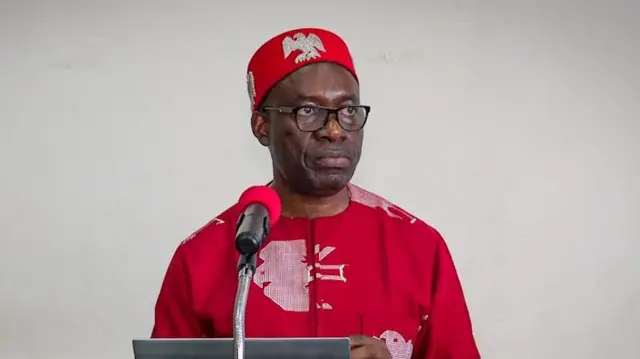
Governor of Anambra State and a professor of economics, Chukwuma Soludo, has cast a doubt on the Federal Government’s policy of achieving $1 trillion economy by 2030, saying that it is difficult to achieve unless Nigeria consistently grows the Gross Domestic Products (GDP) by 20 per cent.
Soludo who was a panelist at the ongoing National Economic Council (NEC) meeting, in Abuja, recalled that when he was a governor of Central Bank of Nigeria (CBN), the unemployment rate was just three per cent. He added, however, that the government has done well in its structural reforms.
In the same vein, Minister of Budget and National Planning, Senator Atiku Bagudu agreed that although the $1 trillion economy is a tall order it’s the ambitious policy the government has determined to achieve.
Bagudu, wondered how the government was going to sustain the momentum so that it would benefit everyone and equip the people with skills to eradicate poverty.
“How do we sustain our momentum, ensure it benefits everyone, equip our people with the necessary skills to compete, and envision the future to plan accordingly? How do we eradicate poverty and reach a minimum $1 trillion economy by 2030? How do we mobilise our three tiers of government and our citizens?
I believe this aligns with what Section 130(2) of our constitution intends” he said.
In her remarks, Vice President, Kassim Shettima stated that the journey towards inclusive growth demands sustainable national development——– development that balances expansion with equity, opportunity with responsibility, and prosperity with environmental stewardship.
“It is no longer enough to measure progress by Gross Domestic Products (GDP) figures alone. We must ask harder questions. How does growth transform lives? How does it uplift communities? How does it strengthen national coherence? As members of this council and leaders of our respective states, the weight of responsibility weighs heavily on our shoulders” he said.
To this effect, Shettima expressed the optimism that with the positive growth of the economic indices, the $1 trillion was achieveable
Other News
“First, state and local governments now receive increased and more predictable federal allocations, improving their capacity to pay salaries, invest in infrastructure, and deliver social services. Second, we have strengthened the macroeconomic stability through improved revenue performance, stronger public financial management, and enhanced physical co-ordination. Third, we have prioritised infrastructural development across the transportation, power, digital connectivity, housing, and irrigation as a catalyst for inclusive growth.
“Fourth, we have expanded social investment and human capital programmes targeting vulnerable households, youth, women, and small businesses. The Renew Hope World Development Project further demonstrates our commitment to grassroots inclusion through a bottom-up approach to national development. These successes reflect strong collaboration among federal, the state governments, and the local governments.
“The Renew Hope National Development Plan 2026-2030 marks the next phase of our national journey. It is evidence-based, realistic, and anchored on an inclusive, balanced, and environmentally sustainable growth. The plan prioritizes economic diversification and productivity, human capital development, national competitiveness based on comparative advantage, private sector-led growth, and climate resilience.
“It is such as we depend largely on effective implementation at the state and local government levels, making it central to aligning national priorities with national realities” he said.