Follow Us on Google
By Steve Agbota, [email protected] 08033302331
2022 stood out as a year of mixed fortunes for stakeholders in maritime industry. It was a year seen by many as one of the toughest driven by high rate of exchange rate, forex scarcity, drop in importation and other.
In the beginning of the year 2022, industry stakeholders had anticipated so much but as the year wound down, outcomes were far from expectations as the industry recorded abysmal results.
The nation’s maritime sector was still bedeviled with several other challenges including traffic gridlock, port congestion and high cost of doing business among others, all of which impacted both stakeholders in more ways than one.
For instance, the ports continued to contend with obsolete infrastructure, including roads, rail system, quay, buildings, equipment and yards and remained heavily dysfunctional, coupled with congestion and high level of insecurity and pilferage.
But as the year 2023 settles in, stakeholders, especially ship owners and Customs brokers/freight forwarders have called for the implementation of national single window regime, creation of Ministry of Maritime Affairs, National Transport Commission (NTC), and favourable trade policies among other things that will bring development to the industry.
Deployment of national single window regime
As issues of corruption and revenue leakages remained paramount at the nation’s seaports, stakeholders have called on Federal Government to deploy the national single window regime to ensure transparency and professionalism, which the sector requires to grow.
The single-window system is a trade facilitation idea. As such, its implementation of enables international traders to submit regulatory documents at a single location or single entity.
As of today, absence of National Single Window Platform (NSWP) in the nation’s seaports is costing the Nigerian economy a whopping N1.08 trillion in Customs revenue annually.
Realising these losses, last year; the maritime agencies under the ministry of transportation, held a meeting to resolve to focus on actualising the single window regime in the nation’s transportation sector.
According to the Economic Recovery and Growth Plan (ERGP) of the Federal Government, the Nigeria Customs Service (NCS) collections would have increased by 90 per cent if the National Single Window has been deployed to the Nigerian ports.
However, to mitigate the losses, the Federal Government agencies under the Federal Ministry of Transportation, reached an agreement to digitalise their internal processes and also maintaining focus on actualising NSW regime.
The registrar of the Council for the Regulation of Freight Forwarding in Nigeria (CRFFN), Sam Nwakohu, said that, full automation of the internal processes of the various agencies represented, is a pre-requisite to achieving the much anticipated National Single Window regime in the sector.
Nwakohu said the Chief Executive Officers (CEOs) of the various agencies have agreed on timelines to achieve full automation of internal processes.
“We have agreed that all agencies under the Ministry of Transportation should as a matter of priority, attain full automation. This process will be well coordinated and we also gave ourselves timelines to achieve this,” he said.
Meanwhile, the Director General of the Nigerian Maritime Administration and Safety Agency (NIMASA), Dr. Bashir Jamoh said, NIMASA automation processes have reached over 80 per cent.
Jamoh also gave the assurance that NIMASA’s commitment to automation is to reduce human interface, while also plugging revenue leakages in the system.
“In line with the federal government’s executive order on Ease of Doing Business, we are committed to full automation to attain reduction of human interface in majority of our transactions with our stakeholders and this is in our bid to ensure transparency and professionalism which the sector requires to grow. The goal is to align with the National Single Window initiative, when all the internal processes of the various Agencies have been concluded,” he said.
Disbursement of CVFF
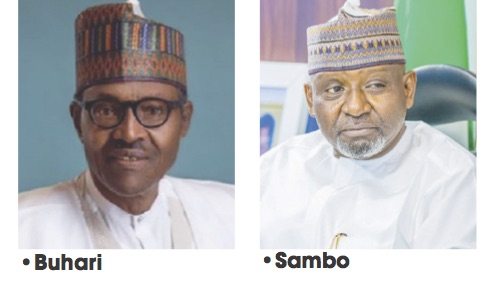
Recently, the Minister of Transportation, Alhaji Muazu Jaji Sambo, announced that President Muhammad Buhari has approved the disbursement of the S350 million and N16 billion Cabotage Vessel Financing Fund (CVFF) to indigenous shipowners.
The CVFF is an intervention fund created by the Federal Government in 2003 for the development of indigenous shipping capacity in Nigeria through the maintenance of existing vessels or the purchase of new ones. The primary source of the fund is from a two per cent deduction on cabotage trade earnings carried out by indigenous operators in the nation’s inland and coastal trade.
The inability of the Federal Government to disburse the CVFF has made local ship owners to be struggling in the nation’s maritime sector.
The recent announcement sent frenzy down the spines of industry stakeholders with many seeing it as sign of a better tomorrow for the sector and others seeing it as another tool of political manipulation in a buildup to election.
The minister, had disclosed that, President Muhammadu Buhari, approved the disbursement of $350million CVFF to local Shipowners, saying five banks, Zenith, Polaris, United Bank for Africa (UBA), Union and Jaiz are the Primary Lending Institutions (PLI), for the disbursement of the fund.
The transportation minister said President Buhari, further approved that the fund should be further disbursed to shipowners immediately it hit $50million threshold in the Treasury Single Account (TSA).
However, stakeholders have expressed displeasure even as they called for auditing of the fund.
According to the Nigerian Shipowners’ Association (NISA), the fund accrued into CVFF so far has grown to over $2billion.
The chairman Board of Trustees (BoT), Chief Issac Jolapamo, stated that indigenous Shipowners would have contributed more than $2 billion to the fund in the last 17 years, saying $350 million cannot fund acquisition of 6 vessels.
He said it was the former Minister of State for Transportation, Sen. Gbemisola Saraki that revealed that the fund contributed so far was around $350 million, which was against figures released by previous ministers.
“It was because the former minister of state for Transportation, Sen. Gbemisola Saraki, that mentioned $350 million that changed the narrative. Nobody has ever mentioned a figure higher than $150 or $190 million.
“For me who knows from the beginning an idea of how much the money is, the money is minimum, nothing less than $2 billion. And we want to get to the root of it.
“Where is the money? $350 million dollars will not do us anything. It can not even buy six ships. So, if we have waited for 17, or 18 years, we should know if anybody has dipped his hands in the money. We need to get to know,” he argued.
Meanwhile, with the approval by Mr President for disbursement coming in the last quarter of 2022, stakeholders are eagerly expecting a disbursement of the fund before the close of Q1 in 2023.
National Transport Commission
The National Transport Commission (NTC) Bill, which was sponsored about 15 years ago, is yet to come to fruition. In 2018, which was exactly 10 years the bill was sponsored, the National Assembly worked on the bill sent it to President Muhammadu Buhari, for assent but Buhari declined it and sent it back.
Buhari rejected the bill on three grounds including the removal of safety issues because the bill is purely economic regulation.
Secondly, the President also said that the royalty to be paid to the commission as source of funds, which was pegged at 10 per cent should be reduced to five per cent.
Thirdly, Buhari also asked the National Assembly to look at the freight stabilisation fee, which was put at three per cent to be reduced to one per cent just like it is in the Nigerian Shippers Council (NSC) Act.
One of the experts in the industry then said that all the grey areas in the bill have been weeded off, and the bill would soon be transmitted to Mr. President again for signing. But since then, nothing has been said or heard about signing the bill soon.
However, stakeholders have called on the National Assembly and President Buhari to workout the modalities and sign the bill this year because the danger in delaying assent to the bill creates uncertainty in the industry.
Vice President of (ANLCA), Prince Kayode Farinto said, “the issue of National Transport Commission (NTC) should be a reality this year so that we will be able to achieve a lot in the industry.”
Creation of maritime ministry
Recognising the huge potential the maritime sector holds, stakeholders at different fora have called on the National Assembly to champion a complete reform of the maritime sector by sponsoring and enacting a bill that will lead to the creation of Ministry of Maritime Industry (MoMI).