Follow Us on Google
By Fred Itua, Abuja
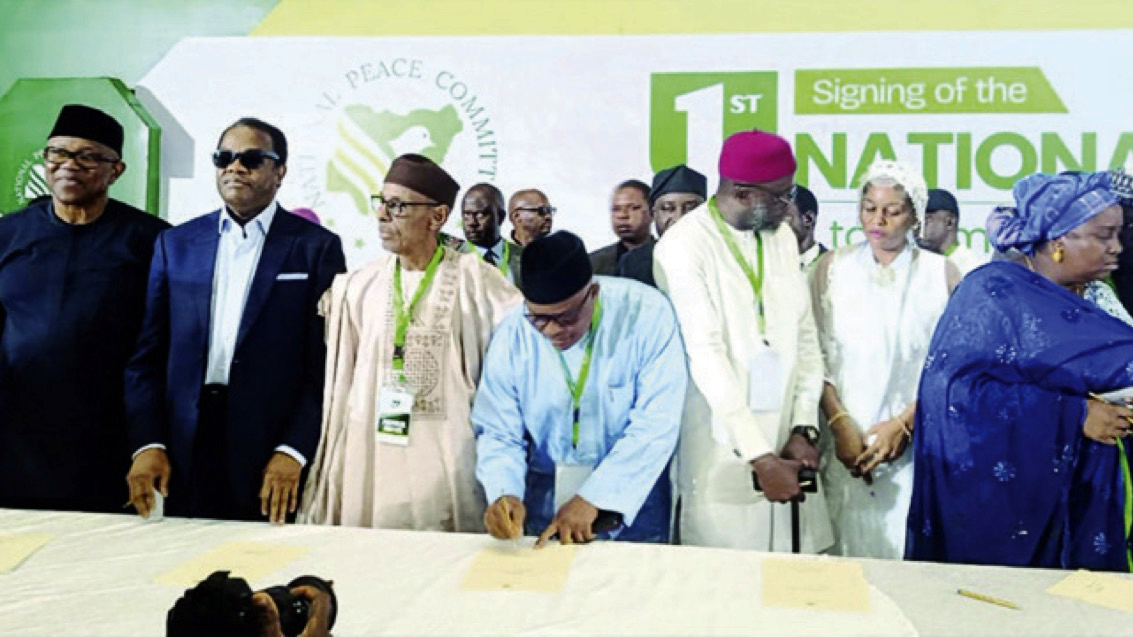
When political parties and their presidential candidates gathered at the International Conference Centre in Abuja, last Tuesday to sign the first National Peace Accord ahead of the 2027 general elections, the ceremony was meant to project unity, restraint and a shared commitment to peaceful campaigns. Instead, what it exposed was a familiar and troubling pattern in Nigeria’s democratic life; a solemn national ritual observed more in its breach than in its keeping, and a document whose greatest weakness has never been its wording, but its complete absence of legal consequences.
Two names loomed over Tuesday’s proceedings. Their relevance is not as a result of what their bearers said, but because of where they were not. President Bola Ahmed Tinubu, seeking a second term on the platform of the All Progressives Congress (APC), did not attend in person and was represented by the Secretary to the Government of the Federation, Senator George Akume.
Former Vice President Atiku Abubakar, the African Democratic Congress (ADC) candidate and the most experienced campaigner in the race, stayed away entirely, with his party represented instead by its National Legal Adviser, Professor Oserheimen Osunbor. Both men were in the country at the time. Neither considered the occasion important enough to attend physically.
A peace pledge missing its two biggest names
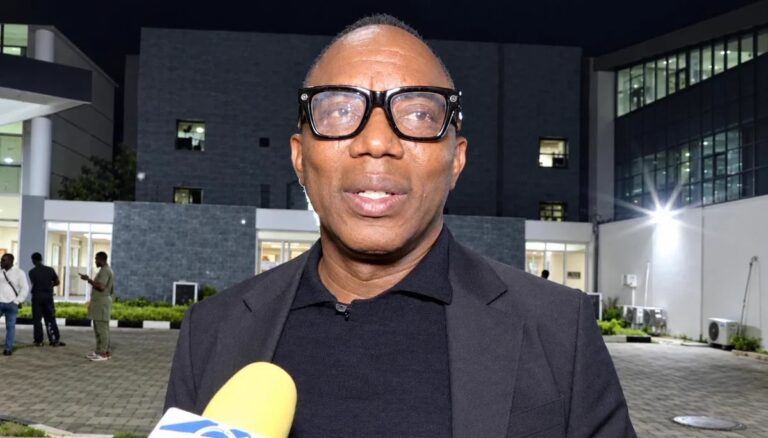
The ceremony was not a routine campaign stop or a minor stakeholder engagement that could reasonably be delegated. It was the inaugural, symbolic moment at which Nigeria’s political class was asked to publicly bind itself, before the cameras and before each other, to a peaceful and issue-based contest for the country’s highest office. Every other major candidate in the race, including Peter Obi of the Nigeria Democratic Congress (NDC), Omoyele Sowore of the African Action Congress (AAC) and Adewole Adebayo of the Social Democratic Party (SDP), found it necessary to be physically present. The sitting president and the man making his seventh attempt at the presidency did not.
For a president already in office and asking Nigerians to renew his mandate, and for a former vice president whose entire political identity has been built around persistence and readiness to serve, the optics of that absence are difficult to explain away as mere scheduling. If the men most likely to occupy or retain Aso Rock come January cannot find the time to stand before the National Peace Committee, the Sultan of Sokoto, Bishop Matthew Hassan Kukah and their own rivals to pledge peaceful conduct, what does that suggest about how seriously either man regards the ritual itself, or the violence it is meant to guard against?
It also bears asking what precedent this sets for candidates further down the ballot. If the two most powerful men in the contest can treat the accord as an event to be delegated rather than attended, state governors, National Assembly candidates and local party chieftains contesting far more localised and, in many cases, far more violent races will have little incentive to treat their own participation as anything more than a formality either. Peace accords work, to the extent that they work at all, through the weight of moral example set from the very top of the political hierarchy. That example was conspicuously absent last Tuesday.
Tinubu’s loud absence sets wrong tone
Tinubu’s absence drew the sharpest public criticism. Speaking on Channels Television shortly after the ceremony, SDP candidate Adewole Adebayo argued that the President’s non-attendance sent a troubling signal, telling the station that Tinubu was, in his words, “not committed to peace.” Adebayo went further, suggesting that the absence risked communicating the wrong message to security agencies and civil servants about how seriously the country’s leadership takes the peace process, and called on the President to issue a public statement clarifying his commitment.
In fairness, Akume, reading a message on the President’s behalf, urged political actors to campaign on the strength of ideas rather than identity politics, warning against the exploitation of ethnic and religious sentiment, and stressing that elections are not a do-or-die affair. For pundits and political observers, those are the right words. But there is an obvious tension between a president who, through a proxy, warns the nation against treating elections as a battle for survival, while being unable to make time to say so himself at the one event explicitly designed to lower the political temperature before campaigning begins. Words delivered by an aide, however well crafted, do not carry the same weight, nor the same accountability, as a personal pledge made in front of one’s rivals and the nation’s moral authorities.
Atiku missed a chance to prove himself
If Tinubu’s absence raises questions about a sitting president’s priorities, Atiku Abubakar’s absence raises a different, arguably a sharper one. Atiku has now sought the presidency in some form in every election cycle since 1993, having previously contested and lost in 2007, 2011, 2015, 2019 and 2023. Few political figures in the country’s history have invested as much time, resources and personal ambition into reaching Aso Rock. If the 2027 race genuinely represents, as his supporters insist, his best and perhaps final opportunity to win the presidency after more than three decades of trying, pundits argue that he would have treated every milestone of the campaign, starting with its very first, as an occasion too important to skip.
Instead, the ADC candidate was absent, with the party citing his schedule and deploying its National Legal Adviser to sign on the party’s behalf. Atiku’s explanation may satisfy the letter of participation, but it does little to answer the underlying question a seven-time contender ought to be able to answer without hesitation; why would a candidate this determined, this experienced and this familiar with the machinery of Nigerian elections, choose to sit out the one gathering explicitly designed to demonstrate that he takes the safety of the process, and by extension the safety of the voters he is asking to trust him seriously? A candidate seeking to convince a sceptical electorate that this attempt is different from the previous six cannot afford to be seen treating a foundational democratic ritual as optional.
Peace pact with no force
The accord itself, organised by the National Peace Committee in partnership with The Kukah Centre, commits political parties, candidates and their supporters to peaceful, issue based campaigns, and to reject hate speech, personal attacks, misinformation and any conduct capable of disrupting the electoral process. The Project Manager of the National Peace Committee, Asabe Ndaye, insisted the document was more than ceremonial, describing it as a commitment anchored in the Constitution, the Electoral Act and guidelines issued by the Independent National Electoral Commission. INEC Chairman, Professor Joash Amupitan, described the timing of the signing, a day before the official commencement of campaigns, as deliberate, meant to establish ethical boundaries before nationwide political activity began in earnest. For stakeholders, these are worthy intentions. But intentions have never been the problem with Nigeria’s peace accords. Enforcement has.
Here lies the uncomfortable truth that last Tuesday’s ceremony, for all its pageantry, did nothing to resolve. A peace accord, as currently constituted, is a moral and political pledge, not a binding legal instrument with defined sanctions. Nowhere in the document, nor in the tradition surrounding it since the National Peace Committee first convened one ahead of the 2015 elections, is there a mechanism by which a candidate, a party official or a thug acting in a candidate’s interest can be investigated, charged and prosecuted specifically for breaching the pledge. The accord asks for good behaviour. It does not, and cannot, compel it.
This is precisely why every election cycle since 2015 has produced the same ritual, the same solemn language, and the same subsequent violations, without a single high profile prosecution tracing directly back to a broken peace accord. The document has become, in effect, a ceremony that photographs well but bites nothing.
Confronting the ghosts of 2023
Other News
Nigerians do not need to search far for evidence of this failure. The 2023 general elections were held under a similarly worded peace accord, signed with comparable fanfare, in fact signed twice, first as a campaign pledge and again days before the poll itself, in a deliberate effort by the National Peace Committee to reinforce its message. Yet, those elections were marred by more than 100 election related deaths by some counts, alongside widespread reports of voter intimidation in states including Lagos, Rivers, Kano, Kaduna and Akwa Ibom. Communities in several states alleged that they were targeted for harassment on account of their ethnic origin, with reports of thugs preventing residents from reaching polling units, ballot boxes being snatched in broad daylight, and results being disputed amid allegations of manipulation at collation centres.
The irony of a document signed twice in one election cycle, and still unable to prevent the violence it warned against, ought to have been a wake-up call. Instead, the same pattern of solemn pledges followed by unpunished violations has simply repeated itself into the current cycle, with little evidence that the intervening years produced any structural change to how, or whether, violators are held to account.
Etim Ekpo: A warning we have chosen to forget
Perhaps no single incident better illustrates the gap between accord and accountability than what happened in Etim Ekpo, Akwa Ibom State, during a fiercely contested senate race in 2023. Thugs armed with axes and bottles attacked election officials and voters in broad daylight. There were arrests at the time, widely publicised in the immediate aftermath. Yet, more than three years later, nobody has been prosecuted for that violence. No trial. No conviction. No consequence.
Etim Ekpo is not an isolated failure. It is emblematic of a wider, well documented pattern across Nigeria’s recent election cycles, one in which security incidents are recorded, suspects are occasionally paraded before television cameras, and then, almost without exception, the cases curiously disappear from public view. Legislative committees set up in the aftermath of previous election cycles to investigate violence and killings have, in more than one instance, failed to produce public findings years later. The message this sends to anyone contemplating violence, intimidation or ballot snatching in the 2027 cycle is unmistakable; the risk of being named is real; the risk of being punished is not.
Multiply Etim Ekpo across the dozens of other flashpoints recorded in 2023, from disputed collation centres in Lagos to allegations of security agency complicity in parts of the South South and South East, and a pattern emerges that no peace accord, however sincerely signed, has yet been able to break. Civil society groups tracking electoral violence have long argued that impunity, more than any single piece of legislation or any single ceremony, is the single greatest driver of repeated offences from one election cycle to the next. Where consequences are absent, deterrence is absent, and where deterrence is absent, the same actors who disrupted the 2023 polls have little reason to behave differently in 2027.
Against that backdrop, the National Peace Committee’s own disclosure that its Election Security Information Hub recorded 2,510 security incidents linked to elections between June 2025 and August 2026 alone, spanning at least 70 off cycle elections, by-elections and reruns, should alarm rather than reassure. Zamfara, Borno, Kaduna, Niger, Benue and Plateau were named as the worst affected states, with banditry, kidnapping and terrorism cited as ongoing threats capable of disrupting the electoral process. These are not hypothetical risks that a signing ceremony can pre-empt through moral suasion. They are an active, geographically concentrated security crisis that no pledge of good conduct, however sincerely worded, can neutralise on its own.
Toothless Peace Accord?
The peace accord’s toothlessness would matter less if the broader legal architecture around Nigerian elections had been strengthened in the interim. It has not. If anything, many of the same voices now urging Nigerians to trust in peaceful, credible elections have spent the past year openly reshaping the rules in ways critics say tilt the field rather than level it.
The Electoral Act 2026, signed into law by President Tinubu in February, was passed after what a coalition of civil society organisations, including the Centre for Media and Society, the Kukah Centre, the International Press Centre, ElectHer, the Nigerian Women Trust Fund, TAF Africa and Yiaga Africa, described as rushed, last minute amendments with limited debate on critical clauses. The ADC accused the President of weakening democratic credibility by assenting to the law. The Inter-Party Advisory Council, representing registered political parties, went further, rejecting the amended Act outright and describing it as a regressive framework that threatens the integrity of the 2027 general election.
A former Resident Electoral Commissioner, Mike Igini, offered perhaps the most damning assessment, arguing that the widely praised 2022 Electoral Act, once regarded as one of the most progressive pieces of electoral legislation in Nigeria’s history, had been diluted by the 2026 amendment. Provisions on the mandatory electronic transmission of results, a reform many Nigerians fought hard for after the disputed 2023 elections, were weakened before public pressure forced lawmakers into a partial concession on Section 60(3) of the Act.
Analysts who tracked the process closely have described the manner in which the amendment was pushed through, with emergency plenary sessions, last minute harmonisation between the Senate and House of Representatives, and limited public debate on some of its most consequential clauses, as itself a symptom of the same disregard for process that peace accords are meant to counteract in the political arena. A law meant to reduce electoral confusion, one legal commentary observed, should not itself be born in confusion. If the National Assembly can rewrite the rules of the contest with so little transparency, the argument that political actors alone bear responsibility for the integrity of the process begins to look incomplete.
If the same National Assembly that watered down safeguards against manipulation and delayed critical electoral reforms until the eleventh hour is now expected to lend real force to a peace accord it has no formal role in enforcing, Nigerians would be entitled to ask precisely which institution is meant to make the accord bite. INEC can disqualify or sanction candidates for specific breaches of the Electoral Act itself, but the peace accord, as a parallel moral document, sits outside that enforcement chain entirely.
None of this is to dismiss the value of dialogue, or the moral authority the National Peace Committee has genuinely built over successive election cycles in bringing rival political actors into the same room. There is something to be said for public commitment, however unenforceable, particularly in a country where political violence has repeatedly cost lives. Organisers of the accord are right that establishing shared expectations before campaigning begins is better than establishing none at all.
Stakeholders, political pundits and observers shared expectations are not the same as shared consequences. They all contend that if the 2027 peace accord is to mean anything beyond a well attended photograph opportunity, it must be paired with something the country has so far failed to deliver: a functioning, independent mechanism capable of investigating and prosecuting anyone, regardless of political standing, found to have instigated or participated in electoral violence, ballot snatching, voter intimidation or the deliberate falsification of results.
They noted that a bill to establish a National Electoral Offences Commission has been before the National Assembly for some time. According to them, its continued delay, set against the scale of violence recorded in cycle after cycle, speaks volumes about where enforcement genuinely ranks among the country’s political priorities.
They have also argued that security agencies must also be held to the same standard of neutrality the accord demands of political actors, given persistent allegations in previous cycles of selective enforcement along partisan lines. They opined that political parties themselves must accept that fielding candidates or mobilising supporters implicated in violence, without consequence, makes their signatures on any peace accord meaningless.
Last Tuesday’s ceremony will likely be remembered less for what was said inside the International Conference Centre than for who was not there to say it. A sitting president seeking re-election and a former vice president chasing his seventh attempt at the presidency both had reason, more than any other candidate in the race, to be seen personally endorsing a peaceful contest. Both chose otherwise, while remaining within the country’s borders throughout.
That choice, set alongside a decade long pattern of unenforced pledges, unresolved cases like Etim Ekpo, and an Electoral Act reshaped in ways many stakeholders consider a step backward, leaves little room for confidence that Tuesday’s signatures will translate into anything more durable than the ones that came before them. For stakeholders, until Nigeria builds a peace accord with actual legal consequences behind it, and until its most powerful political figures treat such pledges as a floor rather than a ceremony to delegate, the document signed in Abuja this week risks becoming, like its predecessors, a moving statement about peace with no binding power to secure it.