Follow Us on Google
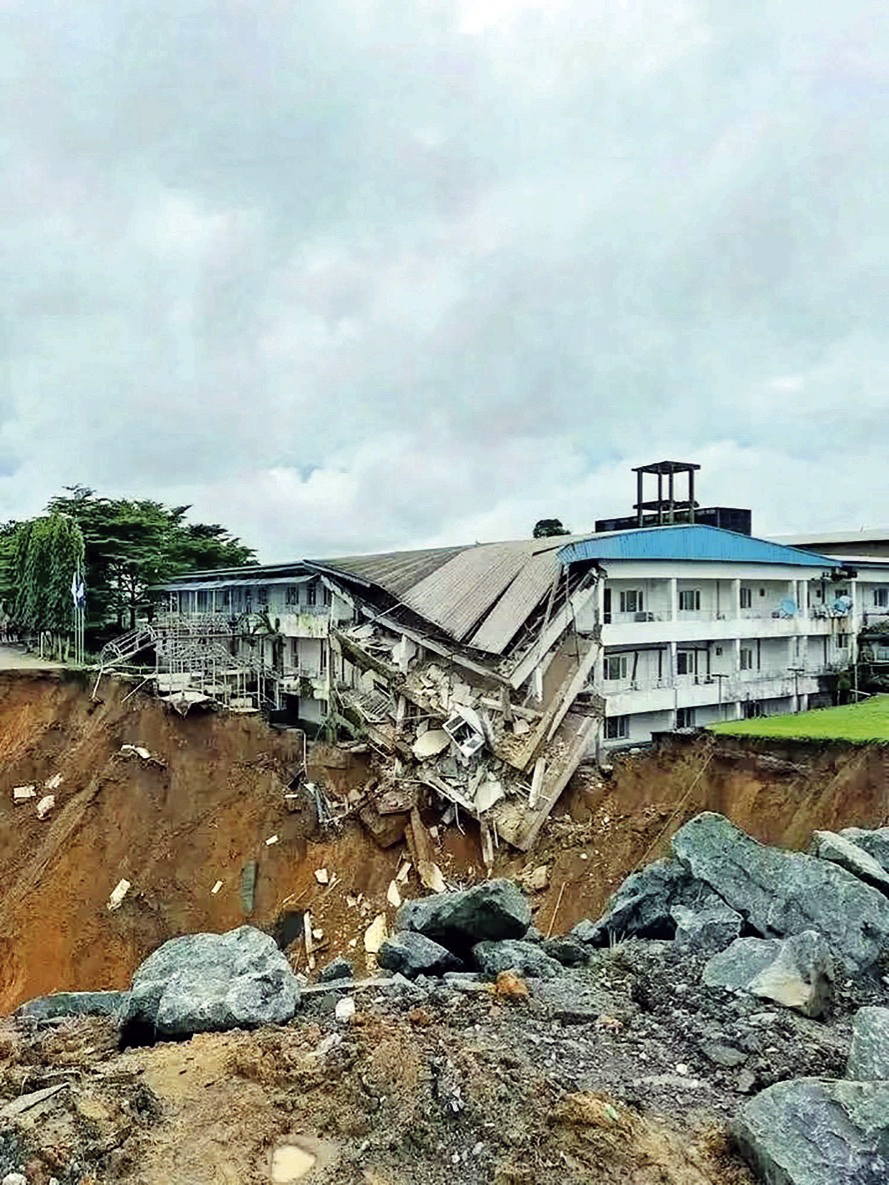
• Residents raise the alarm, say only urgent state, federal help could save houses, businesses
• Community blames poor drainage, spiritual neglect
From Aniekan Aniekan, Calabar
It was supposed to be another rainy morning in Obutong community in Calabar, the Cross River State capital. But rather than the usual rains, residents woke up to the sound of the earth giving way as a landslide swept through houses and businesses, leaving a trail of destruction and cries for help.
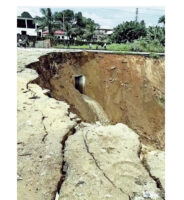
Residents along the Anansa road in Obutong never imagined that the rainfall within a couple of days could cause one of the greatest ecological challenges to ever confront not just the community but the state.
July saw an unprecedented level of rainfall in the state that triggered a very high level of flooding. The huge volume of water caused the failure of an underground drainage system that passes through the area, which caused it to cave in and trigger the crisis in the community.

As at the last count, houses and a major health facility owned by a cement firm has been swallowed up by the ravine, which is fast becoming the biggest ecological crisis in the state.
Acting Chairman of the Obutong Traditional Council, Chief Effiong Etim Eso Archibong, has called for intervention as the scale of destruction is escalating.
He disclosed that the disaster is unprecedented in the history of the community.
“The scale of this disaster is unprecedented. We are calling for intervention from the government and other relevant agencies to avert more damages and also allay fears of protest by the community,”
he said.
Also speaking, Esor Esor Archibong, a community leader in Obutong said the landslide was a natural disaster worsened by construction issues, and not the fault of the current administration.
“These are natural disasters that can happen anywhere and anytime due to wrong constructions.
“So, this particular construction did not happen in the present administration. So why are we protesting or why are we going to be angry?” he asked.
Instead of protest, he said the community is calling on all levels of government and international bodies to intervene.
“What we owe ourselves and the good people of Cross River state is to call for aid. That is a huge project for only our small community to embark upon.”
A community stakeholder, Venerable Harrison Richard Efa warned that the situation is getting worse and needs immediate government action.
“I will beg the government to please do something, because people are losing their properties on a daily basis. If you go to that place, you will see what is happening to people’s properties. And it’s affecting the economy of Cross River State and Nigeria,” he said.
Other News
Efa warned that with more heavy rain expected in Calabar, the landslide could spread further in the next few days and destroy more property.
“If nothing is done urgently, it will cross over to the other side. And it will affect more properties. The government should please come to our aid and assist each and every one of us.”
However while one segment of the community attributes the cause of the landslide to poor construction, another segment attributes it to the sea goddess beloved to be operating in the area called Anansa.
Emmanuel Okon, a youth leader said In Obutong said nothing happens in isolation. In his words, when the land cries and the sea pushes back, it is a sign.
According to him, “Anansa is the custodian of our waters. When the covenant between man and nature is broken, the consequences become physical.
“So, for us, this landslide is spiritual. The rain was the trigger, but Anansa is the message. Where is the sand? You are not seeing the sand. Are you seeing it? Look around; all the sand has been swallowed by the ocean. It clearly shows this is the face of Anansa”, he said.
On the extent of destruction, he said businesses have been shut down. Some buildings have developed cracks, while others have partially collapsed.
“The road is completely cut off. Some families have been displaced, and others are living in fear. Livelihoods are gone. Traders cannot move their goods. This is an economic disaster”, he said.
Deputy Governor of the state, Peter Odey also inspected the site of the landslide at Diamond Hill, near the Calabar Jetty. He described it as a grim reminder of the state’s environmental vulnerability.
Odey said the magnitude of the destruction has surpassed the state’s capacity and requires immediate deployment of federal technical expertise and ecological resources.
He directed the Commissioner for Works to mobilise immediately, noting that the government could not afford to delay in responding to a disaster of such magnitude. He said the government’s priority is to secure the area, prevent further destruction and protect lives and property.
Odey lamented that the Diamond Hill landslide was only one among several ecological disasters triggered by recent heavy rains across the state, assuring citizens that the Governor Bassey Otu-led administration was committed to responding promptly to every affected community.
Also reflecting on the Anansa disaster and other ecological crisis affecting the state, Chairman of the House of Representatives Committee on Disaster Management and Preparedness, Joseph Bassey, described the recent landslide in the state as the worst of its kind in Nigeria, warning that the disaster is beyond the capacity of the state and federal government alone.
Hon. Bassey, who represents Akpabuyo, Bakassi and Calabar South Federal Constituency, said the scale of destruction “is above what we expected” despite early warnings on flooding and rainfall issued earlier this year.
“I don’t think anywhere in Nigeria has such magnitude of landslide. There’s nowhere in Nigeria so far,” Bassey said.
He noted that Cross River was listed among states at high risk due to climate change, and that the National Emergency Management Agency, NEMA, had even conducted simulations in the state.
“We had pre-empted this situation. We knew with climate change that very soon this would happen. Unfortunately, it has been very severe,” he said.
Similarly, the Director General of the Cross River State Emergency Management Agency Efa Nyong alongside officials of the National Emergency Management Agency, NEMA conducted an assessment visit to the impacted communities within Calabar Municipality.
NEMA’s Acting Head of Operations, Mr Awoji Austin, said the assessment was to gather accurate reports for necessary action. He urged residents in disaster-prone areas to heed early warnings and evacuate unsafe buildings.
For now, the people of Obutong are caught between science and spirit — between failed drains and what they call the anger of Anansa. Government has begun filling the ravine with stones and diverting water, but residents say more must be done.
Whether the solution comes from concrete, policy, or prayer, one thing is clear: the earth has spoken. And until the government and community answer together, Obutong will continue to slip away, one rain at a time.