Follow Us on Google
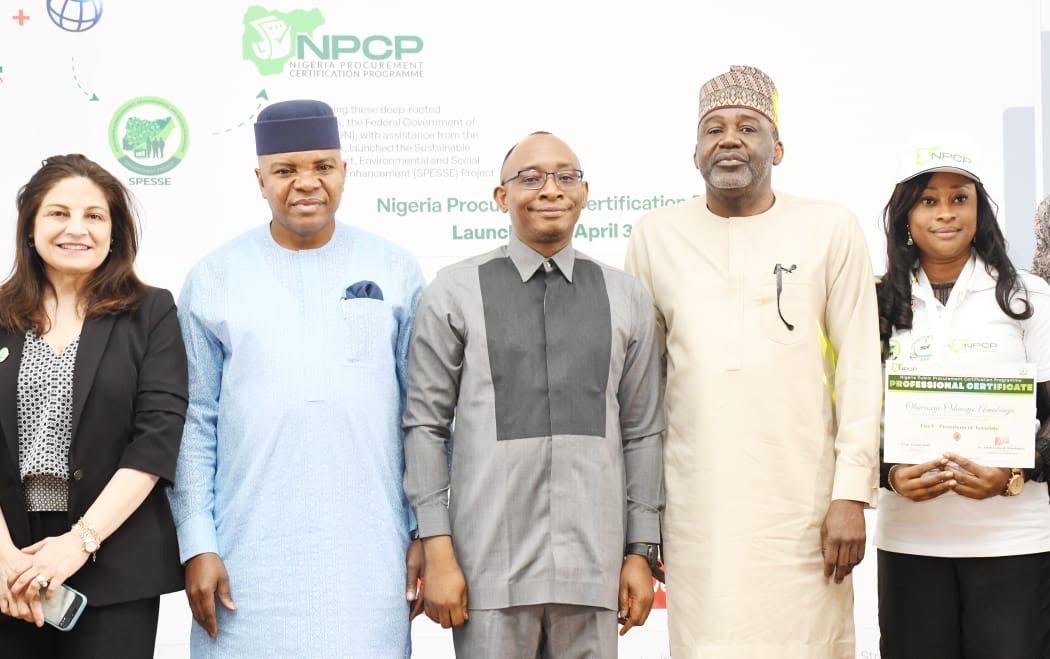
BPP graduates 2,100 in World Bank-backed procurement professionals drive
___________________________
From Juliana Taiwo-Obalonye, Abuja
Vice-President Kashim Shettima has reaffirmed the Federal Government’s ironclad resolve to overhaul Nigeria’s public procurement system, declaring that the administration will not yield to any attempts to derail these critical reforms.
Represented by his Deputy Chief of Staff, Ibrahim Hadejia, at the inaugural graduation ceremony of the Nigeria Procurement Certification Programme under the Sustainable Procurement, Environmental and Social Standards (SPES) Project, at the State House Conference Centre, Abuja, Shettima hailed the certification of 2,100 procurement professionals from Nigeria and abroad as a “game-changing moment” in the nation’s institutional evolution.
Speaking at the event organised by the Bureau of Public Procurement (BPP), he underscored procurement’s pivotal role in national development, transforming public resources into roads, hospitals, schools and security infrastructure. “When procurement fails, development fails,” he stated. “The current administration recognises this reality and, motivated by its devotion to the nation, has elected to confront it.”
He praised President Bola Tinubu’s directive elevating procurement from a “clerical function” to a “strategic governance instrument,” with the BPP modernising practices to align with global standards. Key initiatives include a national professional registry for public and private sector practitioners and the largest cohort of certified professionals in Nigeria’s history, backed by the SPES project and partners like the World Bank.
Shettima highlighted the programme’s integration with the Public Procurement Act 2007, equipping professionals to implement policies like Nigeria First, local content and sector-specific priorities in agriculture, energy, IT, health and infrastructure. Six centres of excellence—at institutions including the University of Lagos, Ahmadu Bello University and the University of Benin—now offer advanced training from diplomas to PhDs.
Yet he issued a stern warning against resistance. “We acknowledge that meaningful reform should only generate recognition. The structures that are in life of security and its order, standardisation, regulations and professional accountability may pose discomfort for certain individuals,” Shettima said. “I want to be clear, this administration will not back down in the face of any attempt to undermine or disrupt this force.”
He added that certified professionals will face heightened standards, with “negligence, ineptitude or ethical violations” met by sanctions—not as punishment, but as “corrective measures” to curb corruption, restore trust and drive economic growth.
Urging procurement officers in civil service, private firms and state agencies to enrol, Shettima called for nationwide collaboration. “Professional proficiency must no longer be optional,” he stressed, congratulating graduates as “pioneers” tasked with upholding integrity. “Let your conscience be guided by your certification. Your practice should be defined by integrity.”
He commended the BPP Director-General, Adebowale Adedokun, and SPES project leaders for turning policy into reality, positioning Nigeria as a benchmark for procurement excellence beyond Africa.
Speaking at the official convocation ceremony, BPP DG, Adedokun, hailed the Nigeria Professional Public Procurement Institute Programme (NPPIP) as a breakthrough in professionalising public procurement in Nigeria. He traced decades of efforts, from the 2001 World Bank Country Procurement Assessment Report to the 2007 Public Procurement Act, which established the BPP.
“Over the years, there have been impact attempts at professionalisation of procurement practices in Nigeria,” he stated. “However, all previous attempts did not solve the identified problems—mainly the lack of professionalisation of procurement operations, no structured and harmonised capacity building programme for procurement professionals, lack of adequate procurement capacity due to absence of capacity development strategy, and inadequate critical skills preventing reform and modernisation of procurement in Nigeria.”
Launched in April 2025 as an online training platform, he said NPPIP has trained 2,075 officers in six months, with 6,500 more enrolled for year-end certification. Adedokun said it equips participants with skills in critical areas, aligning with President Bola Tinubu’s Renewed Hope Agenda—including the Nigeria First policy for local content, affirmative procurement for women, youth and SMEs, plus price intelligence and benchmarking systems.
He revealed President Tinubu’s recent approval for nationwide deployment of community-based public procurement. Adedokun credited the administration’s support for massive savings: “Only in one year, the BPP through the President’s support has been able to save thousands—at least one or two trillion naira—in a single year.” The Federal Executive Council extended the programme in December 2025 with additional financing, bolstering the government’s anti-corruption drive. He also noted the complementary State Public and Environmental Standards for Sustainable and Efficient Procurement (SPESSEP), designed in 2020 to integrate procurement, environmental and social standards across public and private sectors for sustainable development and value for money.
Adedokun assured graduates of unwavering backing from President Tinubu and Vice-President Shettima. “I would like to say, in the history of this country, that BPP is able to provide His Excellency professional advice in implementation of its Renewed Hope Agenda,” he affirmed. He thanked Tinubu for the support, calling it “evidence that the Federal Government has put in place a mechanism to reduce corruption and prevent access to funds that are meant for the benefit of this country.”
Adedokun charged the new certified procurement officers to uphold ethical standards amid rising demands for accountability.
National Project Coordinator, Joshua Attah, hailed the event as a “historic step toward strengthening professionalism, transparency and accountability in public procurement.”
Other News
He emphasised the project’s roots in addressing Nigeria’s shortage of skilled professionals in procurement, environmental and social standards.
“It’s a Federal Government of Nigeria programme. There’s usually this misconception that it’s a World Bank programme, but it’s a World Bank-supported programme for the government,” Attah clarified.
Attah noted that “The design of this programme allowed for flexibility, enabling working professionals and public officers to acquire new competencies without disrupting their careers.”
World Bank Vice-President for Operations, Policy and Country Services, Galina Vincelette, hailed the event as a “landmark achievement” that ushers in a new era of confidence, integrity, transparency and excellence in Nigeria’s public procurement.
Vincelette praised the six-year journey from concept to reality. “This inaugural convocation is more than a ceremony. It signals the dawn of a new era defined by confidence, integrity, transparency and excellence,” she stated.
She highlighted key successes: over 40,000 participants trained across six university centres in procurement, environmental and social standards; 2,075 professionals certified in three years; and a two-year grant to Ministries, Departments and Agencies (MDAs) promoting competition, efficiency and transparency.
Vincelette emphasised procurement’s role in national development. “A robust procurement framework is essential for development… ensuring efficient resource utilisation and enabling efficient delivery of projects and services,” she noted, reaffirming the World Bank’s commitment to Nigeria’s transformation.
Also speaking, World Bank Director and Chief Procurement Officer, Hiba Tahboub, celebrated the inaugural convocation, calling it a “full circle” moment and a model for sustainable capacity building worldwide.
Tahboub reflected on the project’s origins six years ago. “I cannot believe that six years ago only, this was an idea… now this early vision has transformed into structured certification at the institutional level,” she said, crediting pioneers behind the project for the success.
She stressed the need for skilled professionals to elevate public procurement beyond compliance. “No golden rules or perfect procedures will make that happen, procurement must move from administrative and compliance into a function that’s really core in development, core in achieving economic growth,” Tahboub declared. Graduates, she added, are key to this shift, especially in Africa’s largest economy.
Tahboub praised SPES’s partnership with public procurement authorities and six federal university centres offering programmes from short courses to master’s degrees. “This is the big success of this programme, partnering with public institutions, so it can grow organically in the system,” she noted, urging replication globally. “This is a huge success story for the procurement function, not only in Nigeria but globally.”
She encouraged graduates: “Today… this is not the end. This is actually the beginning for you to practise what was learned.”
Chairman of the Nigerian Senate Committee on Public Procurement, Olajide Ipinsagba, hailed the event as a pivotal step in elevating procurement from routine administration to a strategic tool for governance. He stressed that effective public procurement delivers value for money, boosts public trust, drives economic growth, protects the economy and promotes social inclusion, while weak systems erode service delivery and governance. The NPCP, he noted, tackles longstanding capacity gaps by standardising skills, instilling ethical education and ensuring professional accountability among officers handling public resources.
Ipinsagba reaffirmed the National Assembly’s commitment to legislative oversight, institutional reforms and capacity building to enforce the Public Procurement Act and strengthen agencies like the BPP. “Programmes such as the NPCP must be sustained, expanded and institutionalised across all tiers of government,” he declared. Addressing the first cohort of certified professionals, he added, “Certification is both a privilege and responsibility. You are now ambassadors of competence, transparency and integrity. I urge you to apply your knowledge and professionalism to the highest ethical standards in order to accommodate the public interest. Your conduct will define the credibility and consciousness of this programme.”
Chairman of the House of Representatives Committee on Public Procurement, Unyime Idem, celebrated the first graduates of the programme as dedicated professionals ready to transform public procurement through competence, integrity and global best practices.
Idem commended the Federal Government, BPP, programme managers and facilitators for their roles, urging graduates to serve as ambassadors of reform by applying their knowledge with professionalism, integrity, courage, transparency and patriotism. “Deploy the knowledge you have gained with the highest level of professionalism, integrity and courage—courage, transparency and patriotism in the service of our nation,” he charged. He also called on the BPP to submit a bill to the 10th House for amending the 2007 Public Procurement Act to address anomalies and align with global standards.