Follow Us on Google
• As UN rep hails it as ‘promise turned into action’
• Dangote demands tight industry shields, reliable power
• Minister spotlights shea export ban, value-add bill as key boosters
From Juliana Taiwo-Obalonye, Abuja
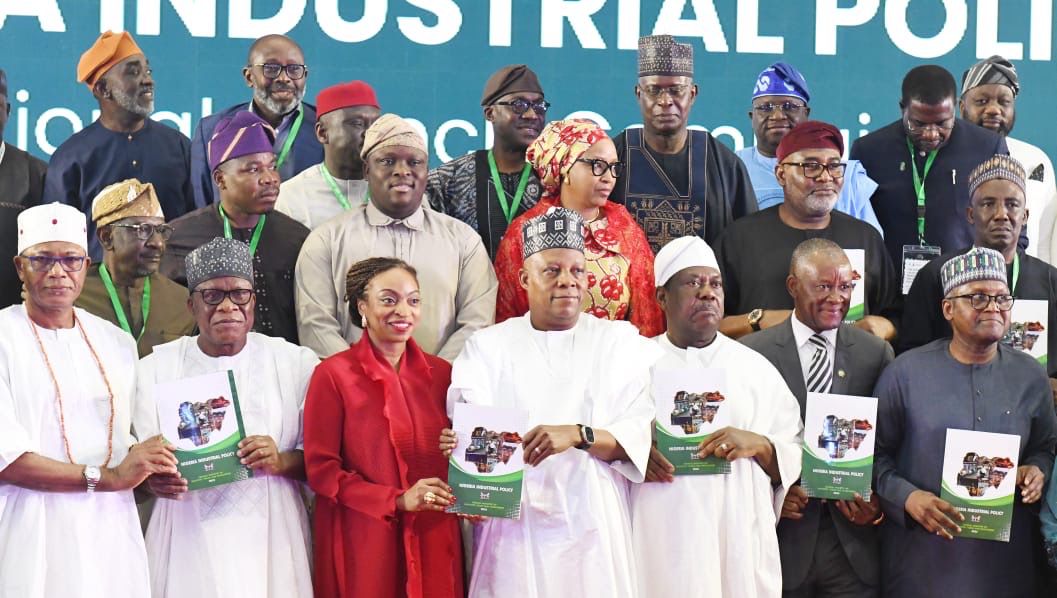
Vice President Kashim Shettima, standing in for President Bola Tinubu, on Tuesday rolled out the Nigeria Industrial Policy 2025 in Abuja on Tuesday, insisting the nation shifts “from policy to productivity” and slams the door on “fragmented and uncoordinated industrial growth.”
At the event themed “From Policy to Productivity: Implementing Nigeria’s Industrial Future,” Shettima positioned the blueprint as a bold fix for Nigeria’s industrial woes, thrusting it toward global competitiveness through targeted reforms in infrastructure, energy, skills, finance, and innovation.
“When we assumed office in 2023, we did so with a promise to redefine our industrial ambition and to set up the infrastructure required to compete with the rest of the world. Industrialisation is not a wish; it is an action we must deliberately perform,” Shettima stated.
He pinpointed longstanding issues like disjointed value chains, soaring costs, infrastructure shortfalls, and erratic policies, explaining the new strategy’s focus on leveraging Nigeria’s strengths, boosting value chains to cut raw export reliance, weaving in MSMEs, and building a robust execution system.
“Policies rarely fail at conception; they fail at execution. The defining strength of this policy is its insistence on implementation. This administration will not measure success by the number of documents we produce, but by the number of jobs created, the value retained within our economy and the mark of Nigerian excellence on goods exported abroad,” he said.
Shettima linked the policy to broader reforms, AfCFTA goals, local content drives, and investor safeguards. Praising the Minister of State for Industry and technical teams for “policy leadership defined by substance, coordination and follow-through rather than noise,” he stressed public-private teamwork, transparency, targets, and accountability.
Spotlighting local manufacturers’ tax muscle, he affirmed: “The government has no business being in business. You are the creators of wealth. Our duty is to provide the stability, infrastructure and policy clarity that allow industry to thrive.”
Other News
Leveraging Nigeria’s youth growth amid global aging workforces, Shettima declared the industrial surge “an achievable reality within our grasp,” adding: “The work begins now, not tomorrow, not next year, but now.”
United Nations Resident and Humanitarian Coordinator Mohammed Fall called the policy a “promise turned into action,” turning national dreams into “clear, actionable direction.”
“Today, Nigeria takes a step into its future. A vision is carved into policy, and hope is turned into action. Nigeria, the Giant of Africa, a beacon of resilience and a land of immense talent, is embracing its industrial destiny,” Fall said.
Born from UNIDO-Federal Government partnership, the framework doubles as a poverty-busting pledge for green, competitive industries. “A map for progress” syncing with SDGs on energy, food, resilience, and growth, it promises manufacturing boosts, value chain integration, and innovation—if executed with will.
“Together, we will turn policy into progress, ambition into achievement and vision into reality. Let this not only mark a launch, but the rise of industry, the bloom of opportunity and the fulfilment of Nigeria’s promise to lead Africa with strength, wisdom and purpose.”
Minister of State for Industry John Enoh dubbed the launch a “consequential turning point,” making industrialisation a “disciplined national priority” via presidential directive turned “executable national programme.”
Shaped by past reviews, it drives shifts from fragmentation to coordination, extraction to value addition, and announcements to action. Key “immediate enablers”: the 2025 raw shea-nut export ban—despite Nigeria’s 50% global output, it snagged under 1% of the $6.5bn market—sparking local processing booms, stabilized prices, higher farmer pay, and shea butter exports.
The second: the Raw Materials Research and Development Council Amendment Bill, mandating 30% value addition pre-export, now awaiting Tinubu’s signature after National Assembly passage. “Government has acted, the legislature has acted; the enabling environment is being created. Now industry must act,” Enoh said, noting BOI and BOA financing ramps.
Dangote Group President, Aliko Dangote on his party urged robust local protections and steady power, slamming import floods as the “missing link” that imports poverty and exports jobs.
“Excessive importation amounts to importing poverty and exporting jobs,” he said, pushing macro stability, anti-dumping walls, and a power summit. “Without power, there is no growth. Without growth, there are no jobs.”
He highlighted self-power costs crippling firms, Nigeria’s market potential for AfCFTA exports, and the need for ethical business to match reforms.