Follow Us on Google
From Adesuwa Tsan, Abuja
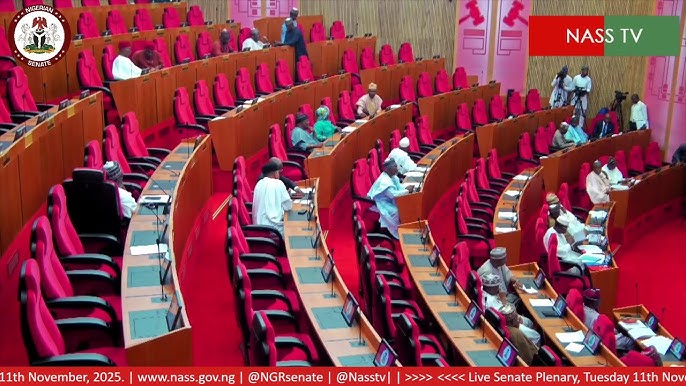
Following a motion raised by Senator Abdul Ningi warning that any alleged foreign military strike on Nigerian territory without due constitutional process amounts to a grave breach of Nigeria’s sovereignty and the authority of the National Assembly, Senate President, Godswill Akpabio, has disclosed that the lawmakers would be briefed on the Nigeria/US security partnership at an executive session.
The Bauchi lawmaker was referring to a Christmas day bombing of terrorists hideouts in Sokoto State by the United States forces in collaboration with the Nigerian security agencies.
Invoking Senate precedence and privilege in plenary under matters of privilege, Ningi demanded that the issue should be taken immediately, stressing that the 1999 Constitution vests legislative powers primarily in the National Assembly, ahead of the executive and the judiciary.
Quoting the constitution, the Bauchi lawmaker said: “The legislative powers of the Federal Republic of Nigeria shall be vested in a National Assembly of the Federation which shall consist of a Senate and a House of Representatives,” adding that the legislature is empowered to make laws for the “peace, order and good government of the federation.”
He alleged that the December strike within Nigerian territory by the United States military is “a complete violation” of the Nigerian Constitution and “a complete breach of the United Nations Charter.”
According to him, only the President, as Commander-in-Chief of the Armed Forces, is constitutionally empowered to authorise any military action within Nigeria. He explained, “The title of Commander-in-Chief of the Nigerian Armed Forces is not ceremonial, it is not a guy thing. It is to give the President such powers to control the armed forces and give them order.” He argued that even the President lacks the power to invite a foreign military to independently carry out strikes in Nigeria.”
While noting that foreign forces can only be invited to align with Nigerian troops, who must retain operational control, Ningi criticised the executive for what he described as silence on the matter, insisting that the legislature has a constitutional duty to speak regardless of the intentions or outcomes of the alleged strike.
“The executive acts but the legislature must talk. This assembly has a core responsibility in governance. This assembly has a core accountability in governance. This assembly is not an appendage of the executive.”
He warned that failure to assert Nigeria’s sovereignty could embolden other powerful nations to act similarly. “The Americans are not the only powerful military on the face of the earth,” he said, citing Russia, Germany and France. “If we deny them their interests, they can take a hit.”
He, therefore, called on the leadership of the National Assembly to demand an immediate security briefing.
“The President of the Senate and indeed the National Assembly leadership must take a brief from the security agencies as to what happened and why this matter happened,” he demanded. Ningi further warned that unchecked violations of territorial integrity could ultimately threaten the independence of the legislature, adding that lawmakers could become targets if Nigeria passes laws unfavourable to powerful foreign interests. He urged that the United States government be formally informed that any such action constitutes a violation of Nigeria’s territorial integrity, while reiterating that any foreign military engagement must be done transparently and in coordination with Nigerian authorities.
Other News
Responding, Senate Akpabio cautioned against further debate on the issue in open session, noting that Senator Ningi had raised a matter of privilege, not a motion for general contribution.
“I don’t want anybody to contribute, and you have gone ahead to argue your issue. You are debating your issue. No contribution is required.”
Akpabio disclosed that after reviewing the relevant constitutional provisions, the Senate leadership had concluded that Ningi’s privilege had not been breached.
“I’ve read the Section 9, I understand it, and I was about to let you know that your privilege has not yet been breached.”
Akpabio explained that the matter involved sensitive security issues that could not be discussed publicly, insisting that a closed session was more appropriate.
“Because it’s a matter of security, we really should not discuss it in the open. We should have a closed session so that we will be well briefed.”
He explained that the Senate was unable to hold such a session earlier due to time constraints following the loss of a senator during the chamber’s first sitting.
While acknowledging Ningi’s concerns, Akpabio said the Senate leadership had already been briefed on the strike, which he said was linked to an incident in Sokoto and carried out with the knowledge and collaboration of Nigerian security agencies.
“Just like you read on the pages of newspapers that the attack you are referring to happened in Sokoto, it happened with the concurrence and the collaboration of the Nigerian security services. We have also been so briefed.”
Akpabio assured the Senate that lawmakers would be properly briefed at the appropriate time
“in closed session. Security is not something that we speak in the market, but your point of order is noted,” the Senate concluded.