Follow Us on Google
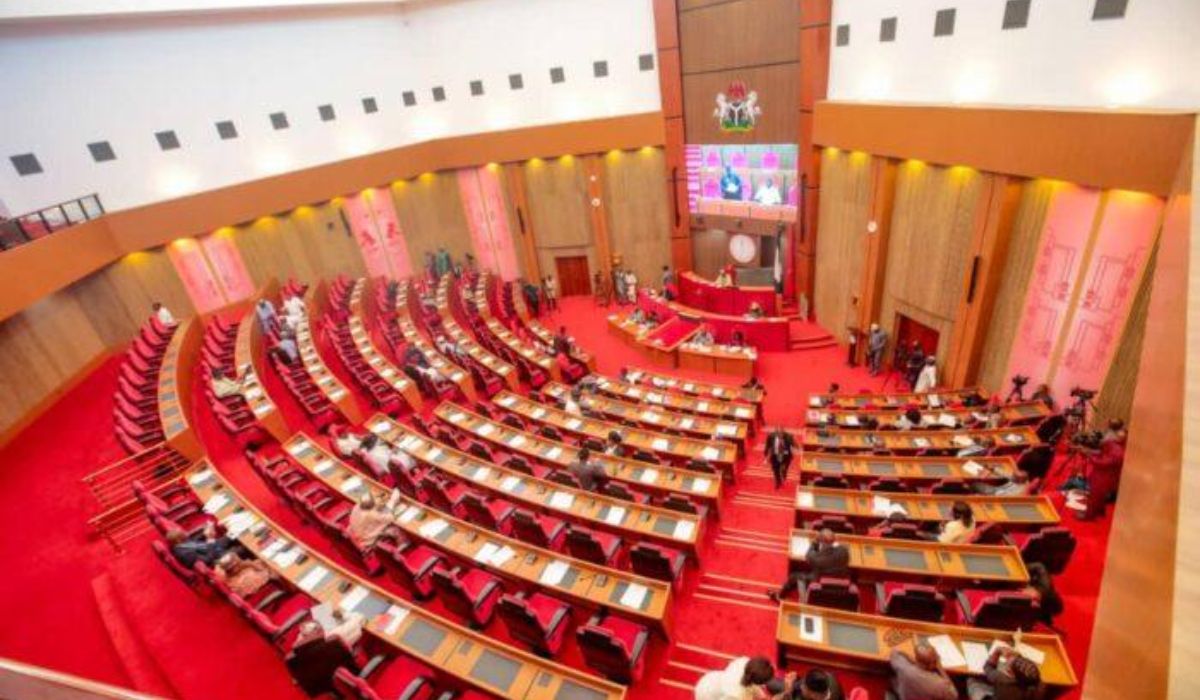
The Senate on Wednesday passed the controversial State Police Bill for second reading despite concerns raised by several lawmakers over funding, oversight and the potential abuse of the proposed security architecture.
The landmark bill, an executive proposal of President Bola Ahmed Tinubu sponsored by Senate Leader Opeyemi Bamidele, has now progressed into the Committee of the Whole where senators are currently considering it clause by clause.
In a dramatic twist, senators abandoned their earlier decision to conduct voting through a manual roll-call process that would have required each lawmaker to publicly declare his or her position.
Instead, after debate on the general principles of the bill, Senate President Godswill Akpabio subjected the legislation to a voice vote.
A chorus of “Ayes” echoed across the chamber, and Akpabio immediately struck the gavel, declaring the bill passed for second reading.
The decision sparked visible discontent among some lawmakers, with murmurs and protests breaking out across sections of the chamber. At one point, Senator Garba Maidoki was heard protesting the procedure, shouting, “This is unfair!” as dissatisfaction spread among some senators who had expected a more transparent voting process.
During debate on the legislation, senators broadly supported the establishment of state police but warned that robust constitutional and statutory safeguards must accompany the reform.
Senator Enyinnaya Abaribe disclosed that although he had previously opposed state police, worsening insecurity had convinced him that extraordinary measures were now necessary.
Abaribe, however, warned that the success of state police would depend largely on the provisions of the enabling legislation rather than constitutional amendments alone.
He cautioned against granting excessive powers to the president to unilaterally take over state police structures and argued that any such intervention should require the involvement of the National Assembly.
The Abia South senator also raised concerns over funding, warning that without constitutionally guaranteed financing mechanisms, state police formations could become vulnerable to political manipulation and operational abuse.
Other News
Tambuwal Backs State Police
Former Sokoto State Governor and senator representing Sokoto South, Aminu Waziri Tambuwal, reiterated his long-standing support for state police, describing it as a necessary step towards deepening federalism in Nigeria.
Tambuwal cited recent bandit attacks in Sokoto State that reportedly claimed dozens of lives, arguing that every legitimate effort to address insecurity should be embraced.
While endorsing the bill, he also stressed the need for safeguards to prevent future abuse by state authorities.
According to him, the Senate has a responsibility to support every initiative capable of improving security while simultaneously protecting democratic principles.
Also contributing, Senator Mohammed Tahir Monguno described the legislation as long overdue.
He argued that several states already operate quasi-policing structures such as the Civilian Joint Task Force in Borno and the Amotekun Corps in the South-West, making the constitutional recognition of state police a logical progression.
According to him, the proposed reform would provide a legal framework, proper regulation and funding mechanisms for such security arrangements.
Clause-by-Clause Voting Begins
Following the second reading, the Senate dissolved into the Committee of the Whole and immediately commenced clause-by-clause consideration of the bill.
Under the procedure now being adopted, senators are being called upon to stand and raise their hands in support of individual clauses, while those opposed remain seated.
The voting exercise remains ongoing as lawmakers scrutinise the detailed provisions of what is widely regarded as one of the most significant constitutional reforms since Nigeria’s return to democratic rule.
The outcome of the clause-by-clause consideration is expected to determine the final shape of a proposal that could fundamentally alter Nigeria’s security architecture and redefine the relationship between the federal and state governments in policing and public safety.